

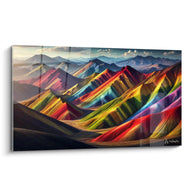

Evoking an immediate emotion through wall art
11 October 2025 · 18 min read · by Walensky
You enter your living room, and that feeling hits you again: your walls seem bare, cold, soulless. Despite all your decor efforts, something is missing to transform your space into a true emotional haven.
The natural light caresses your carefully chosen furniture, but the emotion is missing. Your guests politely admire your interior, but you feel that something is lacking that would make their eyes sparkle.
You've already tried some paintings found in stores, displayed family photos, hung decorative mirrors... But nothing creates that instant magic that you feel in certain places that deeply mark you.
This is perfectly normal, and it's not a matter of taste or budget. The real reason ? Most people ignore the psychological and visual mechanisms that trigger an immediate emotion when looking at wall art.
By the end of this article, you will master the psychological keys to emotional impact and know how to choose wall art that instantly transforms the atmosphere of your interior.
Why is immediate emotional impact so crucial in your decor?
In our hyperconnected world, we have less than 3 seconds to create a first impression in a space. If your decor doesn't evoke emotion at first glance, it will go unnoticed. It's like meeting someone: the first seconds determine everything. A wall without emotional character is a missed opportunity to create a deep connection with your space and your guests.
🎨 Revealing testimony: Sarah, a Parisian interior architect, recounts that she has long sought to understand why some of her projects "worked" emotionally and others didn't. "I realized that my clients only remembered spaces where they felt something immediate upon entering. The rest, even technically perfect, faded from their memory."
Conversation with a decor expert
Wall art is not just decorative, it's emotional: Every glance at your wall should awaken a positive sensation. It's like having a kind friend who smiles at you every time you come home. Result: you and your loved ones will immediately feel more relaxed and inspired in the room.

What's Really Behind Your Décor Frustration
Maybe you recognize yourself in these situations: you spin around in front of a blank wall without knowing what to put on it, you impulsively buy a painting that no longer does anything for you once it's hung, or you hesitate for weeks without ever making a decision.
What's really happening? You're searching for an emotional connection without knowing the codes that trigger it. It's not a matter of taste, it's a lack of understanding of the psychological mechanisms of art.
Imagine trying to learn the piano without knowing the notes. You have a musical ear, but you lack the theory to transform your intuition into concrete results.
The First Hidden Cause: The Familiarity Effect
Contrary to what we believe, our brains don't react to "pretty" images, but to images that create a personal resonance. That's why two people can have totally opposite reactions to the same painting.
It's like perfume: what touches us is what awakens our deep memories and emotions. A mountain landscape will speak to someone who grew up at altitude, while a city scene will touch the city lover.
Impact on your life: you continue to choose with your mind instead of your feelings. You analyze "objective" beauty instead of seeking your emotional truth. Result: walls decorated but without soul.
✨ Instant test: Look at the painting currently hanging in your living room. Close your eyes for 30 seconds, then open them. What is your first sensation? If it's indifference, you chose with your head, not your heart.
The Trap of Perfect Harmony
Many people think that a painting must "harmonize perfectly" with the existing decor. In reality, it's the creative tension that generates emotion. A controlled contrast awakens attention and creates life.
Think of a dish: what makes a dish delicious is the balance between flavors, not their uniformity. A touch of acidity reveals the sweetness, a crunchy texture sublimates the fondant.
Consequence: you create "soft" interiors without character, where everything blends into a bland harmony. Your guests find your decor "very nice" but don't remember it.
The Illusion of the Perfect Size
Almost no one notices that the dimension of a painting directly influences the emotional intensity. A small format creates intimacy, a large format imposes its presence and character.
How to spot it at home? Observe your reactions to different walls. You feel differently in front of a large bare wall than in front of a small corner. Your brain unconsciously demands a proportion that soothes it.
Daily impact: you underestimate the importance of the physical presence of art. You choose timid formats that go unnoticed, missing the opportunity to create a real visual impact.
5 Signs Your Wall Art Lacks Emotional Impact:
- You don't notice it anymore after a week: Sign that the work doesn't create a deep connection, like a soundtrack you eventually stop hearing
- Your guests never make spontaneous comments: Reveals a lack of immediate emotional impact, your art doesn't generate natural conversation
- You hesitate to talk about it or show it off: Indicates a lack of pride and personal connection, you don't feel represented by your choice
The Trigger: Personal Emotional Charge
What really makes the difference is your personal story with the image. Like an emotional lever, a work that resonates with your experiences multiplies its impact on your daily well-being. Clues to identify it: you feel an immediate attraction, a desire to contemplate longer, a feeling of recognition as if the work expressed something you carry within you.
Golden rule of emotional impact: First choose with your feelings, then adjust with your reflection. You know it immediately: facing the "right" work, you instinctively smile. It is this smile that you must seek, not aesthetic perfection.
| ❌ Classic rational approach | ✅ Effective emotional approach | 💡 Why it works | 🎯 Felt benefit |
|---|---|---|---|
| "It has to match my sofa" | "It has to speak to my heart" | Emotion takes precedence over decorative logic | Renewed pleasure every day |
| "I'll play it safe so I don't make a mistake" | "I choose what makes me vibrate" | Neutral quickly becomes invisible | Positive energy in the space |
| "I'm waiting for the perfect inspiration" | "I listen to my immediate instinct" | Instant feeling is reliable | Confidence in your decor choices |
| "I calculate the size according to the formula" | "I feel the necessary presence" | Visual impact follows intuitive rules | Natural and soothing harmony |
— Also to discover


The method of 3 circles to create an immediate emotional impact
Rest assured, creating a strong emotional impact is not complicated once you know the method. Imagine building a house: you start with the emotional foundations, then you add the visual structure, and finally you refine the overall harmony. At each step, you feel your space transforming and becoming more vibrant, more "you".
🎯 Overview of the progression: Circle 1: Identification of your emotional signature (you discover what really touches you), Circle 2: Choice of format and optimal placement (you create the visual impact), Circle 3: Harmonious integration (you balance emotion and aesthetics).
Circle 1: Discover your emotional signature
Starting by identifying your emotional resonance is like discovering your decorative DNA. Without this solid base, you risk choosing with your mind and quickly becoming bored. This step gives you a reliable emotional compass for all your future artistic choices.
Your emotional exploration tools
- Your personal visual journal: Create a notebook where you collect all the images that spontaneously attract you (magazines, social networks, personal photos). This reveals your unconscious emotional patterns. Avoid digital applications that filter your choices according to algorithms.
- Your emotional memory: Reconnect with places and moments that have positively marked you. Each strong emotion leaves a visual trace that you can reactivate. This method is more powerful than classic personality tests because it draws on your real experiences.
- Your bodily reaction: Learn to identify your physical signals of aesthetic pleasure (spontaneous smile, relaxation of the shoulders, deeper breathing). These reactions never lie and guide you towards your true tastes.
Now, let's move on to practice with your personal exploration:
Your emotional exploration session
Create your emotional map: Get comfortable with your visual journal and browse your sources of inspiration. Immediately note your first reaction to each image, before your mind analyzes. Look for patterns: colors, shapes, atmospheres that recur.
⏱️ Time: 30 minutes | ✅ Success when: You identify 3-4 recurring visual elements that attract you | ⚠️ Attention: Don't look for logical consistency, trust your spontaneous attraction
Reconnect with your memorable moments: Close your eyes and revisit 3 places where you felt perfectly good. Note the visual details that come back to you: the light, the colors, the textures, the overall atmosphere. These elements form your personal emotional palette.
⏱️ Time: 20 minutes | ✅ Success when: You feel the positive emotions of those moments again | ⚠️ Attention: Focus on the feeling, not the logic of the place
Test your emotional compass: Visit an exhibition venue (gallery, decor store, even online) and observe your bodily reactions. Note which works you naturally stop in front of, which make you smile, soothe you or energize you.
⏱️ Time: 45 minutes | ✅ Successful when: You clearly identify your positive and negative reactions | ⚠️ Attention: Ignore prices and brands, focus only on your feelings
🎨 Validation of your emotional signature: You must be able to define the atmosphere that corresponds to you in 3 words (e.g., "warm, dynamic, natural”). If you are still hesitating, that's normal - continue to observe your daily reactions. The important thing is to have identified at least 2-3 visual elements that you are consistently drawn to.
Circle 2: Master the visual impact through format and placement
Now that you know your emotional signature, you are going to give it the visual power it deserves. This is the difference between whispering and speaking with confidence. This step transforms your feeling into a real presence in your space, creating the "wow" effect you are looking for.
Your emotional sizing tools
- The rule of emotional proportions: A wall requires a presence that corresponds to its importance in your daily life. Your main living room deserves a work that asserts itself (minimum 60cm wide), while a hallway will appreciate a series of more intimate formats. Avoid timid formats that are forgotten.
- The life distance test: Place yourself at the distance where you naturally look at this wall on a daily basis. The work should be visible and engaging from this position. It is more reliable than mathematical formulas that ignore your actual use of the space.
- The magnetic gaze technique: A well-placed work naturally attracts the eye as soon as you enter the room. It creates a focal point that visually structures the space and guides attention without forcing.
Your optimal placement strategy
Identify your star wall: Observe your natural movements in the room for a day. The wall you look at most often (consciously or unconsciously) is the one that deserves your main work. This is where the emotional impact will be maximum.
⏱️ Time: 1 day of observation | ✅ Successful when: You clearly identify the wall that naturally attracts your attention | ⚠️ Attention: Don't necessarily choose the largest wall, but the one that is most "alive" in your daily life
Determine the ideal emotional size: Use newspaper or A4 sheets to simulate different sizes on your wall. Step back and observe which format makes you smile instantly. The right size immediately creates a feeling of balance and completeness.
⏱️ Time: 15 minutes | ✅ Successful when: A size seems "obvious" and harmonious to you | ⚠️ Attention: Dare to go bigger than your first intuition - we often underestimate the necessary size
Find the height of happiness: Temporarily place your simulation at eye level while standing, then sitting if you often look from a chair. The work should be naturally within your field of vision, neither too high nor too low. Your neck shouldn't strain to admire it.
⏱️ Time: 10 minutes | ✅ Successful when: You naturally look at the work without effort | ⚠️ Attention: Adjust according to your height and habits, not according to general rules
✨ Validation of your visual impact: Your simulation should immediately create a feeling of harmony and completeness in the room. If you feel that "something is wrong", adjust the size or position. A good placement is felt intuitively - you should no longer be able to imagine this wall without this presence.
Circle 3: Seamlessly integrate without losing impact
You've reached expert level: creating harmony without diluting emotion. It's the art of coexisting your favorite piece with your existing environment. Your artwork should feel "at home" while retaining its unique character. The result: a space that breathes personality and balance.
Your tools for subtle integration
- The colored bridge technique: Identify a secondary color in your artwork and create a discreet echo in the room (cushion, vase, plant). This creates a natural visual connection without forcing harmony. Avoid picking up the dominant color, which would break the impact.
- The revealing lighting: Adapted lighting radically transforms the emotional impact of a work. Warm light for intimacy, neutral light to reveal colors. Lighting should caress the artwork, not assault it.
- Breathing space: Your artwork needs air around it to radiate fully. Leave at least 20cm between the artwork and any other visual element. It is this space that gives it its presence.
Your harmonious integration strategy
Create your subtle visual connections: Choose 2-3 elements in the room that will echo your artwork without copying it. A similar texture, a shape that recalls, a nuance that dialogues. The goal is to create a visual conversation, not a repetition.
⏱️ Time: 20 minutes | ✅ Success when: The links seem natural and not forced | ⚠️ Attention: Less is more - 2-3 connections are quite enough
Adjust your emotional lighting: Test different lighting at times when you enjoy the room the most. Daylight, ambient lighting in the evening, spotlights if necessary. Your artwork should be highlighted without creating glare.
⏱️ Time: 1 week of observation | ✅ Success when: The artwork is perfectly visible at all times | ⚠️ Attention: Avoid reflections on shiny surfaces that break the emotion
Release the radiation space: Temporarily move objects close to your future artwork. Observe how it "breathes" better with space around it. Each centimeter gained multiplies its emotional impact.
⏱️ Time: 10 minutes | ✅ Success when: The artwork naturally becomes the focal point | ⚠️ Attention: Resist the temptation to "fill" the space around - art needs emptiness to exist
🎨 Validation of your harmonious integration: Your artwork should seem to have always been there while retaining its emotional strength. If it blends too much into the background, reinforce its presence. If it clashes, subtly adjust the connections. The perfect balance will be immediately apparent to you.
Rule of emotional progression: Move on to the next step when you feel a deep satisfaction with the current step. Your spontaneous smile when looking at your wall is the best indicator of success. Patience in each step guarantees a result that will touch you for years.
Congratulations! You now master the secrets of immediate emotional impact. Here are the expert subtleties that make the difference between a beautiful decoration and a true daily favorite.
🎯 Pro Secret - The Mirror Effect of Emotion: Choose a piece that reflects the person you want to become, not just the one you are. Your subconscious will work to align your energy with this inspiring image. That's why some pieces "lift us up" and others soothe us - they act as catalysts for personal transformation.
Frequently Asked Question from Our Readers
"I find a beautiful piece online, but I'm afraid it won't look right in my living room..."
This hesitation is perfectly normal! Your instinct protects you from an unsuitable choice. The solution: before buying, print the image in A4 format and temporarily place it on your wall. Live with it for 3 days - if it still makes you smile on the third morning, it's the right one. Otherwise, keep searching. This method avoids 90% of choice errors.
💡 Quick Action: Create a "test" folder with 3-5 pieces that attract you. Print them and test them one after another on your wall. You will quickly discover the one that truly transforms your feeling in the room.
— In the same spirit


Our Eye-Catching Selection
Painting Eternal Tranquility - Nature Tree Edition
$233.90
Discover this painting →The Emotional Traps to Absolutely Avoid
Now that you know the method, I want to protect you from mistakes that could spoil your experience. These traps are tempting but subtly sabotage the emotional impact of your wall art.
- 🚫 Choosing based on others' opinions: It's tempting to ask your loved ones for advice or follow Pinterest trends. The result: you end up with a piece that pleases everyone but doesn't touch you personally. Your wall art should first speak to you - you are the one who lives with it every day. This is a very common mistake that creates impersonal interiors.
- 🚫 Underestimating the importance of the frame: You find the perfect piece but neglect its setting. An unsuitable frame can completely ruin the emotion of a beautiful piece. Invest in a frame that enhances your choice - it is what creates the transition between your wall and your favorite piece.
- 🚫 Wanting to harmonize everything at once: You feel the pressure to redecorate your entire space at the same time. This approach kills spontaneity and creates stress. Start with ONE piece that makes you vibrate, then let it naturally guide your next choices. Harmony is built gradually.
- 🚫 Waiting for the perfect moment: You postpone it, waiting to have "everything planned". Perfectionism paralyzes emotion. Your feeling today is more reliable than your planning for tomorrow. A piece that touches you now is likely to accompany you for a long time.
- 🚫 Ignoring lighting until installation: You discover too late that your piece is poorly lit. Poor lighting can kill the strongest emotional impact. Think about lighting when choosing the location - it is what reveals or hides the emotions of your piece.
🛡️ Your quick verification system: Before any purchase, ask yourself these 3 questions : "Does this artwork make me smile spontaneously?", "Do I want to contemplate it regularly?", "Does it truly represent me?" If even one answer is no, keep searching. Warning signs: you justify your choice with rational arguments, you have been hesitating for more than a week, you wonder what others will think.
— Other selected pieces


Your most frequently asked questions about emotional impact
Emotional impact doesn't depend on price but on personal connection. A €150 artwork that touches you deeply will have more impact than a €1000 piece chosen out of conformity. Expect to spend between €100 and €400 for a quality artwork that will last for years. Emotional investment outweighs financial investment.
Emotional impact is immediate if you have chosen well. From the first glance, you should feel a positive emotion. After 2-3 weeks, the artwork becomes an integral part of your daily well-being. If you no longer notice it after a month, the emotional connection was not strong enough.
Absolutely! A small space even concentrates emotional impact. In 15m², a well-chosen artwork completely transforms the atmosphere. Prioritize a moderately large artwork (40-60cm) rather than several small ones. The intimacy of a small space amplifies the emotional connection.
Your superficial style may evolve, but your emotional signature remains stable. If you choose an artwork that resonates with your deep emotions rather than a passing trend, it will age with you rather than tire you. That's why the 3 circles method works in the long term.
It's often a problem of lighting or placement, not the artwork itself. Change the lighting, slightly move the artwork, or reorganize the space around it. Sometimes, simply cleaning the frame is enough to revive the emotion. A true emotional connection does not wear out, it is rediscovered.
Your artistic transformation begins now
In 3 weeks, you will enter your living room and smile spontaneously. This artwork that looks at you from your wall will no longer be just decorative - it will have become your daily emotional companion. Your guests will immediately notice this positive energy and will naturally ask you where you found this masterpiece.
But the impact goes far beyond decoration. You will have developed your confidence in your aesthetic choices, learned to trust your feelings, and discovered that your home can be a true emotional refuge. This new confidence will be reflected in all your other decor choices.
You now have all the keys in hand. The hardest part was understanding the emotional mechanisms - it's done. Your first move? Identify your emotional signature today. In a week, you will know exactly which artwork will transform your space.
🌟 Your wall art awaits you: Trust your heart, it already knows the answer. The artwork that will make you vibrate exists - it only awaits your courage to join your home. Your daily happiness deserves this emotional investment.
Also to read: 🎯 Explore our art enhancement guides
Explore our collections


