



Festival Music Painting
Amid glitter at sunset, flower crowns and arms raised toward the sky, this Festival Music Painting collection captures the collective euphoria of a summer that refuses to end. Each canvas holds a fragment of that shared energy: a complicit laugh, a silent trance, a face gilded by evening light. These festival music paintings bring the vibrant memory of open-air nights into your home, somewhere between sensory freedom and psychedelic radiance.
 Traveler Seated Facing the Pink and Turquoise Lake Wall Art - Suspended Moment - Music Festival Edition$199.90
 Traveler Contemplating a Pink and Turquoise Lake Wall Art - Contemplative Pause - Music Festival Edition$249.90
 Two Laughing Friends with Black and Red Splatters Wall Art - Shared Laughter - Music Festival Edition$249.90
 Woman Crowned with Flowers under Golden Drips Wall Art - Nocturnal Reverie - Music Festival Edition$249.90
 Woman with Raised Arms in Violet and Neon Green Wall Art - Collective Trance - Music Festival Edition$249.90
 Young Man in Blue and Grey Knitted Sweater Seated in the Grass Wall Art - Scene Facing the Main Stage - Music Festival Edition$249.90
 Young Woman with Golden Sequins Wall Art - Sunset Glow - Music Festival Edition$249.90
 Friends Laughing with Black and Red Splashes Wall Art - Shared Laughter - Music Festival Edition$249.90
 Woman with Golden and Violet Crown Wall Art - Twilight Trance - Music Festival Edition$249.90
 Woman with Arms Raised and Purple and Green Waves Wall Art - Luminous Trance - Music Festival Edition$249.90
 Young Man Glittered at Blue Dusk Wall Art - Dawn After the Party - Music Festival Edition$249.90
In the same family
Also explore the theme Music
-
 Accordion26
artworks
-
 Battery40
artworks
-
 Song33
artworks
-
 Clarinet3
artworks
-
 Double bass28
artworks
-
 Bagpipes13
artworks
-
 Ballroom dance34
artworks
-
 Disco51
artworks
-
 Nightclub26
artworks
-
 DJ66
artworks
-
 Electro27
artworks
-
 Flute14
artworks
-
 Panpipes20
artworks
-
 Funk13
artworks
-
 Guitar108
artworks
-
 Handpan20
artworks
-
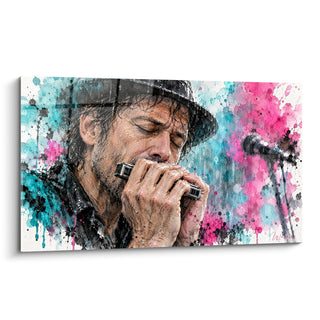 Harmonica3
artworks
-
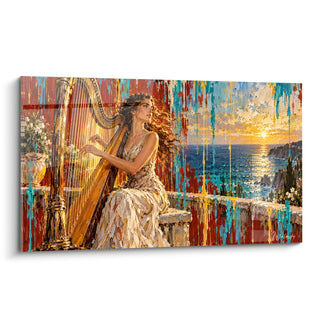 Harp18
artworks
-
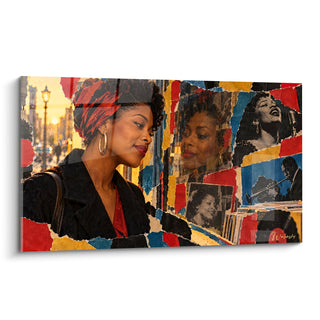 Old School Hip Hop40
artworks
-
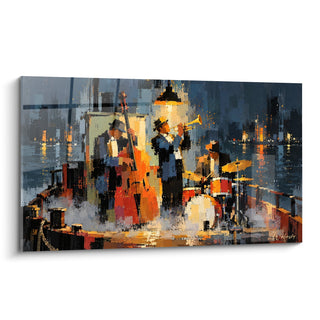 Jazz8
artworks
-
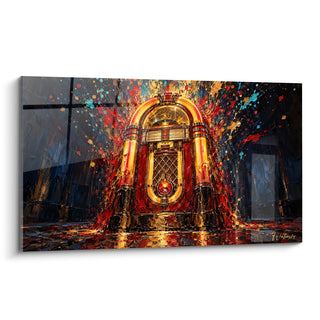 Jukebox12
artworks
-
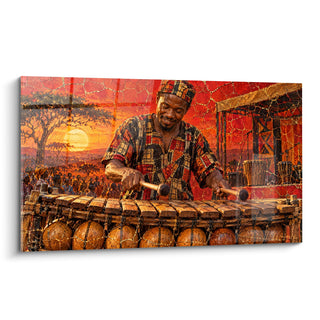 Various Musicians61
artworks
-
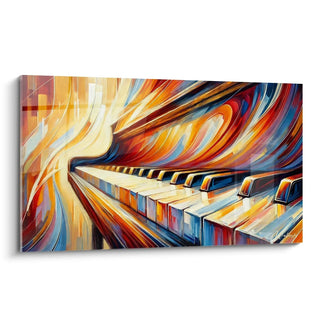 Musical note21
artworks
-
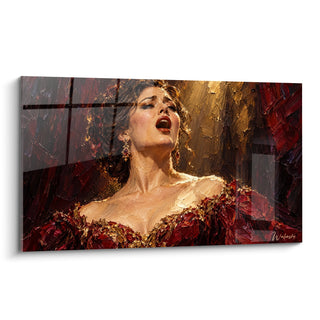 Opera23
artworks
-
 Orchestra6
artworks
-
 Piano295
artworks
-
 Punk35
artworks
-
 Reggae13
artworks
-
 Rock48
artworks
-
 Saxophone64
artworks
-
 Sitar15
artworks
-
 Sound System3
artworks
-
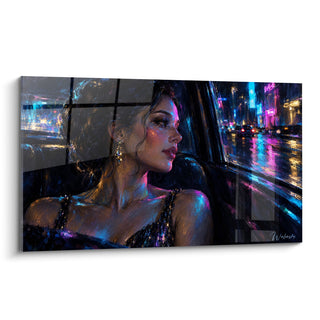 Music Star66
artworks
-
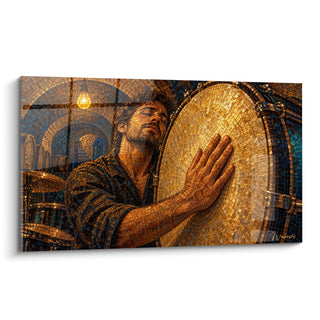 Drum9
artworks
-
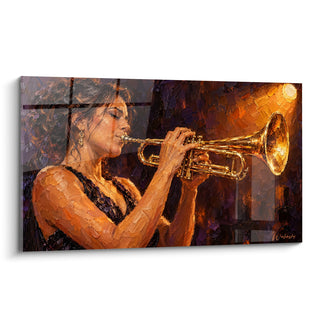 Trumpet14
artworks
-
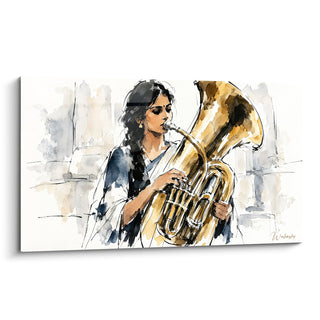 Tuba4
artworks
-
 Trombone2
artworks
-
 Ukulele41
artworks
-
 Vibraphone1
artwork
-
 Violin237
artworks
-
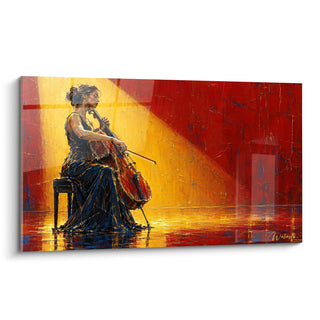 Cello56
artworks
-
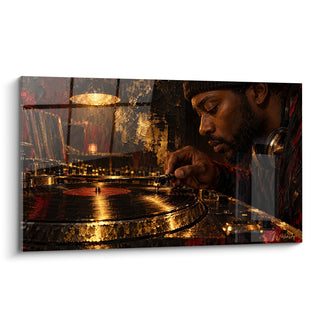 Vinyl43
artworks

All about Festival Music Painting
- Festival Music Painting Overview
- Golden Dusk
- Trance and Vibration
- Faces and Camaraderie
This Festival Music Painting collection gathers faces caught in the heart of the moment: sequins catching the light, flower crowns, arms raised toward a sky saturated with color. These are not anonymous crowd scenes but intimate portraits stolen from the noise, where you can sense the warmth of a summer, the gentle fatigue of a night spent outdoors, or the burst of laughter shared between friends.
What unites these paintings is a palette that refuses half measures: sunset golds, electric violets, fluorescent greens, black and red splashes. Each canvas treats light as a living material, caressing at times over skin dusted with glitter, at other times vibrating like a sound wave crossing the composition. The painterly gesture, often close to pastel or gestural painting, gives these images an almost tactile texture.
This collection is for those who want to keep a little of that collective euphoria at home, the sense of having lived something intense surrounded by strangers who became accomplices for a night. Hung in a living room, an entrance or a shared space, it reminds us that a party is never just noise: it is also faces, gestures, suspended moments.
For anyone seeking decor that tells an emotion rather than a simple motif, these festival music paintings offer a visual memory of effervescence, letting go, and the fleeting beauty of gatherings under open skies.
Why does golden light dominate these festival music paintings?
Where does this amber hue covering the faces come from?
On these festival music paintings, light is never neutral: it always falls at the end of the day, when the low sun cuts through the dust raised by the crowd and tints everything with an orange filter. Outdoor concert photographers know this phenomenon well: the golden hour almost always coincides with the peak intensity of a festival, when the day's heat fades and bodies relax. Hung at home, this light brings a precise sensation, that of the moment when everything tips between afternoon and night, between waiting and surrender.
Do the sequins and fleeting makeup tell something specific?
The shimmer covering some faces in these festival music paintings is not mere ornament: it belongs to a preparation ritual specific to large outdoor music gatherings, where one paints the body to blend into a collective celebration. This practice, inherited from American festivals of the 2010s as much as from older tribal festivities, turns the body into a surface of light. Placed on a wall, this image keeps the trace of an intimate gesture performed just before losing oneself in the crowd, between self-care and belonging to a larger group.
Does this visual warmth change the atmosphere of a room?
The amber and peach tones running through these compositions instantly warm a wall, even in a north-facing room or one with little sun. Unlike classic night scenes, often cold and bluish, these festival music paintings carry a luminosity that lasts all year, like a suspended summer. It is a way of inviting into your home a precise season and hour, when the party is just beginning to wind down, without ever sinking into complete darkness.
How do these festival music paintings convey the movement of a crowd in trance?
Why do some canvases seem to vibrate physically?
The sinuous lines and fluorescent colors running through some festival music paintings draw directly on the visual language born in electronic music venues and large outdoor stages, where light play and deep bass create a physical sensation of vibration. This aesthetic, inherited from the psychedelic record sleeves of past decades, translates into paint what the eye rarely perceives but the body feels: a continuous wave. Hung on the wall, this graphic energy animates an otherwise static space.
Does the body in motion, arms raised or eyes closed, carry a particular meaning?
The postures found in these works, arms stretched toward the sky or eyelids closed in total abandon, belong to a precise bodily vocabulary, that of the collective trance only certain outdoor music gatherings manage to provoke. This gesture, far from incidental, signals a moment when the individual dissolves into the music and the mass, losing self-awareness for a shared sensation. In these festival music paintings, this letting go becomes a fixed image, almost sacred, of what usually lasts only a few seconds.
Why pair acidic colors with such an intense emotion?
The deep violet, fluorescent green or vivid pink saturating certain compositions do not seek realism but emotional intensity, as if color itself carried the sound volume of the depicted scene. This chromatic freedom brings these canvases closer to the visual art associated with electronic music, where color expresses a state rather than a place. For those who love interiors with character, these works add a strong, almost sonic presence without ever relying on a classic figurative vocabulary.
What do the gazes and laughter in these festival music paintings tell?
Why do laughter and camaraderie hold a central place in these scenes?
Many of these festival music paintings choose to show not the stage or the crowd, but the bond between two people, a shared fit of laughter, a hand clinging to another. This choice reflects a reality specific to these large gatherings: one rarely remembers the concert itself, but almost always the people with whom it was lived. By placing human complicity at the center rather than the spectacle, these works capture what memory truly keeps of such an experience, long after the music has stopped.
Does the contrast between realistic faces and abstract backgrounds have a meaning?
On several of these canvases, the facial features are rendered with almost photographic precision while the background dissolves into splashes or uncertain forms. This visual tension reflects a real experience lived at these gatherings, where attention narrows onto a beloved face while everything else, noise, crowd, lights, becomes blurred and secondary. Hung at home, this composition reminds us that the intensity of a memory often rests on a single sharp detail amid the surrounding chaos.
Who do these portraits of festival-goers speak to most directly?
These festival music paintings particularly move those who have known that precise sensation of being part of a crowd while living a deeply personal moment, a laugh, a glance, a silent preparation before joining the mass. This is not a collection for someone seeking a generic concert scene, but for someone who keeps in memory a specific face glimpsed in those circumstances. It speaks to a generation that grew up with these major music events as summer rites of passage.
FAQ about festival music paintings
Why do these paintings show faces rather than concert scenes with stage and musicians?
Because the experience of a festival is rarely lived through the stage itself, but through the faces encountered around us. These works choose to fix what memory truly retains: an expression, a laugh, a gaze turned toward the horizon, rather than a staging quickly forgotten once the night is over.
Do the sequins and makeup visible on some canvases have a specific cultural origin?
This festive makeup practice, rhinestones and sequins placed on the cheekbones or around the eyes, has spread widely at large outdoor music gatherings since the 2010s, borrowing both from body painting traditions and from the aesthetics of fashion shows. It symbolizes a temporary transformation of the body into a collective work of art.
Are these paintings suitable for someone who has never attended a music festival?
Yes, because beyond personal memory, these works speak above all of light, color and shared human emotion, universal sensations. One can recognize oneself in any moment of collective freedom lived elsewhere, without ever having set foot in such a gathering.
Further reading
Our articles on this topic
- Concert scene acrylic glass print: capturing the energy of live music on your wall
- Panoramic night city lights painting: create an urban atmosphere for your evenings
- Paragliding sunset painting: creating a getaway corner at home
- Festival crowd and coloured lights wall decor: capturing the energy of a concert at home
- Music festival painting for a modern living room: capturing the energy of a concert at home
L'art qui suscite l'envie
Maison belge d'art mural grand format
14 jourspour changer d'avis*
Protection Walenskyincluse
Fabriquéen Italie
FormatXXL
Kit de fixationtoujours fourni
* Hors tableaux personnalisés et tailles personnalisées


