


Planet Painting
Here, each wall art opens a window to the infinite cosmos. The Planète Paintings collection brings together celestial spheres, cratered moons, and cosmic spirals, where earthy colors blend with the deep blues of the starry night. These Planète Paintings transform a wall into a silent observatory, between space exploration and intimate contemplation. An invitation to travel, without ever leaving your living room.
 Orange and Anthracite Spheres in Orbit Wall Art - Cosmic Ballet - Planet Edition$249.90
 Purple and Orange Planet with Ink Splashes Wall Art - Distant Small Moons - Planet Edition$249.90
 Globe Earth Wall Art Gray and Yellow in Splinters - Floating Black Spheres - Planet Edition$249.90
 Copper Planet Wall Art with Twin Moon - Rocks on Misty Shore - Planet Edition$249.90
 Pink and Anthracite Clouds Wall Art with Distant Shooting Star - Planet Edition$249.90
 Golden and Grey Sphere Wall Art on Curved Rocks - Red Reflection on Water - Planet Edition$249.90
 Silver and Gold Sphere with Grainy Splashes Wall Art - Sparkling Cosmic Trail - Planet Edition$249.90
 Solar Eclipse Orange and Petrol Blue Wall Art - Birth of a Star - Planet Edition$249.90
 Sparkling Planet Cream and Olive Green on Misty Lake - Double Solar Reflection - Planet Edition$249.90
 Orange Planet Giant Behind a Bare Tree - Dark Night Hill - Planet Edition$249.90
 Planets Wall Art Orange and Green on Rocky Landscape - Alien Sky - Planet Edition$249.90
 Crimson and Orange Sphere Wall Art on Azure Mountains - Ochre Rocks on the Ground - Planet Edition$249.90
 Blue and Brown Globe Earth Under Shooting Star Wall Art - Dark Relief Continent - Planet Edition$249.90
 Grey and Yellow Planet on Rolling Dunes Wall Art - Purple River Meandering - Planet Edition$249.90
 Turquoise and Red Sphere on Multicolored Hills Wall Art - Silver River Meander - Planet Edition$249.90
 Pink Giant Planet Overlooking a Cream Shore - Rise of a World - Planet Edition$249.90
 Astronaut Wall Art Reclining on Pink and Gray Rocks with Clouds - Sparkling Reflecting Helmet - Planet Edition$249.90
 White and Gold Planet Under a Sparkling Star - Distant Urban Silhouettes - Planet Edition$249.90
 Planet ringed pink and pale green on frosted relief Wall Art - Starry luminous ring - Planet Edition$249.90
 Planet Wall Art with Bronze Circle and Midnight Blue Star - Reflections on Dark Water - Planet Edition$249.90
 Marbled Blue and Gold Planet Wall Art on Reflected Lake - Small Integrated Satellite Moon - Planet Edition$249.90
 Red and Black Sphere with Incandescent Clouds Wall Art - Dazzling Star on the Horizon - Planet Edition$249.90
 Two Amber Moons in Blazing Clouds - Starry Night Sky - Planet Edition$249.90
 Blue and Green Globe Earth with Trees Artwork - Original Breath - Planet Edition$249.90
In the same family
Also explore the theme Space
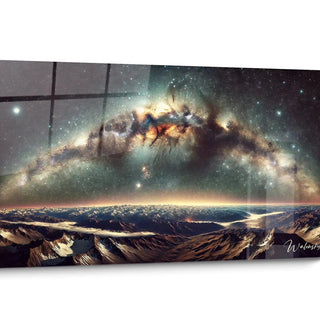
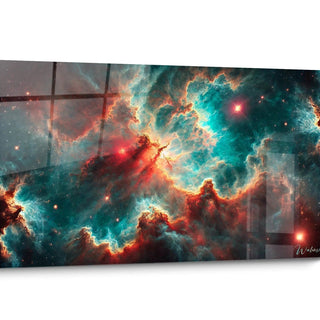
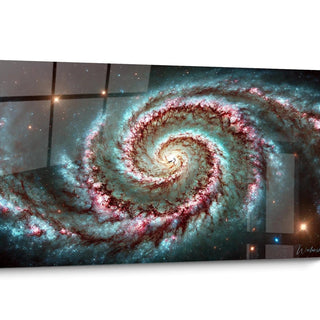
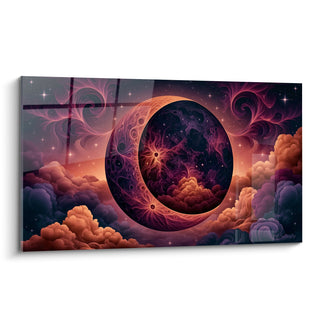
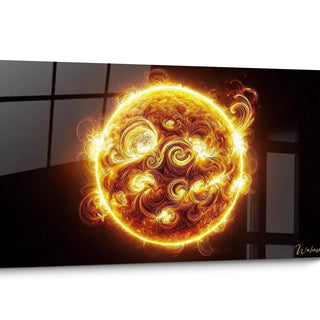
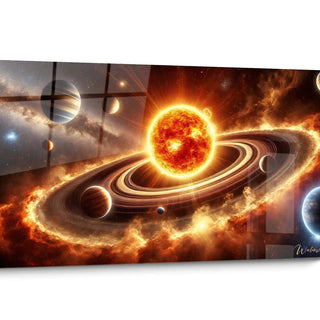
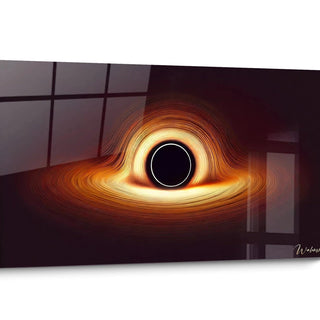
All about Planet Painting
- Presentation Wall Art Planète
- Colors from Elsewhere
- Vertigo of Scales
- Celestial Matter
The Planet Painting collection brings together works where celestial spheres, cratered moons, and cosmic swirls converse with familiar terrestrial landscapes. These are not mere astronomical representations: each composition blends the substance of the soil, the silhouettes of trees or hills, with the immensity of a sky inhabited by immeasurable stars. It is this tension between the near and the far that gives these Planet paintings their unique strength.
What unites these works is a palette that refuses the absolute black of space as we imagine it: terracotta, ochre, navy blue, and sage green warm up subjects that are otherwise cold and distant. Granular, cracked, or striated textures evoke the very substance of the stars, while compositions play on vanishing points that draw the gaze towards elsewhere. Each Planet painting thus becomes a threshold, a suspended moment between two worlds.
This collection is for those who seek to install in their interior an escape to infinity, without abandoning the warmth of a lived-in decor. It is suitable for both an office and a living room where one wants a wall to tell something other than the everyday. Those who love dreamlike universes, between science and reverie, will find here a way to hang cosmic vertigo without leaving their armchair.
The unusual palette of Planet paintings
Why are these stars never gray?
On these canvases, celestial spheres borrow hues one would not expect in the sidereal void: terracotta, olive green, terracotta orange. This chromatic freedom is explained by the way space observation has long been filtered by pictorial imagination rather than scientific photography. The Wall Art Planète draw on this tradition where the artist colors space according to an emotion rather than a measured data. Hung at home, such a work warms a theme yet associated with absolute cold, and installs a warm presence rather than an intimidating one.
Where does this navy blue come from that structures so many compositions?
The deep navy blue that dominates several of these works is not chosen at random: it recalls ancient celestial charts, where orbits were traced in dark ink on a night background. This graphic convention, inherited from 19th-century astronomy atlases, gives the Wall Art Planète an almost scholarly appearance, between scientific engraving and reverie. In a room, this shade brings a depth that does not close the space but opens it, like a sky one would look at from a window rather than a solid wall.
What do the explosions of violet and orange tell?
Some canvases explode the sphere into luminous trails, as if celestial matter were transforming into pure energy. This aesthetic of impact owes much to the way astrophysicists describe cosmic collisions and the birth of stars, translated here into pictorial gestures rather than equations. Planet paintings that adopt this visual language suit those who like interiors where color takes precedence over faithful representation, for a wall that vibrates rather than contemplates wisely.
The play of proportions in Planet paintings
Why do these stars seem so close?
In many of these compositions, the celestial sphere occupies a disproportionate space compared to the terrestrial elements surrounding it, trees, hills, or human silhouettes. This framing choice reverses the real experience of astronomical observation, where the moon or a planet is never more than a distant point in the sky. The Planète paintings play on this inversion to create a sense of near-tactile proximity, as if one could touch the star from their own garden. This vertigo of scales makes these works particularly effective in rooms where one seeks to visually enlarge the space.
What does this dialogue between tree and sphere mean?
Many of these canvases associate plant silhouettes, tormented trees, or conifers, with gigantic stars in the background. This composition recalls an ancient pictorial tradition where the tree symbolizes earthly anchoring facing the infinite celestial, a motif present from romantic landscapes to exploration illustrations. In these Planète paintings, this contrast between familiar vegetation and the unknown astral establishes a human reference point at the heart of immensity, which makes contemplation less intimidating and more accessible to those who view the work from their living room.
Why do some human silhouettes seem so tiny?
When a human figure appears facing a disproportionate star, it is almost always reduced to a simple silhouette, without traits or details. This visual choice is inspired by classic representations of space exploration, where man is shown as an observer rather than an actor of the cosmos. This voluntary disproportion gives these works a meditative dimension: it invites the viewer to project themselves into this smallness in the face of immensity, a sensation sought after by those who like their interior to bear a trace of contemplative vertigo.
The texture of the stars in the Planète paintings
Why do these surfaces seem cracked or striated?
Many of the spheres represented here bear textures that evoke dried earth, fractured rock, or deep craters. This materiality owes much to the scientific images brought back by lunar and Martian exploration missions, which revealed surfaces far more tormented than the smooth roundness long imagined. The Planète paintings that adopt this grainy texture give the star a nearly geological presence, like a fragment of soil torn from the sky to be hung on the wall.
What do the fine hatching of lunar reliefs tell?
Some works treat craters and mountain ridges in a style close to engraving, made of close hatching in gray and white. This technique directly refers to 19th-century scientific illustrations, where the lunar surface was documented in ink before the arrival of photography. This graphic heritage gives the Planète paintings the look of a precious archive, between exploration document and reverie object, particularly suitable for those who like interiors where graphic rigor and scientific imagination blend.
Why do some planets look like pixelated fragments?
Some compositions cause the sphere to disintegrate into small geometric blocks, like a digital image that is corrupting. This motif recalls the way spatial data reaches us today, sensors, pixels, and transmissions, rather than direct observation. This contemporary choice distinguishes these Planète paintings from more classic representations, introducing a tension between ancient matter and current technology, a contrast that particularly speaks to those who live surrounded by screens and still seek a share of cosmic mystery in their homes.
FAQ on Planète paintings
Why are the colors of these planets so different from what is seen in a telescope?
These artworks do not seek scientific accuracy but a pictorial emotion: terracotta, green, or blue hues convey an atmosphere rather than a measured data point. This chromatic freedom allows each wall art to dialogue with the colors already present in a room, which a faithful astronomical image would not allow as easily.
Are these artworks suitable for someone with no knowledge of astronomy?
Yes, these artworks are primarily aimed at the imagination and not scientific knowledge. They appeal as much to those curious about the cosmos as to those who simply like large, dreamlike compositions, without needing to know the difference between a moon and a planet to be carried away by the vertigo of the represented scales.
What is the difference with a simple representation of a starry sky or a galaxy?
A starry sky remains diffuse, without a focal point; these compositions, on the contrary, impose a massive and textured sphere as a central subject, often in dialogue with a recognizable terrestrial element. This confrontation between the nearby celestial body and the familiar landscape creates a visual tension that more abstract galactic representations do not offer.
Further reading
Our articles on this topic
- Which planet painting to give based on your amateur astronomer's profile?
- Cosmos and transcendence wall art, connecting to infinity through image
- Space planet painting for a child's room: how to choose the star planet
- Exoplanets in Art: Imagining the Visual Unknown
- How to pair a planet painting with minimalist decor
- World Travel Map Painting: The Complete Guide to Choosing and Decorating with Style
L'art qui suscite l'envie
Maison belge d'art mural grand format
14 jourspour changer d'avis*
Protection Walenskyincluse
Fabriquéen Italie
FormatXXL
Kit de fixationtoujours fourni
* Hors tableaux personnalisés et tailles personnalisées


