

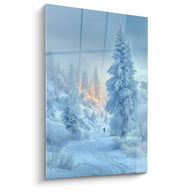

Landscape paintings: a visual escape to serenity
11 October 2025 · 20 min read · by Walensky
You come home after a tiring day, you push open the door to your living room and... nothing soothes you. Your white and cold walls send you the stress of the day instead of offering you that visual breath of fresh air you dream of.
You imagine that moment when, looking up, you could instantly escape to a lush forest, a majestic mountain or a golden plain that reconnects you to nature, even in the heart of the city.
You may have already tried a few cheap posters or printed photos, but the result disappointed you: dull colors, flat rendering, impression of "low-end" decoration that doesn't match your vision.
That's normal, and it's not your fault. The difference between a simple poster and a true landscape painting lies in the quality of the materials, the depth of the colors and the ability to create that virtual window to serenity.
By the end of this article, you will know exactly how to choose and integrate wall paintings of natural landscapes that will transform your interior into a true visual wellness sanctuary, where every glance becomes a mini-regenerating escape.
Why your mental well-being deserves natural landscapes on your walls?
In our hyper-connected and constantly stressful era, your brain needs visual breaks to regenerate. Neuroscience proves it: contemplating natural landscapes, even in reproduction, decreases cortisol and activates brain areas related to relaxation. It's like offering your eyes, tired from screens, an instant rejuvenation cure, available 24/7 in your living room.
Conversation with a decor expert
The golden rule of interior landscapes: Choose scenes that evoke the times of day when you feel most serene. Your brain will automatically associate the view of this painting with that state of well-being, creating a visual relaxation anchor that you will feel in less than 30 seconds with each glance.

Editor's Pick
Snowy peak painting - Majesty of the summits - Montagne edition
213,90€
Discover this paintingWhat really happens when your walls lack nature
You find yourself pacing around your living room without knowing why you feel restless, struggling to relax even in your own home, or experiencing a lack of inspiration and creativity in your living space.
This is not a coincidence: your nervous system is reacting to the absence of soothing visual stimulations. Without natural elements to contemplate, your brain remains in "urban alert" mode even at home. The problem is not you, but the visual environment that you have not yet optimized.
It's like trying to relax in a hospital waiting room: even if you want to, your visual environment isn't helping you. Your eyes instinctively seek natural visual resting points.
The deprivation of "green": an invisible but real stress
Contrary to what one might think, it's not the quantity of decoration that matters, but its ability to connect your brain to natural rhythms. Most people accumulate decorative objects without creating this essential connection with the outside world.
Imagine your gaze as a plant: it needs "green light" to flourish. Without this visual nourishment, it withers, constantly searching for something that doesn't exist in your space.
Result: you experience unexplained eye fatigue, difficulty "disconnecting" mentally, and paradoxically, less desire to spend time in your own living room. The solution completely changes your relationship with your personal space.
🔍 Quick test: Sit in your living room and count how many elements evoke nature within your direct field of vision. If it's less than 3, your brain is working harder than it should to feel "at home".
The illusion of sufficient artificial lighting
Many people think that a good white LED lighting is enough to create a relaxing atmosphere. In reality, your eye distinguishes more than 300 shades of green in nature, compared to only a few tones in standard artificial lighting.
It's like feeding your vision with "empty calories": it illuminates, but it doesn't nourish your nervous system. Your eyes remain "hungry" for this chromatic richness that only natural landscapes can offer.
Hence this feeling of never being totally relaxed at home, despite comfortable furniture and correct lighting. There is a lack of biophilic dimension that your primitive brain instinctively demands.
The trap of false "nature" solutions
Beware of artificial plants or pixelated images of nature printed on cheap canvas: your brain detects them as "fake" in milliseconds and refuses to connect with them emotionally.
You can check this by observing your spontaneous reaction: in front of a well-reproduced landscape artwork, you naturally inhale more deeply. In front of the fake, you pass by without even realizing it.
This is why so many attempts to "green" the interior fail: they aim at the conscious eye but forget the primitive eye which, on the other hand, is not fooled.
3 signs that your walls lack authentic nature:
- You avoid looking directly at your walls: Your brain subconsciously avoids "empty" visual stimuli that require effort without soothing compensation
- Your guests sit with their backs to the walls: Instinctively, they prefer to face the central space rather than surfaces with no visual interest
- You feel the need to "go outside for some fresh air" more often: Your nervous system compensates for the lack of natural stimulation indoors by an increased need for the outdoors
The epiphany: quality over quantity
The real difference lies in a painting's ability to create what is called the "window effect": this sensation that your wall opens onto a real landscape. This effect relies on three elements: the depth of field (foreground, midground, background clearly defined), the natural color accuracy (no artificial oversaturation), and the quality of the support which gives relief without disturbing reflections.
Smart buying rule: A single high-quality painting will transform your daily well-being more than ten average decorations. Test by fixing the artwork for 30 seconds: if your breathing doesn't naturally slow down, the artwork isn't creating the desired neurological connection.
| ❌ Common misconception | ✅ Scientific reality | 💡 Why it works | 🎯 Tangible benefit |
|---|---|---|---|
| It takes a lot of green elements for a natural effect | A single well-chosen landscape is enough to create serenity | The brain processes information quality, not quantity | Space saving and optimized budget for greater impact |
| Nature photos have the same effect as paintings | The texture and relief of the support amplify the soothing effect | The eye perceives physical depth as more "real" | More intense and lasting feeling of escape |
| Any landscape is suitable if it is pretty | Each person reacts to specific types of landscapes | Connection with memories and personal preferences | Personalized well-being according to your emotional profile |
| The decorative effect is more important than the psychological effect | The impact on mood truly transforms your relationship with space | The brain associates space with the emotions felt | Your home becomes a true regenerating refuge |
— Our selection


The foolproof method to create your personalized visual oasis
Rest assured: you don't need to have knowledge of art or decoration to succeed. This approach works like a recipe : just follow the steps in order to get a result that exceeds your expectations. In 3 simple steps, you will transform your wall into a window onto your dream landscape, one that instantly soothes you with every glance.
🗺️ Overview of your transformation: Like a gardener who prepares the ground, plants in the right place and maintains their creation, you will first identify your personal "therapeutic landscape", then choose the optimal location and format, finally master the art of hanging for maximum effect. At each step, your space gains serenity and personality.
Step 1: Discovering your personal "landscape signature"
Starting with this introspection avoids the costly mistake of buying a "pretty" landscape that doesn't speak to you deeply. It's like building a house: the emotional foundations determine whether you will truly feel at home. Once this step is complete, you will already feel the excitement of knowing exactly what you are looking for.
What you need for this exploration:
- A notebook or your phone: To note your spontaneous reactions without filtering them with logic. The goal is to capture your pure emotions in front of landscapes, not to make beautiful sketches. Favor a small notebook that you can take everywhere rather than a large notebook that will stay on your desk.
- A series of varied visual references: Nature sites, travel magazines, Pinterest or Instagram of landscape artists. The principle: expose your eye to a maximum of landscape types to identify what creates that "instant connection". Avoid online art galleries where colors are often distorted by screens.
- A 20-minute moment of calm: Without distractions, so that your brain can really process the emotions that each type of landscape provokes. It is this state of receptivity that reveals your authentic preferences, beyond trends or external influences.
Let's move on to concrete practice now:
How to reveal your deep preferences:
"3 breaths" test: In front of each landscape, take 3 deep breaths while looking at the image. Note whether your breathing naturally slows down (positive sign) or remains tense. This test reveals the real effect of the landscape on your nervous system, beyond intellectual aesthetic appreciation. Do not try to understand why it works or not, just observe.
⏱️ Time: 2 minutes per landscape | ✅ Successful when: You feel a clear difference in relaxation between certain landscapes and others | ⚠️ Attention: Don't choose with your head ("it's beautiful") but with your body (felt relaxation)
Classification by "moments of happiness": Associate each landscape that soothes you with a positive personal memory (vacation, childhood, moment of joy). This emotional connection guarantees that the chosen painting will trigger those same positive sensations every day.
⏱️ Time: 5 minutes of reflection | ✅ Successful when: You have identified 2-3 types of landscapes linked to your best memories | ⚠️ Attention: Avoid "impressive" landscapes but without personal emotional connection
Daily projection test: Imagine yourself returning tired and seeing this landscape on your wall. Which one makes you immediately want to settle comfortably? This is your most reliable indicator for a choice you will never regret.
⏱️ Time: 3 minutes of viewing per landscape | ✅ Successful when: One type of landscape clearly stands out as a "visual refuge" | ⚠️ Beware: Don't confuse "wanting to travel there" and "wanting to contemplate it daily"
✅ Step 1 validation: You have identified your "landscape family" (forest, mountain, ocean, prairie...) and you know precisely why it soothes you. If you are still hesitating between two types, it's normal: step 2 will help you refine it according to your space. Congratulations, you have avoided mistake #1 of the vast majority of buyers!
Step 2: Optimize the location and format for maximum impact
Now that you know your ideal landscape, you are going to stage it so that it truly transforms your daily life. This step is more technical but determines whether your wall art becomes a simple decorative element or a real "therapeutic window" .The snowball effect begins here: your gaze will naturally be drawn to this soothing area.
Measurement and planning tools:
- Tape measure and spirit level: To measure precisely and avoid approximations that ruin the professional effect. A tilted wall art attracts the eye negatively and creates subconscious tension instead of the desired calm. Prefer a magnetic level that temporarily attaches to the nail.
- Smartphone photo app: To virtually test different formats and positions before the final purchase. Photograph your wall, then overlay rectangles proportional to the sizes you are considering. This immediately reveals harmonious proportions according to your architecture.
- Mobile lighting (lamp or spotlight): To test the impact of light on your future location at different times of the day. Lighting completely transforms the effect of a landscape: too direct, it creates reflections; too weak, it dulls the colors. The ideal is indirect light that reveals without dazzling.
The "natural gaze" technique:
Mapping of your visual paths: During a normal day, observe where your gaze naturally settles when you are in the room. Mark these "visual anchor points" with sticky notes. The wall art should be placed on one of these natural paths, not in a blind spot you never spontaneously look at.
⏱️ Time: 1 day of observation | ✅ Successful when: You have identified 2-3 "magnetic" zones for your eye | ⚠️ Beware: Don't choose the most "logical" location but the one you look at most often
Test of the "57 cm rule": The ideal height for your brain to process the wall art as a "window" is 57 cm between the floor and the center of the artwork. This measurement corresponds to the average height of the human gaze and subconsciously creates this feeling of openness to the outside that you are looking for.
⏱️ Time: 5 minutes of measurement and marking | ✅ Successful when: You see the wall art "naturally" without tilting your head up or down | ⚠️ Beware: Adjust according to your height if you are very tall or short
Proportionality with furniture: Your wall art should be between 2/3 and 3/4 the width of the furniture below (sofa, console...). Smaller, it appears lost; larger, it overwhelms the space. This proportion creates the visual balance that allows the brain to relax instead of subconsciously correcting imbalances.
⏱️ Time: 10 minutes of calculations and simulation | ✅ Successful when: The furniture + wall art form a harmonious block | ⚠️ Beware: Measure the actual furniture, not the available wall space
Step 3: Master professional hanging for exceptional results
This final step transforms your choice and positioning into a daily visual experience. This is where the difference between a "discerning enthusiast" and a "connoisseur" is revealed: the technical details that make your landscape seem literally "alive" on your wall. Your surroundings will immediately notice this professional "je ne sais quoi" without being able to explain it.
Premium mounting hardware:
- Adjustable suspension system: Steel cables with adjustable hooks instead of fixed nails. This system allows for millimeter corrections after mounting and distributes the weight better to prevent sagging over time. Invest in quality: it’s invisible but crucial for durability.
- Mounting hardware suitable for wall type: Molly for drywall, chemical anchor for concrete, wood screws for partition walls. An incorrect fastener choice compromises safety and creates vibrations that alter the perception of stability of the artwork. Ask for advice from a specialized store according to your wall type.
- LED accent lighting: Adjustable spotlight with variable color temperature (2700K to 3000K) to reveal nuances without distorting colors. Lighting transforms a "pretty" painting into a "magical" painting that seems to have a life of its own depending on the time of day.
Technique for "invisible" mounting:
Template paper method: Cut a paper to the exact dimensions of the painting, mark the fixing points, position on the wall and drill through the paper. This technique avoids measurement errors and missed holes that require patching and restarting. Professionals systematically use this method.
⏱️ Time: 15 minutes of preparation | ✅ Success when: The painting positions perfectly on the first try | ⚠️ Attention: Check that your template paper does not warp with humidity
Progressive lighting adjustment: Start with very soft lighting in the evening and gradually increase until you find the intensity that reveals all the nuances without creating reflections. The goal: the painting should seem "lit from within" rather than lit from the outside.
⏱️ Time: 1 week of adjustments | ✅ Success when: The landscape seems to have its own luminous atmosphere | ⚠️ Attention: Avoid overly white lighting that "plasticizes" the natural effect
Stability and finishing test: Check that the painting does not move with a light touch, that the cables are invisible from the front, and that no technical elements disrupt the illusion of a "natural window". These details make the difference between an amateur installation and a professional result.
⏱️ Time: 10 minutes of final checks | ✅ Success when: The installation seems "obvious" and natural | ⚠️ Attention: Do not neglect these finishing touches that condition the overall effect
Safe progression rule: Only move on to the next step when you are fully satisfied with the previous step. It’s better to take another week to make a good choice than to rush and regret it for years. Initial patience transforms into lasting daily satisfaction.
You now master the fundamentals, but the true connoisseur's secrets are hidden in these details that even professional decorators don't always share. These refinements will make the difference between a "beautiful painting" and a truly transformative artwork for your space.
🎯 Secret of art gallery professionals: The "maximum depth" effect is achieved by choosing landscapes with at least three distinct planes: a sharp foreground (rocks, nearby trees), a slightly blurred middle ground (hills, clearing), and a very soft background (distant mountains, sky). This trompe-l'oeil technique creates the illusion of true three-dimensional depth, transforming your wall into a convincing window.
Question from an attentive reader
"I love the idea but I'm afraid of getting tired of a landscape I see every day. How can I be sure my choice will remain inspiring over time?"
This concern is perfectly legitimate and shows that you are carefully considering your investment. In reality, it's exactly the opposite that happens with a true natural landscape painting : You look at it more, the more subtle details you discover that you hadn't noticed at first. It's like having a window onto a garden that changes with the light and your moods. The trick: choose a landscape with enough visual richness to nourish your gaze for years.
🔍 Anti-boredom test: Before making a final purchase, fix your gaze on the image of the chosen landscape for 2 full minutes. If your eye continues to discover elements (texture of bark, shades of green, play of shadows...), that's a good sign. A landscape that appears "simple" at first glance but is "rich" to explore resists time.
— Also to discover


Other selected pieces
Painting Cypress under starry sky - Tumultuous night - other landscapes edition
233,90€
Discover this painting →The 5 mistakes that sabotage the "natural escape" effect
Attention, these mistakes are so common that even specialized stores don't always warn you about them. I share them to avoid these costly disappointments that I have observed in many well-intentioned customers.
- 🚫 Choosing a "photogenic" landscape rather than a soothing one: You are attracted to a spectacular sunset or a dramatic summit, but these "strong" images tire the eye on a daily basis. Prefer serenity to spectacle: your brain needs visual rest, not adrenaline. A soothing landscape remains inspiring longer than an "impressive" landscape.
- 📏 Underestimating the necessary size: For fear of overdoing it, you choose too small and the immersive effect disappears. A landscape should occupy enough of the visual field to create the "window" effect. It's better to have a large, average-quality landscape than several small, excellent landscapes that compete for attention.
- 💡 Neglecting the natural lighting of the room: You place your landscape in an area with poor natural lighting, and it loses all its magic as soon as daylight fades. Observe how the light evolves in your room throughout the day before deciding on the final location.
- 🖼️ Saving on the quality of the support: You opt for a low-end canvas print that quickly fades or sags with humidity. The support determines the durability of the effect: invest in a museum-quality rigid support that will preserve its colors and flatness for years.
- ⚖️ Forgetting harmony with the existing decor: Your dream landscape clashes completely with the dominant colors of your room, creating visual tension instead of soothing. Take a photo of your room and virtually check the color harmony before the final purchase.
🛡️ Safety checklist before purchase: Does your landscape instantly soothe you? ✓ Do the colors harmonize with your existing decor? ✓ Is the size proportional to your wall and furniture? ✓ Does the location benefit from good natural lighting? ✓ If any answer is negative, rework this aspect before purchasing.
— In the same spirit


Our curated selection
Painting Tranquil River - Bucolic Serenity - other landscapes edition
233,90€
Discover this painting →Answers to frequently asked questions about wall landscapes
The immediate effect is felt from the first glance (slowing of breathing), but the complete transformative impact unfolds over 2 to 3 weeks. Your brain needs this time to integrate this new "visual refuge" into its relaxation automatisms. To optimize: consciously look at your landscape for 30 seconds each morning, the positive association will strengthen more quickly.
Allow between 150€ and 400€ for a professional-quality painting that will truly transform your daily life. Below 100€, you risk disappointments (dull colors, fragile support). Above 500€, you often pay for the artist's notoriety more than the therapeutic impact. The sweet spot is around 250€ for a 70x100cm format in museum quality.
It's counterintuitive, but a large landscape visually expands a small space by creating an "opening" to the outside. The mistake would be to multiply the small elements that fragment the space. Golden rule for small rooms: one large landscape on the main wall instead of several small elements scattered around.
Absolutely! Use drilling-free fixation systems such as high-strength adhesive hooks (up to 8kg) or tension rods for opposite walls. Elegant alternative: the floor easel design that transforms your painting into a mobile sculpture. These solutions preserve your walls while creating the desired decorative effect.
Artistic stylization can even amplify the soothing effect by avoiding distracting details and focusing on the essential emotional aspect of the landscape. Simple test: does the artwork make you want to "walk into" it mentally? If so, it doesn't matter whether it is photographic or stylized, the therapeutic effect will be present.
Your new life with your personal window on nature
In a few weeks, when you step through the threshold of your living room, your gaze will automatically settle on your chosen landscape and your breathing will instantly slow down. Your guests will notice this "particular atmosphere" in your interior without being able to explain it. You will feel this secret pride of having created a space that truly resembles you, that tells your need for nature and your taste for beautiful things.
Beyond decoration, you will have developed what I call the "decorator's eye" : this ability to analyze a space, identify what is missing to make it truly soothing, and know how to remedy it with precision. This skill will transform your relationship with all your living spaces and impress those around you.
The most difficult part was understanding the mechanism, now you know exactly what to do. Start today by identifying your landscape signature by observing your reactions to nature images. In 30 days, you will have created your own daily visual oasis that you will no longer be able to do without.
🚀 Your transformation begins now: Every major change in ambiance starts with a conscious first look at your current space. You now have all the keys to create the visual escape you dreamed of, the one that will transform your "home" into a true personal sanctuary.
Also read: 🎨 Explore our other artistic guides
Isolated script with walensky prefix to avoid conflictsExplore our collections


