

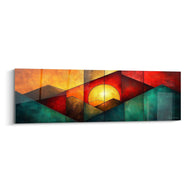

Create a gallery effect at home with modern, contrasting paintings
October 11, 2025 · 18 min read · by Walensky
You look at your living room and feel that familiar frustration: despite your beautiful furniture and carefully chosen decor, your walls seem dull, impersonal, almost bare. You have hung a few paintings here and there, yet the whole thing badly lacks character and visual impact.
Perhaps you even tried buying artworks you liked, but once hung they get lost in the space, create no dialogue between them, and give that disappointing impression of a mismatched assortment rather than a harmonious composition.
You have probably tried the classic advice: "match the colors", "respect the proportions", "space them evenly"... But the result remains disappointing, far from the sophisticated gallery effects you admire in decor magazines.
Rest assured, this is neither a lack of taste on your part nor a question of budget. The real difficulty lies in not knowing the professional wall composition codes that turn simple paintings into a truly immersive visual experience.
By the end of this article, you will master the expert techniques to create a striking gallery wall at home, one that captivates the eye and reflects your artistic personality with sophistication.
Why does the gallery effect instantly transform your interior?
Creating a gallery effect wall decor at home is not just a passing decorative trend: it is a genuine layout strategy that instantly transforms the atmosphere of your home. Imagine the impact on your guests when they discover a wall that tells a story, where each painting converses with the others in a masterfully controlled visual symphony. Without this approach, your walls remain passive surfaces that waste the emotional potential of your space.
🎨 Real transformation: Sarah, a Parisian interior architect, had an elegant but cold living room. In one afternoon she transformed her main wall with five contrasting modern paintings. Result: her 30 m² space now looks twice as large, and every visitor spontaneously compliments this "professional private gallery".
A conversation with a decor expert
The golden rule of modern galleries: A successful gallery wall creates controlled visual tension, like a musical chord where each note enriches the overall harmony. You will notice this transformation at first glance, and the effect improves over time.
Why didn't your previous attempts work?
Do you recognize yourself in these situations? You hang a painting, step back, and feel that "something is off". You move it three times without being satisfied. Or worse: you hesitate for weeks before daring to drill your wall, paralyzed by the fear of an irreversible mistake.
The problem is not your artistic sense, but an approach that is too fragmented and intuitive. Unlike professional galleries that follow precise composition rules, you try to create an overall effect by thinking about each work one at a time, as if you were composing a melody note by note without knowing the scale.
It's like cooking a gourmet dish by improvising each ingredient: even with excellent products, the result will remain disappointing without the overall composition method.
The myth of "instinctive hanging"
Contrary to what some magazines suggest, creating a professional gallery effect is not a matter of spontaneous inspiration. The most beautiful wall compositions follow precise mathematical principles: proportions, visual rhythms, anchor points, lines of force.
Imagine a conductor leading "by feel" without a score: even with excellent musicians, the result would be cacophonous. Your paintings are these talented musicians, waiting for coherent direction to reveal their harmonic potential.
This realization changes everything in your approach: you move from hit-or-miss attempts to mastered composition, from accumulating objects to creating an immersive visual experience.
🔍 Instant test: Take a photo of your current wall with your paintings. View it in black and white on your phone. If the ensemble doesn't create a visible "movement" even without color, the structural composition needs rethinking.
The mistake of uniform spacing
Many believe that spacing artworks evenly creates harmony. In reality, this approach produces the opposite effect: a monotonous rhythm that lulls the eye instead of stimulating it. Modern galleries use varied spacing that creates movement and breathing room.
It's like the difference between a mechanical metronome and a jazz rhythm: perfect regularity quickly becomes boring, while subtle variations sustain attention and create emotion.
This awareness frees your creativity: you are no longer constrained by perfect symmetry, but guided by the pursuit of dynamic balance that characterizes the most captivating gallery walls.
The illusion of the "dominant color"
You have probably heard that you should choose a dominant color and build around it. This approach works for classic decor, but considerably limits the visual impact of a modern gallery wall. The most striking compositions play on controlled chromatic contrasts.
Look at your favorite wardrobe: you don't necessarily wear blue from head to toe, but you know how to combine colors that enhance one another. A gallery wall works on the same principle of sophisticated complementarity.
Result: instead of looking for "matching" paintings, you will learn to create chromatic dialogues that reveal the richness of each work while building a strong visual identity for your space.
3 signs your composition needs rethinking:
- The eye doesn't know where to land: No element naturally guides the eye, like a text without punctuation that tires the reader
- Some paintings "disappear": Despite their quality, they fail to capture attention, a sign of a visual hierarchy problem
- The whole seems to "float": The artworks appear disconnected from the furniture and architecture, creating a sense of instability
The trigger factor: the centerpiece
Here is what makes all the difference: every successful gallery wall has a pivotal artwork that structures the whole, like the soloist in a concert who sets the tone for all the other musicians. Without this clearly identified centerpiece, even the most beautiful paintings struggle to create a collective impact. The secret lies in choosing and strategically positioning this central work, which will serve as the visual anchor for your entire composition.
Professional gallery rule: Always start by identifying your "star" painting, place it strategically, then orchestrate the other works around it. Check this by mentally covering that piece: if the whole visually collapses, you've succeeded!
| ❌ Amateur approach | ✅ Gallery method | 💡 Why it changes everything | 🎯 Visible result |
|---|---|---|---|
| I hang at random according to my moods | I compose according to an overall plan | Coherence is born from the overall vision | Immediate "signature wall" effect |
| I space everything uniformly | I create varied visual rhythms | Movement captures and guides attention | Dynamism and sophistication |
| I look for matching colors | I orchestrate controlled contrasts | Controlled tension generates emotion | Memorable visual impact |
| I accumulate my favorites | I build a hierarchy around a centerpiece | Structure guides perception | Readability and artistic depth |

Our selection
Painting Reflection in Black and Gold - Abstract Face Edition
$233.90
Discover this paintingThe 3-step method to create your gallery effect
Creating a sophisticated gallery wall follows a logical progression, like building a house: solid foundations, load-bearing structure, then refined finishing touches. This methodical approach saves you costly trial and error and guarantees a result worthy of your aesthetic ambitions. In the end, you will obtain a space that breathes artistic expertise and reflects your personality with elegance.
🗺️ Overview of your project: Step 1: define your artistic universe and choose your centerpiece (immediate satisfaction). Step 2: compose the ensemble according to the rules of proportion and contrast (visible gallery effect). Step 3: refine the hanging and lighting for a professional finish (maximum impact).
Step 1: Define your artistic signature
Starting with this step helps you avoid the pitfall of impulse buys and costly regrets. Like an architect who draws before building, you will first clarify your aesthetic vision to guide all your future choices. This reflection phase will bring immediate satisfaction: finally a clear direction for your decor project!
The key elements to gather
- Your main favorite painting: This centerpiece should move you instantly and reflect your personality. Choose a work that triggers a strong reaction, not something "pretty" or "practical". Avoid mass reproductions: favor originality that will give character to your composition. This artwork will set the tone for your entire gallery.
- A guiding theme or style: Modern abstract, contemporary figurative, art photography... Your common thread unifies diversity without falling into monotony. It is not rigid: a theme can be a color, an emotion, or even an artistic technique. This invisible coherence creates the professional effect you are after.
- Your space constraints defined: Measure your wall surface precisely and identify fixed elements (outlets, switches, furniture). This practical mapping will prevent disappointments and optimize your composition. A precise plan frees your creativity instead of limiting it.
Now, let's move on to concrete practice
How to proceed without going wrong?
Create your visual moodboard: Gather 10-15 images of gallery walls that inspire you (Pinterest, magazines, galleries you have visited). The goal is to identify common points: do you prefer strong or subtle contrasts? Varied or uniform formats? This analysis reveals your deeper tastes beyond trends.
⏱️ Time: 45 minutes | ✅ Successful when: You can explain in 2 sentences what attracts you to these compositions | ⚠️ Warning: Don't copy an existing composition, draw inspiration from the general spirit
Select your pivotal artwork: Among your current paintings or your purchase wishes, identify the one that will be the "conductor" of your composition. It must be visually strong enough to structure the whole, but not so dominant that it overwhelms the others. Think "first violin" rather than "absolute soloist".
⏱️ Time: 30 minutes | ✅ Successful when: This artwork still moves you after 5 minutes of contemplation | ⚠️ Warning: Resist the temptation of "bigger" or "more expensive" = more important
Define your creative constraints: Set yourself 3 rules maximum (e.g., "only works with black", "rectangular formats only", "urban theme"). These apparent limitations actually stimulate your creativity by channeling your choices. It's the principle of haiku: constraint generates beauty.
⏱️ Time: 20 minutes | ✅ Successful when: Your rules naturally eliminate 50% of the options | ⚠️ Warning: Too many constraints kill spontaneity, too few create chaos
✓ Step 1 validation: You have a clear vision of your style, a pivotal artwork that makes you vibrate, and precise selection criteria for your next choices. If you still hesitate, that's normal: refine progressively rather than starting over. The next step will bring this vision to life!
Step 2: Orchestrate the overall composition
You now move to the next level: creating your visual symphony. This step transforms your collection of individual paintings into a true artistic installation. The effect is spectacular: your wall instantly takes on a professional dimension that impresses and inspires. This is where the magic truly happens.
Professional composition tools
- Kraft paper or newspaper: Cut out shapes at the exact dimensions of your paintings to test compositions directly on the wall. This gallerist technique avoids costly mistakes and lets you experiment freely. Tape them temporarily: you instantly see the final effect without damaging the wall. Minimal investment, guaranteed professional result.
- Spirit level and tape measure: Millimetre precision separates an amateur hanging from a gallery presentation. A 2° deviation is enough to ruin the overall effect, even with magnificent works. Technical rigour enhances your artistic creativity instead of constraining it.
- Plumb line or smartphone app: To check vertical alignments that are invisible to the naked eye but unconsciously perceptible. These details make the difference between "pretty" and "professional." Your brain detects these micro-imbalances and translates them into a feeling of general instability.
Composition according to the golden rules
Apply the rule of thirds: Mentally divide your wall into 9 equal zones (3x3). Place your pivotal work on an intersection of these lines, never at the exact geometric centre. This photographic technique naturally creates dynamism and guides the eye harmoniously. The perfect centre produces a static effect that lulls the gaze.
⏱️ Time: 20 minutes | ✅ Success when: The main work immediately "catches" the eye on entering the room | ⚠️ Warning: Don't confuse the "rule of thirds" with "haphazard off-centring"
Create visual triangles: Organise your paintings along imaginary triangles that structure the whole. This invisible geometry creates reassuring stability while maintaining dynamism. Alternate upward-pointing triangles (lift) and downward-pointing ones (grounding) for a sophisticated balance that the eye perceives without analysing.
⏱️ Time: 40 minutes | ✅ Success when: You can trace at least 3 triangles linking your main works | ⚠️ Warning: Triangles guide but must not trap the composition
Respect the wall's breathing space: Keep 5-15 cm between works depending on their format and intensity. Intense works (vivid colours, strong subjects) need more space to "breathe." It's like conversation: the silence between words gives meaning to sentences. This breathing space avoids visual cacophony.
⏱️ Time: 30 minutes | ✅ Success when: Each work retains its individual impact while contributing to the whole | ⚠️ Warning: Too much space scatters, too little suffocates
Step 3: Finish the professional hanging
Excellence lies in the details: this final step turns your beautiful composition into a gallery-grade wall installation. Each millimetre adjustment and each lighting choice helps create that particular "presence" that distinguishes exceptional interiors. Your guests will immediately feel this quality without necessarily being able to explain it: it is the signature of expert work.
Finishing equipment
- Suitable hanging system: X hooks, a picture rail, or wall fixings depending on the weight and value of your works. A badly fixed 2 kg painting can fall and break: skimping on fixings costs more in repairs. Rails offer maximum flexibility for readjusting without drilling again.
- Directional lighting: Adjustable LED spotlights or lighting rails to reveal textures and colours without glare. Lighting turns a decorative wall into a true artistic scenography. Cool light reveals details, warm light creates atmosphere: alternate according to the effect you want.
- Wall material detector: Essential for locating load-bearing studs and avoiding pipes and cables. A failed drilling can cost hundreds of euros in repairs and compromise your whole installation. Safety comes before aesthetics: a painting that falls instantly destroys the gallery effect.
Expert progression rule: Master each step perfectly before moving on to the next. Objective criteria: step 1 is achieved when you can explain your choice in 30 seconds, step 2 when the composition works even photographed in black and white, step 3 when the lighting reveals each work without dazzling. Patience and ambition feed each other.
You now master the fundamentals of gallery composition. Here are the expert subtleties that distinguish the passionate amateur from the true connoisseur. These refinements give your installation that particular sophistication that marks exceptional interiors and earns the admiration of the most demanding visitors.
💎 Professional gallerist's secret: Create "controlled accidents": a painting slightly offset, a format that breaks the series, a colour that stands out... These calculated "imperfections" generate captivating visual tension and avoid the overly perfect "catalogue" look. Art lives on these controlled surprises that keep attention alive.
"What if I get tired of my composition in 6 months?"
"I don't dare start because I'm afraid of quickly tiring of the arrangement..."
This concern shows excellent decorative intuition! Contrary to popular belief, a well-designed gallery wall evolves with you rather than freezing. The trick is to plan from the outset "modular zones" where you can easily swap 20-30% of the works according to your seasonal wishes. Just as a well-organised wardrobe lets you renew your outfits with a few key pieces, your gallery reinvents itself through subtle touches without starting over.
🔄 Anti-boredom strategy: During your initial composition, identify 2-3 "satellite" locations around your pivotal work. These areas will hold paintings that are easier to replace (standard formats, simple fixings). Result: you keep a strong structure while varying the details.
— Also worth discovering


— Other selected pieces


The 5 mistakes that ruin a gallery effect (and how to avoid them)
Even with the best method, certain pitfalls await enthusiastic beginners. These mistakes are so common that I prefer to warn you now: they waste months of effort and considerable budgets. Good news: they are all easily avoidable once you know them!
- 🔴 Buying on impulse without an overall plan: Enthusiasm pushes you to fall for a "magnificent" painting that turns out impossible to integrate harmoniously. Result: frustration and wasted budget. Solution: always visualise the work within your existing composition before buying. This discipline avoids 80% of decorating regrets!
- ⚡ Neglecting lighting until the end: Poorly planned lighting can turn your finest paintings into dull or glaring surfaces. The mistake costs dearly in electrician fees and may require rethinking the whole layout. Include lighting from the design stage: it is part of the final work.
- 📐 Hanging too high relative to the furniture: The standard "150 cm from the floor" only applies in an empty space ! With a sofa, a console, a table, everything changes. Golden rule: 15-20 cm maximum between the furniture and the bottom of the nearest painting. This proximity creates the essential furniture-art dialogue.
- 🎨 Shying away from contrast for fear of "overdoing it": Chromatic timidity produces bland compositions that go unnoticed. A gallery wall needs character! Dare to pair a colourful abstract with a black-and-white photograph: the contrast reveals the beauty of each work. "Too much" only begins when harmony disappears.
- 🔧 Underestimating the importance of fixings: A cheap hook for a valuable painting is like fragile foundations for a luxury house. Security determines the peace of mind of your project. Invest in quality fixings: your peace of mind and the protection of your works are worth it.
🛡️ Anti-error checking system: Before drilling for good, photograph your test composition with your paper templates. Wait 24 hours, then look again: defects jump out with some distance. Check that you can trace coherent guidelines, that each work "breathes," and that the whole works even in peripheral vision. Warning sign: if you have to "explain" why it's beautiful, it isn't beautiful enough.
— In the same spirit


Answers to the questions you're asking yourself
Allow 300-800 € for a five-work gallery wall depending on your level of demand. Optimise by mixing 1-2 centrepieces (100-200 € each) with more affordable complementary works (30-80 €). Hanging and lighting represent 15-20% of the total budget but make 80% of the final effect. Concrete example: Marie created her salon gallery for 450 € by investing in 2 modern paintings at 150 € and 3 art photographs at 50 €, plus 75 € of LED lighting.
3 weeks to absorb the method, 1 weekend to compose and hang. The real difficulty is not technical but decisional: choosing and daring! Once your style is defined (step 1), the rest follows naturally. Tip: start with a test wall in a bedroom or office before tackling the main living room.
No special skills needed! With a spirit level, a tape measure and suitable fixings, anyone can do it. The trickiest part: drilling straight and to the right depth (3 minutes to learn). If you can assemble an Ikea piece of furniture, you can hang professionally. For concrete walls or very heavy works, a craftsman costs 80-120 € and fully secures the installation.
Even better! Small spaces concentrate visual impact and allow bolder compositions. Specific rule: favour 3-4 medium-sized works over 6-8 small ones that scatter attention. In a 25 m² studio, a well-composed gallery wall visually doubles the sense of space by creating depth and character. The effect is spectacular precisely because it is unexpected in a small volume.
The secret: an invisible common thread (a recurring colour, theme, era, technique...). Successful example: black-and-white urban photography + geometric abstract + modern illustration = coherence through a contemporary spirit. Avoid mixing more than 3 different artistic worlds: richness becomes cacophony. Foolproof test: if you can explain the link in one simple sentence, it's harmonious!
Your artistic transformation starts now
In 3 weeks, you will look at your living room with new pride. This wall that frustrated you so much will have become your personal decorative signature, a magnetic zone that instantly draws attention and earns admiring compliments from your guests. You will have joined the circle of people who master the art of living at home, the ones whose interiors are remembered long after the visit.
But this transformation goes well beyond decoration: you will have developed a refined artistic eye that will serve you in all your future aesthetic choices. This newly acquired confidence in your tastes and your ability to create beauty will transform your relationship with your living space and strengthen your personal expression every day.
Understanding was the main obstacle: now that you know the method, taking action becomes natural. Start today by identifying your pivotal work among your current possessions or your wishes. This first concrete step launches a creative momentum that will surprise you with its transformative power!
🚀 Your artistic adventure starts here: You now have all the codes to create at home the sophisticated gallery atmosphere you dreamed of. The expertise you have just acquired is worth years of haphazard experimentation: it is your shortcut to decorative excellence!
Also read: 🎨 Exploring artistic styles for paintings


