

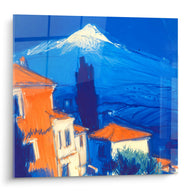

Cubism Wall Art on Acrylic Glass: Why This Medium Elevates Geometric Shapes
8 min read · by Walensky
ART MOVEMENTS WALL ART
Place a cubist painting and an acrylic glass print of the same motif side by side. The difference is obvious in three seconds: the angles stand out, the planes overlap with almost surgical sharpness, and the eye no longer knows where to land first. This is exactly the effect Picasso and Braque were after when they broke reality into facets, except they didn't have acrylic glass to render it.
Cubism has never been an easy style to live with in a living room. Too angular for some, too austere for others who still imagine it belongs only in museums. Yet when reinterpreted on a contemporary medium, it finds a real place in today's interiors, provided you understand what makes it work visually.
- Cubism breaks forms into geometric facets and layers multiple viewpoints within a single composition.
- Acrylic glass enhances contrast and depth thanks to its glossy surface, whereas textured canvas softens them.
- A cubist artwork fits better in a room with simple furniture, letting the geometry speak for itself.
Cubism, an Art Movement Built on Geometry and Contrast
Cubism emerged in the early 20th century under the impulse of Pablo Picasso and Georges Braque, who decided no longer to paint what is seen from a single point of view, but what is perceived while moving around a subject. A face becomes a stack of planes. A guitar breaks down into triangles and fractured lines.
Two phases are generally distinguished. Analytic Cubism, more restrained in color, breaks volumes into nearly monochromatic facets: grays, ochres, browns. The Synthetic Cubism that followed reintroduced color and broader flat areas, with more legible and more decorative forms.
This second phase is the one that speaks most to contemporary interiors. It keeps the geometric framework of the movement without its initial coldness, and that is precisely the territory where a cubist artwork takes on its full meaning today.
Cubism does not seek to resemble reality: it seeks to show several truths about the same subject at once.
Why Does Acrylic Glass Change the Way We Perceive Cubist Works?
A cubist composition thrives on its contrasts and sharp edges. The support that holds it must therefore render crisp lines and a clear separation between color planes, which is exactly where acrylic glass excels.
Depth and Gloss: An Optical Effect Close to the Gallery
The glossy surface of acrylic glass slightly reflects light, creating an optical sense of depth: the darkest planes seem to recede, the lightest ones seem to advance. On a cubist composition, where each facet plays a role in building space, this effect is far from incidental. It recreates part of what the eye naturally tries to do with these fragmented shapes: rebuild a volume.
This is a rendering often associated with works displayed behind glass in galleries, which is why it appeals to anyone who wants to recapture that sensation at home without installing a display case.
Line Precision Impossible on Textured Canvas
Classic canvas has a grain, a weave visible up close. On a classical figurative composition, this grain often goes unnoticed. On a cubist composition, where the rigor of right angles and diagonals is half the point, that same grain slightly blurs the contours.
Acrylic glass, by contrast, is perfectly smooth. A straight line remains a straight line, free of the micro-vibration caused by texture. This allows the eye to follow effortlessly the multiple perspective breaks that define the movement.
Acrylic glass is especially well suited to a room where you can control direct light. Facing a floor-to-ceiling window in full sun, opt for Alu Dibond, with its matte finish, which avoids any distracting glare.
The shop's creations that reinterpret Cubism often rely on stylized plant subjects, such as cacti, agaves, and desert gardens, treated as compositions of colorful facets. It's a contemporary way to preserve the geometric framework of the movement while anchoring it in a warm, readable universe.
These two pieces illustrate the principle well: angular forms, bold flat color areas, and an acrylic glass support that heightens every contrast between facets.

Favorite Pick
Opuntia Cactus Wall Art in Green and Orange on a Coral Background - Plant Radiance - Cubism Edition
From $228.90
Discover This ArtworkWhat Criteria Should You Use to Choose a Cubism Wall Art on Acrylic Glass?
Choosing a cubist artwork isn't just about liking angles. Three simple criteria help avoid disappointment: the palette, the size, and the room's light.
- The Palette: a synthetic Cubism in orange, purple, or turquoise stands out as the centerpiece of a wall; a more restrained Cubism with earthy tones blends more easily into an already visually busy atmosphere.
- The Size: the more facets a composition has, the more space it needs to unfold without feeling cramped. A large or extra-large format lets the lines breathe.
- The Room's Brightness: in abundant, direct natural light, the matte finish of Alu Dibond avoids glare; in softer or controlled light, acrylic glass reveals its full depth potential.
The contrast with the furniture matters too. A vivid, colorful Cubism calls for fairly neutral furniture so it doesn't compete visually. This is often the classic mistake: pairing an already highly graphic piece with a patterned sofa or a wall already rich in color.
— Our Selection


Where and How Do You Incorporate Cubist Wall Art into a Contemporary Interior?
The living room remains the most obvious choice: above a low sofa with clean lines, a cubist artwork becomes the visual anchor of the entire room, without needing other decorative elements to support it.
In an office, a more restrained composition, in earthy or monochromatic tones close to analytic Cubism, adds character without distracting, just as abstract art movements suited to professional spaces follow the same principle of balance. In an entryway, a panoramic format stretched widthwise naturally accompanies the gaze traveling through the space.
A series of geometric and contemporary artworks also works very well grouped on the same wall, as long as the palette stays coherent. To explore other compositions in this spirit, a selection of contemporary abstract painting artworks lets you compare moods before deciding.
— You May Also Like


Cubism and Other Movements: How Do You Avoid Awkward Mixes?
Cubism is recognized by its sharp facets and its openly multiple perspectives: you can often still make out the object or plant that served as the starting point, even when decomposed. Abstract art, by contrast, breaks away completely from the recognizable subject, with no possible return to an identifiable form. Art Deco, finally, shares with Cubism a fondness for geometry, but with more symmetrical, more ornamental lines and a palette often gold or metallic.
Mixing these three universes in the same room produces a muddled result: too many competing visual languages vying for attention. It's better to choose one dominant movement and let the other decorative pieces play a secondary role.
To go further on these distinctions, our guide to art movements in decor details the visual markers specific to each current, from Cubism to Impressionism through Abstract art.

In the Same Spirit
Panoramic Green and Red Geometric Leaves Wall Art - Abstract Jungle - Cubism Edition
From $242.90
Discover This Artwork →Frequently Asked Questions
What Is a Cubist Artwork?
It is a work that breaks a subject, whether an object, face, or plant, into geometric facets showing several viewing angles simultaneously, rather than a single classical perspective.
Why Choose Acrylic Glass Over Canvas?
Because its smooth, glossy surface renders crisp lines and an optical sense of depth, two essential qualities for the facets of Cubism to stand out clearly, which canvas texture slightly softens.
How Can You Tell a Cubist Style from an Abstract One?
Cubism keeps a visible link to a recognizable subject, even fragmented. Abstract art breaks away from it entirely: no identifiable form remains.
In Which Room Should You Hang a Cubist Artwork?
The living room, above a low sofa with simple lines, remains the most effective spot. A home office or entryway also works, depending on the intensity of the chosen palette.
Cubism is by no means a style frozen in art history textbooks. Placed on a medium that finally reveals the sharpness of its angles and the depth of its planes, it becomes a strong, almost living piece in a contemporary interior. To compare other movements and find the one that truly suits your space, the cubism wall art collection brings together all the compositions in this spirit, and the shop's cubist universe lets you explore the formats and finishes in more detail.
Explore Our Collections


