

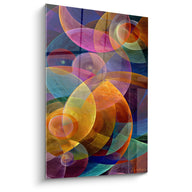

COWORKING PAINTING
It's 3:40 p.m. Two hours in front of the screen, the gaze drifting without finding anywhere to land, a blank white wall opposite, bare and smooth, with not a single detail for the mind to hold on to. It isn't physical tiredness that hits at this hour. It's something else — a kind of mental fog that caffeine no longer clears.
This fog has a name in cognitive psychology: attentional fatigue. And a wall can, quite literally, do something about it.
The direct answerWall art improves productivity by giving the brain micro-breaks of "soft fascination" that reduce attentional fatigue, according to the Attention Restoration Theory developed by psychologists Rachel and Stephen Kaplan. In practice, a well-chosen and well-placed artwork allows voluntary attention — the kind we draw on to concentrate — to recover between two tasks, instead of being depleted by a blank wall or a visually chaotic environment.- Attentional fatigue, rather than lack of motivation, explains the drop in concentration at the end of the day
- Kaplan's attention restoration theory shows that certain visuals rest the brain without distracting it
- The type of artwork should match the type of task: abstract and urban for creativity, landscapes and calming patterns for analytical work
Workplace productivity, a matter of attention more than motivation
Voluntary attention is a limited resource, not a character trait. Cognitive psychologists compare it to a muscle: it tires with use, especially when you must actively ignore distractions to stay focused on a task.
This is known as directed attentional fatigue. It explains why a simple task becomes painful after several hours in an open-plan office, why errors pile up toward the end of the day, and why irritability rises for no apparent reason. The visual environment plays a role in this fatigue — a role we largely underestimate, out of habit, by thinking of decoration as an extra touch of soul rather than a cognitive tool.
A blank wall does not rest attention: it abandons it, offering nothing to gently hold on to.
A workspace overloaded with screens, notifications and noise wears down this resource faster than an environment that provides visual breathing room. In this context, wall decoration is not an aesthetic gadget: it is a lever on the ambient cognitive load.
What science says about the link between visuals and concentration
Neuroaesthetics and environmental psychology offer precise mechanisms — not vague impressions — to explain why a dressed wall really makes a difference.
Attention Restoration Theory (ART) applied to the office
Formulated in the 1980s by Rachel and Stephen Kaplan, attention restoration theory holds that certain environments allow directed attention to recover through a mechanism called "soft fascination": visual interest sufficient to capture the mind without demanding cognitive effort.
Natural elements — forests, horizons, organic textures — produce this kind of fascination particularly reliably, which fuelled the whole biophilia movement in interior architecture. But the principle goes beyond nature alone: a well-conceived wall artwork, placed within the peripheral field of vision of a workstation, can play that same role of restorative micro-break between demanding tasks.
Soft fascination works better in peripheral vision than in direct frontal vision: an artwork placed on the side wall of a workstation rests the eye without constantly catching it.
The effect of colours and contrasts on cognitive rhythm
The psychology of colour applied to workspaces broadly distinguishes two registers. Cool, desaturated hues — deep blues, muted greens, greys — foster a calm state conducive to long analytical tasks. Warm, contrasting hues — orange, red, bright yellow — stimulate alertness and activation, useful for creative phases or short brainstorming sessions.
Contrast matters as much as colour itself. A visual that is too busy, with multiple competing points of focus, increases cognitive load instead of reducing it: the eye keeps searching for where to land, which exhausts rather than rests.

Which types of artwork truly boost performance depending on the task
Not all artworks produce the same cognitive effect, and this is where most office layouts go wrong by choosing uniform decoration for very different uses.
Creative tasks: abstract and urban artworks
For spaces dedicated to brainstorming, design or innovation, abstract art and urban compositions stimulate divergent thinking — the ability to consider several solutions to the same problem. Non-figurative geometric forms impose no single interpretation: the brain stays active decoding them, in a stimulating rather than soothing register.
The Urban Mosaic painting - Abstract Cubism Edition, with its blue and orange tones and geometric composition inspired by Cubism, illustrates this register well: structured enough not to distract, dynamic enough to awaken.
Analytical tasks: landscapes and calming patterns
For positions requiring long concentration and precision — accounting, writing, data analysis — natural motifs and uncluttered landscapes foster a lasting state of attentional calm, in direct line with attention restoration theory.
The Tree Trunk Wall painting - Forest Landscape Edition, with its birches and green and white tones, is particularly well suited to this type of zone: it offers soft fascination without drawing attention away from ongoing files.
In a coworking space that mixes both uses, it is often more effective to zone: a "creative" wall near the brainstorming tables, a "focus" wall near individual workstations, rather than a single choice for the whole space. This is in fact the approach detailed in our guide to wall decoration in open-plan offices.
— Our selection


Measuring impact: indicators and company feedback
You don't steer a wall decoration project like a marketing campaign, but certain indicators remain observable without laboratory instruments. Occasional absenteeism, stated satisfaction in informal conversations, creativity perceived by managers during brainstorming: these are signals, not statistical proof, but they usefully guide a decision.
- Observe qualitative feedback after a targeted change on a pilot wall before generalising
- Note whether certain areas are spontaneously used more for short breaks
- Compare the feelings expressed during team meetings, before and after the redesign
The goal is not to produce a rigorous internal study — few companies have the means for one — but to honestly document a perceived change, enough to justify a decoration budget to a management team that asks for concrete arguments rather than aesthetic ones.
— Also to discover


Common mistakes that cancel out the benefits of wall decoration
Poorly conceived wall decoration can produce the opposite of the intended effect, and this is often more common than one might think.
Other classic pitfalls: an artwork that is too small, lost on a large wall, never truly capturing attention; placement facing a window with a glossy surface that creates annoying reflections — in that case, an Alu Dibond print for a home office, free of glare, is preferable to acrylic glass; or a purely decorative choice, unrelated to the actual use of the space.
For mixed spaces, a good practice is to browse the painting collection for professionals, designed precisely for this kind of trade-off between visual registers and office use.

In the same spirit
Landscape painting No. 1 - Landscape edition
From $273.90
Discover this painting →Frequently asked questions
Does wall decoration have a scientifically proven impact on productivity?
There is no single, definitive study measuring a quantified productivity gain from wall decoration. However, the underlying mechanisms — attention restoration theory, colour psychology, reduction of cognitive load — are well established in environmental psychology and logically apply to workspaces.
Which type of painting should you choose to boost creativity at the office?
Favour abstract art and urban compositions in contrasting colours, which engage divergent thinking without imposing a single reading. Format matters too: an artwork occupying 60 to 75% of the wall's width creates a sufficient focal point without overwhelming the space.
How do you measure the effect of wall decoration on team performance?
Test a pilot wall before generalising, and observe qualitative signals: spontaneous use of certain areas, informal feedback in meetings, variations in occasional absenteeism. These are not scientific proof, but they are sufficient indicators to justify a decision.
Which mistakes should you avoid when decorating the walls of a workspace?
Visual overload is the number one mistake: several artworks on the same wall tire attention instead of resting it. Also avoid artworks that are too small for the wall, and glossy surfaces facing a direct light source, which create annoying reflections.
The blank wall at 3:40 p.m. is never an architectural fate. It is a choice — often by default, rarely by intention. Before rethinking an entire floor, test a single artwork, on a single wall, facing a single workstation: Kaplan's theory does not need large resources to produce its first effects.
To go further on the overall layout of a professional space, our article on office decoration in companies details other practical levers. And if the idea is to rethink an entire floor rather than a single wall, the coworking painting collection offers a coherent starting point, designed for the mixed uses of modern workspaces.
Explore our collections


