


Are stretched fabric paintings safer than framed paintings?
July 12, 2026 · 6 min read · by Walensky
A Sunday morning. Your child is running down the hallway, bumps into the living room wall, and that framed painting you loved so much crashes to the floor in a shower of broken glass. Your heart sinks. Bare feet. Shards everywhere. If this image tightens your throat, you are not alone, and the question deserves a real answer.
Here is what paintings on stretched fabric concretely offer: a total absence of broken glass, a considerably reduced weight on the wall, and wrapped edges that do not cut. Three advantages that change everything, especially in spaces where children, animals or simply... imperfect humans who sometimes knock things over live.
Are you torn between a classic framed painting and a stretched fabric painting to decorate your home? The safety question is nagging at you, but you don't want to sacrifice aesthetics on the altar of caution. Good news: you don't have to choose. This guide will show you why the stretched fabric painting stands today as the smartest option, and the most beautiful.
What nobody tells you about framed paintings
A traditional framed painting means first a frame in wood or metal with protruding corners, a protective glass pane that can shatter, and a weight that is often underestimated. In an adult living room, carefully decorated and rarely disturbed, this rarely poses a problem. But look around you: how often does your interior really look like a lifeless magazine spread?
Framed paintings fall. Not often, but they do. A poorly assessed fixing, a hollow wall, an accidental snag with the vacuum cleaner, and the framed painting becomes a projectile. The glass fractures. Shards scatter. And in a child's bedroom or near a play corner, this physical reality becomes a very concrete risk.
This is not paranoia. It is the architecture of everyday life.
The stretched fabric painting, the anatomy of thoughtful safety
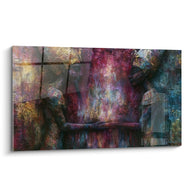
A stretched fabric painting, also called a canvas stretched on a stretcher bar, consists of a print on polyester or canvas fabric, stretched over a lightweight wooden frame. No glass. No pane. No exposed sharp corners. The edges are wrapped, rounded, padded with a slight thickness of canvas.
Concretely, this means that if your stretched fabric painting were to fall, a scenario we hope you avoid but must consider, it would bounce gently onto the floor without exploding into a thousand pieces. A child who touches it, handles it, or even pulls it off the wall faces no risk of cuts. This is a fundamental difference from the glass-covered framed painting.
Weight is also a key factor. A stretched fabric painting measuring 40x60 cm weighs on average two to three times less than a framed painting of the same size with glass and frame. Less weight means less strain on your wall fixing, and less kinetic energy in the event of a fall.

Stretched fabric paintings vs framed paintings: an honest comparison
On physical safety
The stretched fabric painting wins the comparison unequivocally. No glass, soft edges, reduced weight: the three vectors of potential injury from a framed painting are eliminated from the outset. For a child's bedroom, a busy hallway, or an active living space, the stretched fabric painting is objectively the safest choice.
On durability and maintenance
Stretched canvases hold up remarkably well over time. A quality fabric print does not yellow or crack the way a framed print under glass can, where condensation may form. A soft cloth is enough to dust your stretched fabric painting. The framed painting, on the other hand, requires more careful upkeep to avoid marks on the glass and moisture between the pane and the image.
On aesthetic impact
This is where many people hesitate wrongly. The stretched fabric painting has a strong visual presence, almost sculptural, thanks to the thickness of its frame which gives it relief on the wall. Without glass, colors are perceived directly, without parasitic reflections. The image lives with the natural light of your room rather than pushing it away. Many interior designers now favor the stretched fabric painting for this quality of raw, immediate rendering.
Where to hang your stretched fabric painting with complete peace of mind
The child's bedroom is the flagship space for the stretched fabric painting. But its safety and aesthetic advantages make it a relevant choice in many contexts:

- The child's bedroom and the nursery : no glass, no edges, light fixing. It is the obvious choice for decorating with complete peace of mind.
- The hallway and passageways : where arms brush the walls and bags snag frames, the stretched fabric painting absorbs impacts without deforming.
- The playroom and play areas : children touch, explore, approach. A stretched fabric painting in their living space is decor that welcomes their energy.
- Small spaces and cluttered walls : lightweight and adaptable, the stretched fabric painting hangs without extraordinary wall reinforcement.
— Also to discover


The art of choosing a good stretched fabric painting
Not all stretched fabric paintings are equal. A few criteria to check before buying:
The quality of the fabric : a high-grammage canvas (300 g/m² and above) guarantees even tension and a sharp print. Fabrics that are too thin create unsightly ripples over time.
The thickness of the frame : a stretcher bar 2 to 3 cm thick gives volume and presence. A frame that is too thin visually flattens the stretched fabric painting and can deform more easily.
The finish of the corners : the corners of a quality stretched fabric painting are wrapped with care, without rough folds or visible staples from the front.
Resistant UV printing : so that the colors of your stretched fabric painting remain vibrant for years without fading in daylight.
Decorate without compromise between beauty and safety.
Discover our exclusive collection of paintings for children's rooms, combining high-definition prints on premium stretched canvas with total safety for your little ones.

The stretched fabric painting, living decor for lived-in homes
There is something deeply right about the idea of a stretched fabric painting. Fabric, a warm and familiar material, turns an image into an almost tactile object. You don't feel the need to walk around it with caution as you would a fragile mirror. You want to approach it, touch it, live with it.
This generosity is what makes the stretched fabric painting a particularly suitable decoration for homes where life overflows: large families, homes with animals, Parisian apartments where walls are close and spaces are dense. The stretched fabric painting does not fear movement. It welcomes it.
And this freedom, no longer watching a fragile frame out of the corner of your eye, no longer dreading children running down the hallway, is in itself a form of domestic comfort that you only truly measure once you have experienced it.
Conclusion: the informed choice for modern interiors
Imagine your living room or your child's bedroom six months from now. Walls dressed with stretched fabric paintings in carefully chosen colors. Morning light playing directly on the pigments, with no glass glare. And above all, that light serenity, almost imperceptible but very real, of knowing your decor is equal to your life, and not the other way around.
The stretched fabric painting is not a compromise. It is an informed design decision that reconciles visual elegance and practical intelligence. Start with one piece, one format, one subject that moves you, and let the stretched canvas do the rest.
Frequently asked questions
Is stretched fabric safer than a painting under glass?
Yes, on three points. No glass that could shatter into shards. Wrapped, rounded edges that don't cut. And a markedly reduced weight, so less strain on the fixing and less energy in the event of a fall. These three vectors of injury disappear.
How is a stretched fabric painting made?
It is a print on polyester or canvas fabric, stretched over a lightweight wooden frame. No pane, no exposed sharp corners: the edges are wrapped by the canvas itself. Its frame thickness gives it relief, an almost sculptural presence on the wall.
How do you recognize a good-quality stretched canvas?
Check the fabric's grammage: a thick canvas guarantees even tension and a sharp print, whereas thin fabrics ripple over time. Check the thickness of the frame, the finish of the corners, wrapped without rough folds or visible staples from the front, and the durability of the print.
Where should you install a stretched canvas painting in your home?
In the child's or nursery bedroom first: no glass, no edges, light fixing. In hallways and passageways, where arms brush the walls and bags snag frames. In the playroom. And on walls that cannot support reinforcement.


