

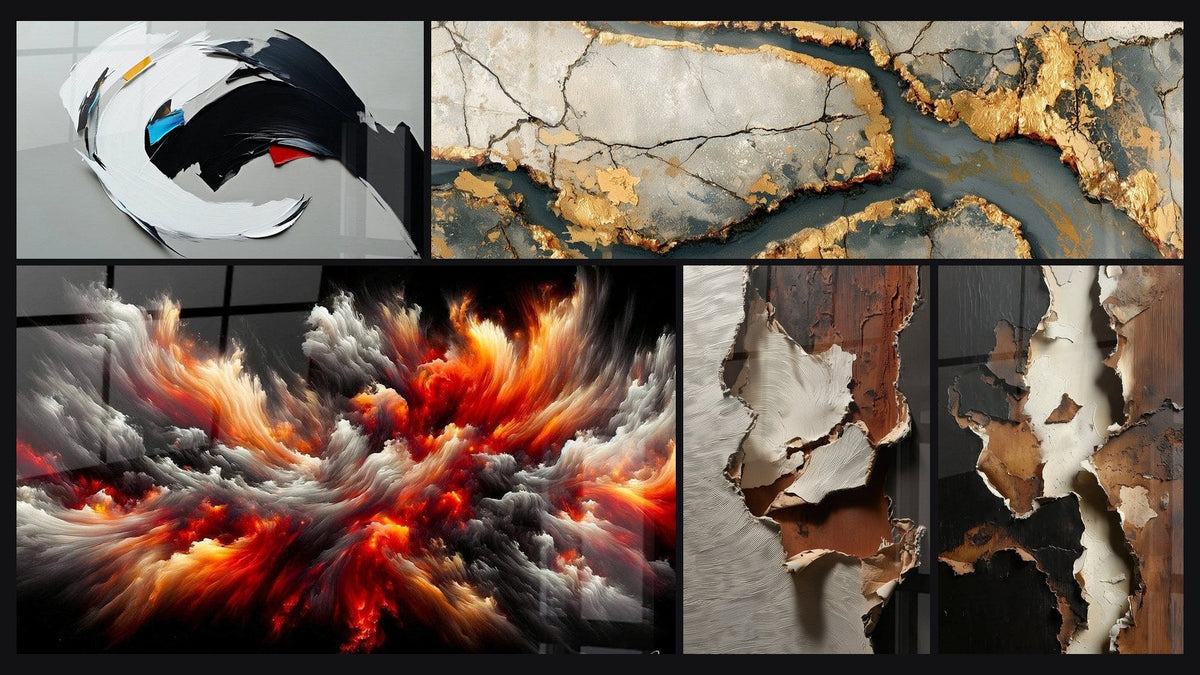
Picture yourself before a canvas where the paint seems to rise from the surface, almost tangible, where every stroke of the knife tells a story of rebellion and freedom. Gustave Courbet, the giant of French Realism, did not simply paint: he sculpted light, layering color the way a mason lays stones. The palette-knife impasto technique that Courbet generalized turns painting into a tactile relief, where the material becomes as important as the subject itself.
Here is what this revolutionary technique brings to your interior: a captivating physical presence that changes with the daylight, raw authenticity that rejects academic smoothness, and visual energy that dialogues with modern space. This painterly approach creates works that breathe and live, occupying the space with a thoroughly contemporary boldness.
You admire these old paintings in museums, but their printed reproductions leave you cold? This frustration comes precisely from the absence of material. Traditional brushwork, however refined, does not create that striking relief, that architecture of color that makes a canvas vibrate. Rest assured: understanding Courbet's palette-knife impasto will allow you to recognize and appreciate these works that truly transform a space. I will guide you through the secrets of this technique that revolutionized painting and continues to inspire the most refined interiors.
The Boldness of the Knife: When Courbet Revolutionized Painterly Material
In the mid-nineteenth century, while the Academy imposed fine brushes and transparent glazes, Gustave Courbet seized a palette knife and changed the course of art history. This flexible blade, normally reserved for mixing colors on the palette, became his main brush. Palette-knife impasto consists of applying paint directly in thick layers, creating a sculpted relief where the material captures and reflects light in an entirely unprecedented way.
Courbet was not seeking the polished finesse of salon portraits. He wanted tangible truth, the physical presence of his landscapes of Ornans, his crashing waves, his steep rocks. Each pass of the knife leaves a visible trace, a furrow, a thickness that makes the painting exist as a three-dimensional object. This impasto technique creates accumulations of pure pigment, sometimes several millimeters thick, where colors blend directly on the canvas rather than on the palette.
What fascinates in this approach is its irreversible and spontaneous character. Unlike glazes that build up slowly, the knife imposes an immediate decision. The color spreads, sculpts itself, stratifies in a single definitive gesture. This immediacy gives Courbet's works a raw force, a vital energy that grips the viewer from the first instant.
The Technical Secrets of a Masterful Impasto
The generalization of palette-knife impasto by Courbet rests on several sophisticated technical principles. First element: the consistency of the paint. Courbet worked with thick pigments, barely diluted, which retain their body and do not slump once applied. This creamy texture allows him to build reliefs that hold over time, creating those famous characteristic impastos where light catches the edges and sinks into the hollows.
Second fundamental aspect: the angle and pressure of the knife. Courbet mastered the tool like a sculptor his modeling tool. A knife held almost flat spreads the color broadly, creating luminous and smooth zones. Tilted further, it leaves streaks, furrows, rough textures evoking tree bark, the foam of a wave, the roughness of a rock. This variation in application generates a living surface, animated by a thousand tactile nuances.
The Layering of Colored Strata
Palette-knife impasto is not a mere chaotic accumulation. Courbet built his canvases through successive layers, superimposing colors that partially blend at their interfaces. This technique creates a fascinating optical depth: light penetrates slightly into the semi-transparent upper layers before bouncing off the more opaque lower ones, generating an inner luminosity impossible to achieve with flat techniques.
In his seascapes, Courbet masterfully exploits this layering. The deep greens of the waves are laid in thick strata, then topped with frothy whites applied with the knife in quick, nervous touches. The result? A sea that truly seems wet, where each crest of foam possesses a tangible volume. This architecture of painterly material transforms contemplation into a quasi-tactile experience.

Why This Technique Still Fascinates Art Lovers
The palette-knife impasto generalized by Courbet resonates particularly with our era. In a world saturated with smooth, uniform digital images, the asserted materiality of this technique offers a refreshing counterpoint. These paintings do not merely demand to be seen: they ask to be experienced in real space, where natural light constantly reveals new reliefs and new nuances depending on the hour and the viewing angle.
This physical presence explains why works worked with the knife radically transform an interior. Unlike a perfectly flat print, an impasto painting creates a permanent dialogue with its surroundings. In the morning, raking light accentuates the reliefs, creating miniature play of shadows across the surface. In the afternoon, more direct light makes the pure pigments blaze. In the evening, artificial lighting sculpts the material differently, revealing an almost new work.
Contemporary interior designers are rediscovering this tactile dimension. In a minimalist living room with clean lines, an impasto painting brings that touch of raw humanity, a reminder that art is born from a manual gesture, from a physical presence. Palette-knife impasto perfectly embodies the balance between sophistication and authenticity that high-end modern interiors seek.
How to Recognize Authentic Palette-Knife Impasto
Before a work, several clues reveal the palette-knife impasto characteristic of Courbet's approach. First sign: observe the surface under raking light. Genuine impastos create a tangible relief, with thicknesses sometimes reaching several millimeters. These accumulations of material are never uniform: they follow the logic of the gesture, pile up at the points of pressure of the knife, thin out where the tool was lifted.
Second indicator: the streaks and furrows left by the passage of the blade. Unlike brushstrokes that create soft, rounded traces, the knife carves into the material clean, angular, almost architectural marks. These furrows catch light differently, creating intense light contrasts that give impasto paintings their vitality.
Courbet's Visual Signature
Courbet pushed palette-knife impasto to the point of creating a true visual signature. In his landscapes, the rocks and cliffs are literally sculpted in thick paste, where each geological stratum becomes a pictorial stratum. The skies, on the other hand, may be treated more finely, creating a striking contrast between earthly materiality and atmospheric immateriality. This hierarchy of impasto reveals a remarkable compositional intelligence.
Flesh tones in his realistic portraits also benefit from this technique. Rather than smooth academic glazes, Courbet builds the skin through accumulations of tones laid with the knife, creating a texture that evokes the organic reality of skin. This approach, scandalous for its time, anticipates all of modern painting and its refusal of idealization.

The Contemporary Legacy of a Painterly Revolution
The generalization of palette-knife impasto by Courbet opened a royal road for all modern movements. The Impressionists amplified this approach: Monet, Renoir, Pissarro used the knife to capture the instantaneous luminous vibration. Van Gogh, a few decades later, pushed impasto to expressive heights, creating canvases where the material seems tormented, alive, almost volcanic.
Today, this technique continues to inspire contemporary artists seeking an alternative to dominant virtuality. Palette-knife impasto affirms the materiality of the work, its irreducible physical presence. In contemporary galleries, these rugged, rough surfaces are rediscovered, refusing smooth perfection and claiming their manual making.
For collectors and lovers of decorative art, understanding this technique allows one to refine aesthetic choices. A reproduction of an impasto work, to be satisfying, must absolutely restore this characteristic relief. Classic giclée prints, perfectly flat, betray the very essence of these paintings. Only textured reproductions or original works restore this fundamental tactile dimension.
Transform your space with the power of painterly material
Discover our exclusive collection of paintings inspired by famous artists that capture the raw energy and tactile presence characteristic of the great masters of impasto.
Imagine your interior transformed by living material
Picture your living room or office with, before you, a canvas where light dances across the reliefs, where every glance reveals a new texture, a new detail. The palette-knife impasto generalized by Courbet is not merely a historical technique: it is an invitation to live with art in a more embodied, more sensual, more authentic way.
This nineteenth-century painterly revolution speaks directly to our era, in search of tangible materiality. By understanding the secrets of this technique, you sharpen your eye, enrich your aesthetic experience, and create interiors that tell a story of creative courage and artistic freedom. Courbet's knife cut a deep furrow in the history of art: now it is up to you to let its echo enter your daily life.
Begin by observing the works you encounter differently, seek out these revealing reliefs, let your eye learn to read the material as much as the subject. This new sensitivity will transform your relationship with art and considerably enrich your decorative choices.
Frequently Asked Questions About Courbet's Palette-Knife Impasto
Did Courbet invent the palette-knife impasto technique?
No, Courbet did not invent palette-knife impasto, but he generalized and systematized it in a revolutionary way. Before him, a few artists occasionally used the knife for particular effects, but Courbet made it a central pictorial principle, applicable to all subjects: landscapes, portraits, still lifes. His boldness was to assert this rough approach against academic canons that valued smooth, polished surfaces. By generalizing palette-knife impasto, he affirmed that painterly material possessed a dignity equal to the subject represented, thus paving the way for all modern painting, which would explore the materiality of the medium itself.
Can an impasto painting be integrated into a minimalist interior?
Absolutely, and it is even particularly recommended! In a pared-down minimalist interior, a painting worked with palette-knife impasto creates a captivating focal point without breaking the overall harmony. The key lies in chromatic choice: opt for works whose palette harmonizes with your dominant tones, but whose textural richness brings that touch of humanity and sensuality that keeps minimalism from tipping into coldness. The relief of the impasto dialogues beautifully with contemporary smooth surfaces (waxed concrete, glass, metal), creating a sophisticated tactile contrast. This juxtaposition of the painting's artisanal roughness and the modern austerity of the space generates a particularly elegant and contemporary aesthetic tension.
How to maintain an artwork with significant impasto?
Paintings with pronounced palette-knife impasto require particular attention but remain entirely manageable. First rule: avoid abrupt temperature variations and excessive humidity that could weaken the painterly material. For dusting, use a soft natural-bristle brush, gently grazing the surface without pressing on the reliefs. Never a cloth that could snag on the irregularities! Absolutely avoid any cleaning product: water and solvents can alter the pigments and the cohesion of the impastos. Position your painting away from direct sunlight, which accelerates aging. With these simple precautions, a well-executed impasto will endure for decades, retaining all its textural and chromatic vitality, for the pleasure of several generations of admirers.


