

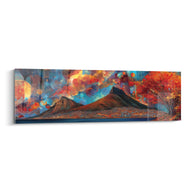

Why is the chameleon sacred in Yoruba iconography?
October 11, 2025 · 10 min read · by Walensky
During my first visit to a traditional bronze workshop in Ifẹ̀, Nigeria, I noticed a recurring motif on palace doors and ceremonial textiles: a small stylized reptile, sometimes barely recognizable, but always present. The chameleon. It was only while speaking with a priest of Obàtálá that I understood the immense symbolic weight of this creature in Yoruba cosmology.
Here is what the sacred chameleon brings to Yoruba iconography: it embodies the divine prudence that structures the universe, symbolizes the creative patience of the gods, and reminds every believer of the need to walk carefully along the path of life. In a tradition where every image carries a cosmological message, this discreet reptile holds a central place.
Yet, faced with Yoruba motifs — gelede masks, orisha sculptures, royal beads — many enthusiasts of African art remain puzzled. Why does this modest animal appear alongside powerful deities? What meaning lies behind its stylized representation?
Rest assured: understanding the sacred dimension of the chameleon in Yoruba iconography does not require ten years of immersion within religious brotherhoods. It is enough to know a few foundational narratives and grasp the symbolic logic that animates this millennia-old tradition.
In this article, I invite you to discover this fascinating figure — from the creation myth to its current influence on contemporary African art. You will understand why the Yoruba chameleon transcends the simple decorative motif to become a true ambassador of cosmic wisdom.
The messenger of Olodumare: when the chameleon created the Earth
In the Yoruba cosmogonic account, before the Earth existed, there was only primordial water and the sky, the domain of Olodumare, the supreme god. When the Orisha were entrusted with the mission of creating solid ground, it was Obàtálá who was chosen to descend from the heavens with a calabash containing sand, a five-toed hen and, a crucial element often forgotten, a chameleon.
The hen scattered the sand that formed the continents, but before anyone could set foot on this new world, Obàtálá sent the chameleon to verify the firmness of the soil. The reptile advanced slowly, testing every centimeter of earth with its delicate feet. Only after this meticulous inspection could the divinities descend safely.
This founding myth explains why the sacred chameleon appears so frequently in Yoruba iconography: it is literally the first being to have walked upon the Earth, the tester of divine creation. In the temples of Obàtálá at Ile-Ifẹ̀, considered the cradle of Yoruba civilization, stylized representations of the chameleon adorn the altars, recalling this primordial role.
The symbolism of the cautious gait
Beyond the myth, it is the chameleon's characteristic gait that fascinates the Yoruba. Its slow, swaying, almost hypnotic movement embodies iwà pẹlẹ — gentle and thoughtful conduct, a cardinal value of Yoruba philosophy. In a culture where haste is regarded as the source of all ills, the chameleon represents the antithesis of recklessness.
Yoruba artists incorporate this symbolism into their works by stylizing the reptile's posture: legs spread, tail coiled, head slightly tilted. On the carved doors of the palaces of the Oba (kings), the chameleon often appears in a forward-moving position, reminding visitors that they are entering a sacred space that demands respect and circumspection.
The chromatic metamorphosis: the symbolism of divine adaptation
If you have ever observed a live chameleon, you know its extraordinary ability to change color. For the Yoruba, this faculty is not mere camouflage: it symbolizes spiritual adaptability and mastery over transformations.
In religious iconography, the chameleon is frequently associated with Ẹ̀ṣù (Eshu), the Orisha of crossroads and of communication between worlds. Ẹ̀ṣù, known for his versatile nature and capacity to take many forms, shares with the chameleon this existential fluidity. On certain altars dedicated to Ẹ̀ṣù, chameleon sculptures are placed at the four cardinal points, symbolizing the deity's ability to navigate between all spaces.
Adire textiles — those magnificent indigo cloths with resist-dyed patterns — often incorporate stylized representations of the chameleon among their symbols of transformation. The dyers of Abeokuta explained to me that the chameleon motif is especially sought after for ceremonial garments, for it grants its wearer protection during life's transitions : initiation, marriage, appointment to an honorary title.
The sacred colors in representations
In Yoruba sculptures and paintings, the chameleon is rarely depicted in its natural colors. Artists favor symbolic hues: white for Obàtálá (purity and creation), red for Ṣàngó (power and fire), blue-green for Yemoja (water and fertility). This polychromy reinforces the reptile's association with divine universality — it belongs to all the Orisha and transcends divisions.
In a private collection in Lagos, I discovered an ancient gelede mask where the chameleon was carved atop the headdress, painted in black and white checkers. This chromatic alternation, the collector explained, represents the cosmic balance between opposing forces that the chameleon, through its patience, maintains in harmony.

Discover this inspiring work
From altar to living room: the chameleon in contemporary Yoruba art
The iconography of the chameleon has not remained frozen in temples. It permeates contemporary African art with surprising vitality. Artists such as Twins Seven Seven (who died in 2011) reinterpreted traditional Yoruba motifs in a vibrant, psychedelic style, in which the chameleon appears as guardian of ancestral secrets.
In the galleries of Lagos and Ibadan, I have observed a resurgence of interest in traditional Yoruba symbols. Young Nigerian creators incorporate the sacred chameleon into mixed compositions — digital painting, collage, sculpture in recycled materials — creating a fascinating dialogue between ancient cosmology and contemporary urban aesthetics.
This trend extends beyond Nigeria's borders. In the African diaspora, particularly in Brazil (where the Candomblé religion perpetuates Yoruba traditions) and Cuba (with Santería), representations of the chameleon adorn sacred spaces but also private interiors, serving as a bridge between spiritual identity and decorative expression.
Bringing Yoruba symbolism into your décor
For lovers of African art who wish to go beyond mere exoticism, understanding the meaning of the chameleon radically transforms the experience of a work. A painting depicting this reptile is no longer a simple decorative element: it is a daily invitation to patience, reflection, and careful walking through an uncertain world.
In my own space, I placed a reproduction of an Ifẹ̀ bronze showing a stylized chameleon near my desk. Whenever urgency overtakes me and haste threatens, this small silent guardian reminds me of the wisdom of measured movement. That is the power of Yoruba iconography: it does not merely decorate, it teaches.
— Our selection


Taboos and precepts: living alongside the sacred chameleon
In traditional Yoruba communities, the living chameleon is surrounded by strict precepts. It is generally forbidden to kill it, disturb it, or even point at it. Certain priestly lineages consider that spotting a chameleon before an important decision is a sign from Obàtálá: one must slow down, reflect further, and not rush.
These taboos are reflected in art: depicting a chameleon in a religious work requires preparatory rituals. The sculptors of the Onisona corporation (master carvers) traditionally observe a partial fast before carving a chameleon destined for a sacred context. This ritual precaution ensures that the work will carry divine blessing rather than mere aesthetic qualities.
Even in secular contemporary art, many Yoruba artists maintain particular respect for this motif. In conversation with a painter from Oshogbo, he confided that he always begins paintings featuring a chameleon with a brief prayer to Obàtálá, thus perpetuating, in a modern context, a millennia-old connection with the sacred.

Discover this inspiring work
— Also to discover


Beyond the Yoruba: cultural influences and resonances
While the chameleon occupies a central place in Yoruba cosmology, its sacred dimension resonates in other cultures of West and Central Africa. Among the Fon of Benin, neighbors of the Yoruba, the chameleon is likewise a messenger of the gods, associated with the vodun Mawu-Lisa, a dual creator divinity.
This symbolic convergence is not coincidental: it bears witness to an ancient cultural substratum, predating current ethnic divisions. Precolonial trade routes, migrations, and marriage exchanges between royal families spread and enriched the symbolism of the chameleon across vast territories.
Today, this African universality of the sacred chameleon facilitates its adoption by an international audience. Unlike certain symbols specific to a particular lineage or cult, the Yoruba chameleon carries an accessible message: the wisdom of slowness, the strength of thoughtful adaptation, the beauty of conscious transformation. Values that resonate powerfully in our age of acceleration and instability.
Invite ancestral Yoruba wisdom into your interior
Discover our exclusive collection of African paintings that celebrate the symbolic richness of Yoruba traditions and transform your space into a place of contemplation and daily inspiration.

In the same spirit
Chameleon Painting Holographic Guardians - chameleon edition
$232.90
Discover this painting →When patience becomes a way of life
Understanding why the chameleon is sacred in Yoruba iconography means accessing a millennia-old philosophy of life that has lost none of its relevance. In a world where speed is elevated to supreme value, where instant transformation is promised by every advertisement, this small stylized reptile on a textile or sculpture reminds us of a fundamental truth: true strength is tested step by step.
The next time you contemplate a work of Yoruba art — whether a gelede mask, an Ifẹ̀ bronze or a contemporary painting — look for the chameleon. It is often there, discreet yet essential, bearing a message our ancestors had carved in stone, wood and bronze long before our modern cultures rediscovered the importance of mindfulness and slowing down.
Inviting Yoruba iconography into your space means choosing to live surrounded not by mere decorations, but by symbolic companions that enrich daily life. The sacred chameleon then becomes what it has always been: a silent guide along the path of a more thoughtful, more adaptable life, more rooted in the wisdom of a patient balance with the world.
Frequently asked questions about the Yoruba tradition
Can one have a Yoruba chameleon representation at home without being initiated?
Absolutely. Unlike certain Yoruba ritual objects that require initiation or particular consecration, artistic representations of the chameleon are accessible to everyone. They function on several levels: decorative for the uninitiated eye, symbolic for those who know the tradition, spiritual for initiates. In Yoruba philosophy, beauty and wisdom are never reserved — they shine naturally. Having a painting or sculpture depicting the sacred chameleon in your home is a respectful way to honor this tradition, provided one knows and appreciates the symbolic depth of this motif. It is precisely this knowledge that transforms a decorative object into a support for contemplation and personal transformation.
How to recognize an authentic Yoruba chameleon in African art?
Yoruba representations of the chameleon display recognizable stylistic features. The reptile is usually stylized with a spirally coiled tail (symbolizing the cosmic cycle), legs spread in a cautious walking position, and often an exaggerated dorsal crest. In Ifẹ̀ bronzes and wood sculptures, the chameleon frequently appears in profile, head slightly raised. On adire textiles, it is often represented as a repeating motif or integrated into a cosmological composition with other symbols such as the calabash of creation or the five-toed hen. Contemporary works take more artistic liberty but generally retain these basic elements. To authenticate a piece, the essential step is to verify overall stylistic coherence and, if possible, the documented provenance of the work.
What is the difference between the Yoruba chameleon and other African reptilian symbols?
This is an excellent question that reveals the symbolic diversity of Africa. While the python is often associated with strength and royalty (particularly in Dahomey), the crocodile symbolizes aquatic and ancestral power, and the lizard generally represents agility and resurrection, the Yoruba chameleon specifically embodies prudence, patience, and divine verification. Its role as tester of creation sets it radically apart from other reptiles. Moreover, its capacity for color change makes it a symbol of conscious and controlled transformation, unlike the snake that sheds its skin (transformation through abandonment) or the lizard that regenerates (transformation through reconstruction). In an interior, choosing a chameleon over another reptile means favoring the values of reflection and harmonious adaptation over those of raw power or spectacular regeneration.
Explore our collections


