

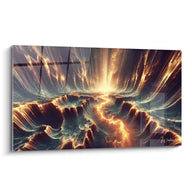

Do Art Deco geometric paintings convey professional elegance?
May 26, 2026 · 9 min read · by Walensky
I spent fifteen years restoring 1920s New York skyscrapers, and I learned one thing:Art Deco never grows old. Those sharp lines, bold zigzags, and octagonal forms structure space like a mental architecture... When a client asks me how to suggest authority without falling into corporate coldness, I always point to these geometric motifs that defined an era where modernity meant excellence.
Here is what Art Deco geometric paintings bring to a professional space: timeless legitimacy that transcends trends, visual sophistication that commands respect without arrogance, and aesthetic coherence that turns an ordinary office into a controlled place of power.
You may be looking to create this impression of professional excellence in your practice, executive office, or meeting room. But how do you avoid the trap of an impersonal décor? How do you bring personality while keeping the essential gravitas?
Rest assured: Art Deco was invented precisely to solve this equation. This movement of the Roaring Twenties combined geometric rigor with the sensuality of materials, formal discipline with chromatic daring. Art Deco geometric motifs are not mere decoration; they are a visual philosophy.
In this article, I will show you how these angular compositions naturally convey professional elegance, why they work in demanding contexts, and how to integrate them without turning your space into a museum.
Geometry as the language of controlled authority
When I restored the lobby of the Chrysler Building, I viscerally understood why geometric motifs command respect. Those rising triangles, concentric circles, and interlocking rhombuses are not random; they structure the gaze, create a visual hierarchy, and establish order.
In a professional environment, this orderly geometry communicates instantly: someone masters this space. Straight lines evoke intellectual rigor. Symmetries suggest balanced judgment. Rhythmic repetitions recall professional consistency.
An Art Deco painting with its fan or zigzag motifs produces a fascinating psychological effect: it projects confidence without aggression. Unlike contemporary abstract works that can disorient, or classical landscapes that soften the atmosphere, Art Deco geometric compositions establish a firm yet elegant presence.
Her clients spontaneously commented on the change: "Your space radiates excellence". The geometric shapes had created an atmosphere of quiet competence.
Why Art Deco works where other styles fail
The genius of Art Deco lies in its perfect balance between tradition and modernity. Unlike Scandinavian minimalism, which can feel cold, or industrial style, which sometimes lacks refinement, Art Deco geometric motifs offer this layered sophistication.
The balance between boldness and restraint
Art Deco geometric paintings play on controlled contrasts: gold and black, copper and navy, silver and deep burgundy. These palettes simultaneously evoke luxury and discipline. You can assert your taste without slipping into ostentation.
In my projects for architecture firms or consulting practices, I systematically use this Art Deco palette. It communicates: "We value aesthetic excellence, but we remain focused on substance".
The implicit cultural reference
Installing an Art Deco geometric motif painting in your professional space also evokes an era of excellence: that of great builders, well-run industrial empires, and technological innovation coupled with refinement.
Your cultivated clients will unconsciously recognize these visual codes. They will associate your environment with iconic skyscrapers, luxury ocean liners, and legendary hotel lobbies. This cultural resonance reinforces your professional elegance without a single word spoken.


Favorite
Geometric Motifs Painting - Burgundy Elegance - Art Deco Edition
$233.90
Discover this paintingThe three golden rules for integrating these paintings into a professional context
After fifteen years advising lawyers, entrepreneurs, and executives, I have identified three infallible principles so that Art Deco geometric motifs elevate your space without overwhelming it.
Rule 1: Format as a statement of intent
A small geometric painting lost on a large wall dilutes your message. Conversely, a monumental composition in a cramped waiting room overwhelms the space. For an executive office, favor a minimum 90x120 cm format behind your chair; this creates a visual presence of authority.
Participants unconsciously feel they are in an organized, thoughtful place.
Rule 2: A palette aligned with your message
Art Deco geometric motif paintings in gold and black tones project luxury and exclusivity, perfect for a high-end consulting firm. Compositions in navy and silver evoke institutional reliability, ideal for law or financial practices.
Copper and forest green variations bring a more contemporary touch while preserving this Art Deco elegance, excellent for architects or designers who want to show their aesthetic sensitivity.
Rule 3: Lighting as an amplifier
An Art Deco geometric painting poorly lit loses 70% of its impact. I systematically install warm-temperature directional LED spotlights (2700-3000K) to create play of shadow and light across the geometric relief.
This illumination turns your artwork into a living architectural element. In the morning, the angles catch the light differently than late in the afternoon. Your space breathes and evolves while retaining its reassuring geometric structure.
— Our selection

Mistakes to absolutely avoid
Having seen dozens of failed installations, I can tell you that even the most beautiful Art Deco paintings can fail if poorly deployed.
Mistake 1: Confused stylistic mixing. Combining Art Deco geometric motifs with sleek Scandinavian furniture or raw industrial design creates visual cacophony. Your space seems indecisive. Favor furniture with structured lines and noble materials (brass, marble, dark wood) that dialogue with the Art Deco aesthetic.
Mistake 2: Decorative overload. A geometric motif painting with complex patterns is already a strong statement. Multiplying artworks or adding too many accessories dilutes the impact. Remember: professional elegance lies in mastery, not accumulation.
Mistake 3: Neglecting the architectural context. In a modern open space with glass partitions, a large Art Deco geometric painting with saturated colors can seem out of place. Adapt the chromatic intensity to your environment: the more minimalist the architecture, the more you can afford bold motifs.

— Also to discover


Art Deco as a distinctive professional signature
When you choose Art Deco geometric motif paintings, you are not simply decorating; you are signing your professional identity. You communicate that you value history, aesthetic excellence, and intellectual rigor.
I supported a young law firm that wanted to stand out from established giants. Instead of copying the expected classical style, they invested in a collection of contemporary Art Deco geometric paintings. The result: their clients perceived an innovative team while being reassured of its professionalism. The Art Deco motifs created this perfect bridge between tradition and modernity.
This approach works especially well for professions where trust is essential: lawyers, consultants, wealth managers, architects. The Art Deco geometric style reassures through its clear structure while impressing with its refinement.
In a professional world saturated with interchangeable offices, these geometric compositions become your memorable differentiator. Your clients will remember "the firm with the magnificent golden motifs". Your space becomes an integral part of your brand.
Transform your professional space into a place of visual excellence
Discover our exclusive collection of paintings for law firms that combine Art Deco sophistication with timeless professional elegance.

Your professional space deserves this structured elegance
Art Deco geometric motif paintings do not merely suggest professional elegance; they create it, materialize it, and make it tangible for anyone who crosses your threshold.
Imagine your next clients entering your office, their gaze immediately captured by these rising lines, perfect symmetries, and controlled chromatic play. Without a word, your environment has already communicated your level of excellence.
Start modestly if necessary: a single well-chosen and properly positioned Art Deco geometric painting will already transform the perception of your space. Observe the reactions, adjust the lighting, and let the artwork structure the room.
Professional elegance is not a matter of lavish budget; it is a matter of coherent choices and visual sensitivity. Art Deco geometric motifs offer you this universal visual language that transcends passing trends.
Your professional space tells your story before you even speak. Make sure it tells one of excellence, structured elegance, and controlled sophistication. Art Deco paintings are the perfect narrators of this story.
Frequently asked questions
Do Art Deco geometric motifs suit all types of professions?
Absolutely, but with important nuances. For legal, financial, or consulting professions, Art Deco geometric motifs in restrained palettes (black, gold, navy) reinforce credibility and seriousness. For creative professions like architects or designers, you can dare bolder chromatic variations (copper, emerald green, burgundy) that show your aesthetic sensitivity while keeping the reassuring geometric structure. The key is to adapt the visual intensity to your clients: the more they seek security and tradition, the more you should favor pared-down compositions. Medical or therapeutic professions can also benefit from Art Deco geometric paintings in soothing tones that structure the space without creating visual tension. The key lies in consistency between your professional message and your chromatic palette.
How do I choose the right size for my office or meeting room?
The rule of thumb I have applied for fifteen years: your Art Deco geometric motif painting should occupy between 50% and 75% of the width of the main wall to create optimal impact. For a standard executive office (15-20 m²), favor a minimum 90x120 cm format placed behind your chair; this creates the essential visual presence of authority. For reception areas or entrance halls, dare to go large (150x200 cm), which instantly creates the desired wow effect. Caution: a geometric painting that is too small on a large wall dilutes your message and looks cheap. Conversely, a composition that is too imposing in a small space can feel oppressive. Measure your wall and take 60% of its width; that is your target dimension. And don't forget the hanging height: the center of the artwork should sit 150-160 cm from the floor, aligned with the standing eye level.
Can I mix Art Deco paintings with modern or contemporary furniture?
It is not only possible but often desirable to avoid a frozen museum effect. The secret lies in identifying points of stylistic connection. Art Deco geometric motifs share with modern design a passion for clean lines and structured forms. Pair your Art Deco painting with contemporary furniture featuring architectural lines: think metal-framed armchairs, desks with thick tops, asymmetrical shelving. Avoid, however, pairings with hygge Scandinavian style (too soft), bohemian (too organic), or Japanese ultra-minimalism (opposing philosophies). Noble materials create the perfect bridge: a modern desk in solid walnut dialogues beautifully with a geometric painting in bronze tones. Likewise, metallic accents (brass, brushed copper) on your contemporary furniture echo the golden accents typical of Art Deco. The trick is to maintain consistency in geometric rigor: straight lines, sharp angles, assumed symmetries. Your space then projects timeless professional elegance that transcends stylistic labels.


