

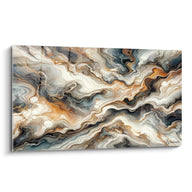

Are giclée canvas prints a good compromise between quality and price?
June 3, 2026 · 10 min read · by Walensky
I remember this client, a thirty-something entrepreneur, who had found a stunning photograph of an Oxford library during a trip. He wanted to hang it in his office, but the original art print cost over 2,000 euros. His face lit up when I told him about giclée canvas printing. Six months later, his guests systematically ask where he found that "magnificent painting". This scene repeats itself every week in my gallery.
Here is what giclée canvas printing brings: exceptional image quality that rivals original works, a durability of several decades without alteration, and a price 5 to 10 times lower than traditional techniques.
You may be facing this dilemma: you want to dress your walls with genuine artworks, not cheap posters that scream their industrial nature. But numbered art prints seem out of reach, reserved for wealthy collectors. You hesitate between investing a substantial sum in a single piece or settling for mediocre compromises.
Let me share what fifteen years of advising art lovers have taught me: giclée technology has revolutionized access to beauty. This professional printing technique now makes it possible to recreate the texture, depth and nuances of original works with astonishing fidelity.
In this article, I reveal exactly why giclée canvas printing represents the sweet spot between museum quality and a reasonable budget, how to recognize a truly beautiful piece, and in which situations it even outperforms certain more expensive alternatives.
The silent revolution of giclée printing
The term "giclée" comes from the French "gicler" and designates an ultra-sophisticated inkjet printing technique. But forget your desktop printer: we are talking here about professional machines capable of projecting up to 12 different pigment ink cartridges onto cotton or linen canvas.
What makes giclée canvas printing so special? Resolution reaches 2400 DPI compared to 300 for a standard print. In practical terms, this means that even 20 centimeters from your artwork, you will not distinguish a single pixel or halftone dot. Gradients are smooth, and fine details retain their sharpness.
I have seen professional photographers choose giclée printing over traditional silver halide prints for their exhibitions. Why? Because the color gamut is wider, especially in deep blues and saturated reds. Modern pigment inks capture shades that classic chemical processes cannot reproduce.
The canvas support adds that tactile dimension that transforms a simple image into an art object. The texture of the weave, sometimes visible depending on the chosen grain, creates subtle play of light. When natural light bathes your interior in late afternoon, your canvas print reacts like an original painting, revealing unsuspected depths.
Durability: the investment that stands the test of time
Let's be frank: what good is a work's beauty if it yellows in two years? This is where giclée canvas printing proves its exceptional value. Pigment inks resist UV rays, humidity and thermal variations.
Serious manufacturers guarantee their giclée prints for between 75 and 200 years without noticeable degradation, depending on display conditions. In my personal collection I have prints that are 12 years old, hung facing a south-facing window. No pallor, no discoloration. Compare that with a laminated poster that starts to deteriorate after 18 months in the same spot.
This longevity completely transforms the price-quality equation. A giclée canvas print at 150 euros that lasts 20 years actually costs 7.50 euros per year. A 30-euro poster replaced every 3 years costs you 10 euros annually. The calculation changes our perspective, doesn't it?
Value for money decoded without sugarcoating
Let's be concrete with real figures. For an 80x120 cm artwork, expect 120 to 250 euros for a professional-quality giclée canvas print. The same image as a limited silver halide art print would cost you 600 to 1,500 euros. Original screen print? Between 800 and 3,000 euros depending on the artist.
But be careful, not all giclée prints are equal. I have seen 50-euro prints that looked like color photocopies on fabric. Quality depends on three critical factors: the resolution of the source file, the quality of the printer and inks, and the weight of the canvas.
A professional giclée canvas uses a support of 350 to 450 g/m². Below that, the canvas becomes translucent and fragile. The stretcher bar also matters: solid pine with tensioning keys, not stapled plywood that warps within six months. These details justify the price gap between a low-end print and a piece worthy of your living room.
When giclée printing surpasses originals
Here is a truth few dare to say: in certain cases,giclée canvas printing offers advantages that the original cannot match. I have worked with interior designers who preferred giclée reproductions of photographic works over original silver halide prints for three precise reasons.
First, standardization. With giclée printing, you obtain three pieces rigorously identical in color and contrast. Impossible with handmade prints where each piece varies slightly.
Second, format customization. You love a photograph but your space requires a 30x90 cm panoramic format? The canvas print adapts to your architectural constraints without losing quality. Traditional artists rarely offer this flexibility.
Third, maintenance. A giclée canvas is cleaned with a slightly damp microfiber cloth. Try that on an original watercolor and prepare to weep. For families with children or in commercial spaces with heavy foot traffic, this practicality changes everything.

Our selection
Cracked Textures Painting Ochre and White - Mineral Erosion - Marble Abstract Edition
213,90€
Discover this paintingPitfalls to avoid absolutely
After seeing hundreds of disappointments, I can outline the classic mistakes. The first: buying a giclée print from a low-resolution file. If your source is less than 3000 pixels on its longest side and you aim for a format above 60 cm, the result will be disappointing.
Second trap: confusing giclée printing with standard digital printing. Some sellers use the term "giclée" loosely for ordinary inkjet prints. Demand details: pigment or dye inks? Which certification (Epson UltraChrome, Canon LUCIA PRO)? A serious professional answers without hesitation.
Third mistake: neglecting the finish. A giclée canvas without protective varnish remains vulnerable to splashes and greasy dust. UV varnish adds 15-25 euros to the price but triples longevity. It's like buying a car and refusing anti-corrosion treatment.
Last crucial point: the framing. Many choose a basic stretcher to save 40 euros, then regret the cheap look. A giclée canvas print with a American-style stretcher or noble wood framing completely transforms the perception. The eye immediately catches the difference between a decorative product and a true art piece.
— Also to discover


How to integrate these works into your decor
Giclée canvas printing flourishes particularly in certain decorative contexts. Contemporary interiors with light walls love bold large formats.
In an office or a library, canvas prints of vintage typography, antique maps or botanical plates bring that intellectual sophistication without the budget of period engravings. An architect client lined her studio with giclée reproductions of Haussmann plans: the effect systematically impresses her clients.
Open-plan living spaces particularly benefit from coherent series. Four giclée canvases of 50x70 cm on a common theme (seascapes, geometric abstractions, urban photographs) create a visual rhythm that structures the space. It is the decorators' secret for giving depth to large volumes.
For bedrooms, favor giclée prints in soothing tones. I have noticed that deep blues, forest greens and pearl grays work wonderfully. One client swore only by her reproduction of a Trinity College library: the rows of antique books soothed her every evening, creating an intellectual cocoon conducive to sleep.
The lighting that enhances your prints
A giclée canvas print reacts dramatically to light. It is often the difference between "it's pretty" and "it's magnificent". I systematically install adjustable LED spotlights with a 3000K color temperature at least 4 meters away. This warm light makes reds and ochres sing without harshening the blues.
Absolutely avoid direct sunlight on your giclée canvas, even with UV-resistant inks. Not out of fear of rapid fading, but because reflections kill the depth of the image. If your wall is flooded with sun in the afternoon, hang your artwork on a perpendicular wall.
Wall sconces with articulated arms let you adjust the lighting according to the time of day and the mood. In the evening, grazing light from below creates soft shadows that reveal the texture of the canvas. Your giclée canvas print becomes alive, almost three-dimensional.
Transform your space with the timeless elegance of knowledge
Discover our exclusive collection of Library paintings in premium giclée canvas printing, to create that refined atmosphere that both impresses and soothes.

— In the same spirit


The verdict after fifteen years of observation
So, is giclée canvas printing a good compromise? This question assumes it is a makeshift solution, a default choice. My experience prompts me to reformulate: in 80% of domestic or professional decorative situations,giclée printing represents the optimal choice, not a compromise.
It offers a visual quality that only a trained eye can distinguish from an original work at less than 50 centimeters. Its durability surpasses that of many cheaper traditional techniques. Its price allows you to compose coherent ensembles where a single original would empty your budget.
Of course, collecting numbered and signed originals retains its charm and heritage value. But how many of us can afford to dress three walls with pieces at 800 euros each?Giclée canvas printing democratizes access to beauty without sacrificing standards.
Imagine your living room transformed by those three large canvases you had spotted. No more bare walls that depress you every evening. Instead, images that tell your story, your passions, your dreams. Your guests stop, observe, ask questions. Your space finally reflects who you truly are.
The first step? Identify the emotion you want to create in each room. Then, look for high-resolution visuals that embody that emotion. Finally, find a serious printer who guarantees pigment inks, a canvas of at least 380g and solid wood stretchers. Your investment will span decades, appreciating a little more each day.

Other selected pieces
Liquid Marble Eternity Blue Painting - modern abstract edition
$232.90
Discover this painting →Frequently asked questions about giclée printing
How long does a giclée canvas print really last?
A professional-quality giclée canvas print with certified pigment inks lasts between 75 and 200 years depending on display conditions. I have clients whose prints are 15 years old with no visible degradation. The key lies in three factors: avoiding direct sunlight for more than 2-3 hours a day, maintaining relative humidity between 40-60%, and applying a UV protective varnish. Under normal domestic conditions, your giclée canvas will keep its brilliance well beyond your period of residence. It is an investment that can literally span generations, unlike posters that yellow within a few years.
How do you recognize a genuine, high-quality giclée print?
Several signs don't deceive. First, examine the canvas up close: you must be able to distinguish the texture of the textile weave, not a smooth laminated surface. A genuine giclée print uses a cotton or linen canvas of at least 350g/m². Second, check the fine details: zooming in on small elements should reveal no pixelation or visible halftone. Third, explicitly ask the seller: which inks (demand pigment, not dye), which printer (Epson SureColor and Canon imagePROGRAF are reference models), which longevity certification? A serious professional answers precisely. Finally, the price tells you something: below 80 euros for a 60x80 cm format, be wary. An authentic giclée canvas has an irreducible production cost.
Can you have your own photos printed as giclée on canvas?
Absolutely, and it is even one of the most rewarding applications of giclée canvas printing. I have supported dozens of clients who transformed their travel photographs into genuine wall artworks. The sine qua non condition: your file must be high resolution, ideally 300 DPI at the desired print size. For an 80x120 cm format, aim for a minimum of 3500x5000 pixels. Recent smartphone photos (from 12 megapixels onward) work well up to 50x70 cm. Choose a lab that offers color correction: the rendering on giclée canvas differs from the screen, and a professional will adjust contrasts and saturation for an optimal result. The cost ranges from 90 to 200 euros depending on format and finishes, turning your memories into decorative pieces worthy of galleries.
Explore our collections


