

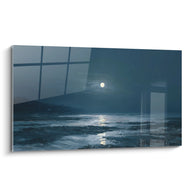

Do 3D relief artworks create an interesting visual effect next to protruding books?
July 14, 2026 · 8 min read · by Walensky
There's that precise moment, often in the evening, when you look up at your bookshelf and something escapes you. The books are there, neatly arranged, some sticking out, others set back, already creating a subtle geography on your wall. But something is missing. A breath. A visual tension. That focal point that would make this ensemble a truly accomplished composition.
Here is what 3D relief artworks bring to this space: a depth that engages with the volumes of the books, a tactile presence that magnifies the natural three-dimensionality of your library, and an artistic signature that turns a simple arrangement into a genuine decorative installation. If you have ever felt that frustration in front of a wall of books that doesn't yet "tell" a visual story, be reassured — the solution is less complex than it seems. Together, we will explore why this pairing of 3D relief and protruding books is one of the most powerful combinations in contemporary decoration.
Depth calls for depth
When you observe a well-composed bookshelf closely, you realize it is never truly flat. Books advance and recede, interposed objects create different levels, and the eye naturally travels through this three-dimensional space. This is precisely why a 3D relief artwork fits in with an almost obvious coherence.
Unlike a classic painting — however beautiful — a relief creation responds to the spatial logic already present in your bookshelf. It does not impose itself as an external element stuck onto a wall: it continues the conversation your books have started. The protruding volumes of the books find an echo in the roughness, layers, and thicknesses of the artwork. The result? An ensemble that seems to have been conceived as such from the start.
This visual coherence is what designers call spatial pattern repetition : when the same formal principle — here, depth — is expressed at several scales within one space, the eye perceives a harmony that is both reassuring and fascinating.
How do protruding books create the perfect ground for relief?
A book laid flat on a stack, a decorative object slipped between two rows, a volume pulled out a few centimeters from the others — each of these gestures creates what scenographers call a play of foreground and background. Your bookshelf then becomes a small theatre stage, with its different planes of depth.
Place in this setting a 3D relief artwork — whether a wall sculpture, a textured painting with generous materials, or a geometric relief composition — and you add a leading actor to this stage. The artwork catches light differently depending on the time of day, casting shadows that change and move, bringing the space to life in a way that a framed print never could.
The visual effect generated is twofold: on one hand, unification — everything seems to belong to a single coherent three-dimensional universe; on the other, emphasis — the relief artwork concentrates the gaze and gives a center of gravity to your bookshelf composition.

Favorite
Canvas with golden veins on nuanced blue-grey background - Mineral elegance - Abstract Marble edition
213,90€
Discover this paintingThe magical role of light on relief surfaces
This is perhaps the most underestimated aspect of this pairing. A 3D relief artwork placed near a bookshelf does not produce the same visual effect at 9 a.m. as at 7 p.m. Raking light — that of a reading lamp, an adjustable spotlight, or even natural light in late afternoon — reveals details invisible in full daylight.
Micro-reliefs cast slight shadows. Textured surfaces catch light in some places and let it slip away in others. This play of shadow and light gives the artwork an almost kinetic quality — it seems to move without ever shifting position. And this permanent animation contrasts wonderfully with the reassuring stability of your rows of books.
If your protruding books are lit by a spotlight, the effect is multiplied: each volume creates its own shadow, and the relief artwork blends into this ballet of shadows as if it had always been there. This is interior scenography in the purest sense of the term.
— Our selection


Choosing the right relief artwork for your bookshelf
Not all 3D relief artworks engage with protruding books in the same way. A few principles guide the choice:
Scale above all. An artwork that is too small will get lost in the visual mass of the bookshelf. An oversized one will crush it. The rule of thumb: the artwork should represent between a third and a half of the visible width of your book zone. It should be perceived immediately without overwhelming the volumes around it.
A chromatic palette in echo. There's no need to look for the exact color of your bindings. Instead, look for a dominant tone that picks up an element already present — the shade of a decorative object, the color of a recurring binding. Harmony is born from resonance, not repetition.
Materials in conversation. If your books mostly have matte covers, a relief artwork in raw materials — plaster, thick paper, textile, wood — will create a wonderful sensory continuity. If you have gilded or pearlescent bindings, a relief with slightly varnished or metallic surfaces will make the sheens converse.

Paintings specially designed for bookshelves: a new decorative category
Today there exists a decorative approach that takes the bookshelf context into account from the design stage. These bookshelf paintings consider the coexistence between the artwork and the books: formats adapted to niches and spaces between shelves, compositions visually enriched by the presence of surrounding volumes, 3D reliefs calibrated so as not to exceed in depth and risk hindering access to the books.
These specific creations transform the bookshelf into a living painting — in the literal sense. The ensemble of books and artwork becomes an artistic installation in its own right, one that your guests will comment on before even noticing each of its elements individually.
Your bookshelf deserves an artwork worthy of it.
Discover our exclusive collection of Bookshelf paintings that turn every row of books into a true three-dimensional artistic composition.
— Also to discover


When the visual effect exceeds every expectation
What really happens when you pair a 3D relief artwork with protruding books goes beyond the simple addition of two decorative elements. What arises is what one might call a visual critical mass effect : beyond a certain level of coherence and density, the ensemble produces an impression far greater than the sum of its parts.
Visitors no longer see "a bookshelf with a painting." They see a space that has an intention, a thought, a personality. The sculptural dimension of the relief artwork, combined with the natural volumes of the books, creates a rare perceptual richness — something the eye never finishes exploring.
Ultimately, this is the goal of all good decoration: not to show everything at a single glance, but to invite return, to look again, to always discover a new detail. Relief artworks possess this quality in its purest form. Placed near protruding books, they multiply it.

In the same spirit
Shards of Paint Painting - Abstract Pop Art Edition
$233.90
Discover this painting →The transformation you were hoping for
Imagine yourself this evening, standing before your transformed bookshelf. The books you love are still there, but they are now part of a composition greater than themselves. The 3D relief artwork hung among them catches the light of your reading lamp and casts soft shadows that animate the whole. Your friends stop in front of this wall, try to understand what has changed, and finally ask the name of your decorator. The answer is you. A right choice, in the right place, is often enough to change everything. Take this first step.
Frequently asked questions about relief artworks near books
Could a 3D relief artwork damage my protruding books or hinder their access?
This is a very legitimate concern, and the good news is that it is easily avoided. 3D relief artworks designed for the bookshelf environment generally respect a maximum depth of 3 to 5 centimeters, which does not interfere with handling the books. The essential thing is to position the artwork in a clear space — between two sections, above a row, or in a niche designed for it — rather than directly in front of books you consult regularly. If your bookshelf is open and highly functional, opt for shallow reliefs; if it is more of a decorative bookshelf, you can afford more generous volumes. In all cases, the installation must be solid and well anchored to prevent any movement that could damage nearby volumes.
What size of relief artwork should I choose for a standard bookshelf?
For a standard-format bookshelf — between 80 cm and 120 cm wide — a 3D relief artwork of about 30 to 50 cm in its largest dimension is generally ideal. It will be present enough to capture attention and create the desired visual effect, without saturating the space or competing visually with the whole set of books. If you have a large wall bookcase — the kind running the full length of a living room — you may consider several relief artworks of varying sizes, arranged at different heights, to create a visual rhythm along the piece of furniture. The important thing is always to leave breathing zones: the relief artwork should be surrounded by space, even relative, so that its volume is fully perceptible and appreciable.
Can I create a 3D relief artwork for my bookshelf myself, or is it better to choose an artisanal piece?
Both options have their charm and their logic. Creating a relief artwork yourself — with plaster, papier-mâché, salvaged materials, volumetric fabric — can yield absolutely magnificent and personal results. The process itself is an enriching creative adventure. However, control over the final result is less assured, particularly in terms of solidity, uniformity, and finish. An artisanal piece or an artist's creation brings a guarantee of quality, a mature artistic reflection, and often a uniqueness that homemade work struggles to achieve. For a first investment in this universe, a 3D relief artwork designed by an artisan or creative studio remains the safest choice for achieving this spectacular visual effect near your protruding books — and not regretting the result.
Explore our collections


