

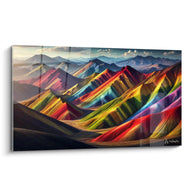

Harmonica print on acrylic glass: why does this pattern catch the light so beautifully?
8 min read · by Walensky
HARMONICA PAINTING
A living room wall, late afternoon. The low, angled light glides over a glossy surface and, instead of flattening out, it begins to ripple. That is exactly what the harmonica pattern does: vertical lines that are never straight, never static, transforming a simple painting into a kind of visual breath hung on the wall.
The harmonica pattern on acrylic glass is no aesthetic accident. It is the meeting of a design made to vibrate and a support made to reflect light. The two add up, and the result resembles no other modern decorative painting.
The direct answerThe harmonica pattern on acrylic glass produces a particular luminous effect because its wavy vertical lines create zones of reflection and shadow that shift with the viewing angle, somewhat like the folds of a crumpled curtain. Acrylic glass, naturally glossy, amplifies this play by reflecting light differently on each curve, giving an illusion of movement and depth that matt supports do not reproduce.- The harmonica pattern plays on wavy vertical lines that catch the light differently depending on the viewing angle.
- Glossy acrylic glass amplifies this phenomenon; matt Dibond aluminium smooths and softens it.
- This pattern works best under controlled light (artificial, subdued) rather than direct full sun, which washes out the reflections.
What is harmonica print on acrylic glass?
The harmonica pattern refers to a design made of wavy vertical bands, reminiscent of the reeds of a mouth harp or the pleats of a gathered curtain. Nothing to do with a landscape or a portrait: here, it is the structure itself, repetitive and rhythmic, that carries all the visual interest.
Technically, the printing is done in UV directly onto acrylic glass, a transparent and glossy sheet that gives depth to colours and a rendering close to an art gallery. UV ink dries instantly under ultraviolet light, which fixes sharp hues and marked contrasts, essential so that the undulations of the harmonica pattern remain legible from afar as well as up close.
A harmonica pattern is not an image you simply look at: it is a surface that moves with you as you move.
Why does this pattern react so well to light?
Because its wavy lines never present the same inclination to the light: each curve catches or returns the rays at a different angle, creating an optical vibration impossible to achieve with a flat pattern.
The role of wavy lines in light refraction
A straight line reflects light in a single, uniform block. A wavy line, on the other hand, multiplies micro-angles: each crest and each trough corresponds to a slightly different refraction. This is what produces the sensation of relief even though the surface, physically, remains perfectly flat.
The brain, accustomed to reading cast shadows as cues of volume, interprets these variations as genuine depth. It is a gentle optical illusion, never garish, yet present enough that a harmonica painting changes appearance depending on the time of day.
Acrylic glass vs other supports: the difference in rendering
On acrylic glass, the glossy surface acts like a small light magnifier: it captures ambient rays and returns them with intensity, which accentuates the vibration effect specific to the harmonica pattern. On a matt support such as Dibond aluminium, the same pattern exists, but light diffuses evenly, without catching: the rendering is softer, calmer, with slightly less vivid colours.
- Acrylic glass : ultra vibrant colours, depth, no matteness, ideal for amplifying the harmonica effect in a room with controlled light.
- Dibond aluminium : matt surface, zero reflection, softer colours, perfect facing a window or in direct natural daylight.
If your wall faces a very bright picture window all day long, Dibond aluminium will avoid annoying reflections. Acrylic glass, for its part, shines mostly when the light is changing or artificial, especially in the evening.
This collection plays on contrasts of lines and curves that also exist, in other forms, in the stained glass style painting collection, where the play of light this time comes from flat areas of colour in the manner of a glass window.

Favourite
Painting Midnight blue and fuchsia planet with trickling streaks - Translucent grid overlay - Planet edition
From $273.90
Discover this paintingIn which room and under what light should you hang a harmonica painting?
The harmonica pattern shows its best in a room where the light varies: a living room with accent lamps in the evening, a lobby lit artificially, a dimmed dining room. For an adult bedroom, a black and white harmonica painting with a minimal aesthetic pairs particularly well with soft, subdued lighting. The vibration effect needs contrast to exist, not flat, constant light.
In a bedroom, prefer soft, dimmed lighting in the evening: the acrylic glass will reveal gentle, almost hypnotic reflections. In a very bright office during the day, Alu Dibond will be more comfortable, with no halo or stray reflection on the neighboring computer screen.
Other designs take advantage of the same optical principle without being harmonica patterns as such. The luminous rendering of an orchestra print on acrylic glass or that of a manta ray print on acrylic glass also play on curves that catch light differently, proof that acrylic glass has a real predilection for organic, wavy motifs.
— Our selection


Pairing ideas with other paintings from the collection
A harmonica painting, by nature graphic and rhythmic, pairs surprisingly well with softer, more figurative works, provided the palette stays coherent, which also means taking into account the choice of harmonica painting according to your wall color.
For a living room that mixes abstraction and nature, you could imagine a harmonica design in deep midnight blue alongside a softer floral or aquatic painting, which calms the rhythm without breaking the luminous atmosphere.
These three pieces share pastel or aquatic tones that dialogue easily with a harmonica design in deep colors, without ever competing visually. The idea is not to match everything identically, but to let each artwork breathe on its own stretch of wall.
— Also worth discovering


Maintenance and installation tips to preserve the luminous effect
The luminous effect of a harmonica painting depends directly on the cleanliness of its surface: dusty acrylic glass or glass marked with fingerprints loses a good part of its ability to reflect light.
How do you clean an acrylic glass painting?
A slightly damp microfiber cloth is enough, with no abrasive product or alcohol. Wipe in one direction, without rubbing in circles, to avoid micro-scratches that eventually dull the reflections.
Dust the painting once a week with a dry feather duster: this prevents the buildup of particles which, on a glossy surface, show up much faster than on a matte support.
Does acrylic glass deteriorate over time?
No, not under normal indoor conditions. Acrylic glass retains its shine and colors over the long term, provided it is not exposed directly and for long periods to the sun, which, as with any support, can slightly fade the intensity of the colors over many years.
As for installation, the fixings are included and the painting is delivered without a frame, ready to hang. For an L format of 120x70 cm, aim for a center height of about 1.50 m from the floor, at eye level, so the vibrating effect of the harmonica design fully reveals itself as soon as you enter the room.

In the same spirit
Crystal Clear Lake Sweetness Painting - impressionism edition
From $273.90
Discover this painting →Frequently Asked Questions
What is the difference between printing on acrylic glass and on canvas?
The shop does not offer canvas: paintings are printed on acrylic glass or Alu Dibond. Acrylic glass offers a shine and color depth that a classic canvas, with its matte texture, cannot reproduce.
How to clean a glass acrylic painting?
A slightly damp microfiber cloth, with no abrasive product, in a single pass. Avoid alcohol and scouring sponges, which scratch the surface.
Does a harmonica design suit a modern living room?
Yes, it is even one of its favorite settings. Its rhythmic graphics and play of light blend naturally with trendy, minimalist wall decoration featuring contemporary lines.
Does acrylic glass deteriorate over time?
No, it keeps its shine over the long term indoors, provided it is not exposed to direct and prolonged sunlight for years.
A wall that no longer teases you because it literally lives with the light of the room: that is what a well-chosen harmonica design changes. If you are still hesitating between the vibrancy of acrylic glass and the matte softness of Alu Dibond, the best approach is to compare both renderings on the harmonica painting collection and let your eye decide, not theory.
Explore our collections


