

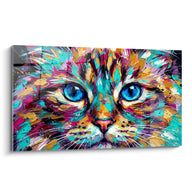

Direct printing vs mounted print: which should you choose?
October 11, 2025 · 17 min read · by Walensky
You have just fallen for this perfect artwork that will transform your living room, but when you finalize your order, you come across these mysterious technical terms: "direct printing" or "mounted print". Your enthusiasm instantly turns into anxiety.
You already picture the painting arriving at your home, hanging it with pride, then discovering a few weeks later that it peels, warps, or that the colors fade prematurely. Could this simple technical decision ruin your art investment?
You have probably already tried to research online, but between incomprehensible technical explanations and contradictory reviews on forums, you are even more lost than before. Every seller seems to promote their own method without really explaining why.
It's perfectly normal to feel disoriented! These technical terms actually hide fundamental differences that directly affect the durability, aesthetics, and value of your future purchase. The problem is not your lack of knowledge, but the absence of clear and honest explanations.
By the end of this article, you will fully master these two printing techniques, you will instantly know which one to choose according to your needs, and you will be able to invest with confidence in the painting that will adorn your walls for decades.
Why does this decision determine your painting's future?
Your choice today shapes how your interior will look for the next 20 years. A poor technical choice can turn your artistic crush into a daily source of frustration. It's like choosing between concrete or sand foundations for your house: the effect shows over time, but by then it's too late to go back.
🎨 Testimony from Sarah, interior architect: "I ordered a magnificent abstract painting for a client's entrance hall. Three months after installation, micro-bubbles appeared on the surface. The result was spoiled, and I had to explain to my client that the problem came from the wrong printing technique. A costly lesson that taught me to dig into these technical details!"
A conversation with a decor expert
Golden rule of wall art: The printing technique determines 70% of the final visual impact, far more than the format or even the frame. Once hung, you will notice the difference every day for years. Allow 3 to 6 months for your eye to fully adjust to the chosen rendering.

Let's uncover what really lies behind your hesitations
You probably feel this nagging frustration when comparing options: either you are tempted by the cheaper one without knowing what you sacrifice, or you hesitate to invest more without understanding the added value, or you postpone your purchase altogether for fear of making a mistake.
This confusion actually comes from a chronic lack of transparency in the decorative art market. Sellers often use these technical terms as marketing arguments without explaining their concrete impact on your daily life. It's like buying a car knowing only its color!
Imagine buying a smartphone solely for the beauty of its case, without knowing the processor's performance. That is exactly what happens with printing techniques for paintings : the invisible technical aspect determines the final user experience.
The truth about direct printing that no one tells you
Contrary to popular belief, direct printing is not a "low-end" technique. It is in fact the method favored by contemporary artists and prestigious galleries for a simple reason: it preserves the textural authenticity of the original artwork.
Think of the difference between touching real oak parquet and a perfectly imitated laminate. Direct printing is the authentic parquet : it retains micro-reliefs, grain nuances, and that natural "breathing" of the support that brings the image to life.
This authenticity transforms your daily relationship with the artwork. Instead of owning a "reproduction," you possess an artistic object that interacts with natural light and reveals different details depending on the time of day and viewing angle. Your living room becomes a living gallery.
🔍 Revealing test: Get within 30 cm of a direct-printed painting and observe it from different angles. You will distinguish the texture of the support creating play of shadow and light impossible to reproduce on a perfectly smooth surface. It is this "breathing" that makes all the difference!
The secret of mounted printing that dealers keep to themselves
Mounted printing is not just "an extra protection." It is a complete transformation of the artwork that shifts it from the artisanal realm to the ultra-sophisticated universe of contemporary design.
It's like the difference between an ancient manuscript and its version in a modern book: the content remains identical, but the reading experience changes radically. Mounting enhances fine details and creates a striking sense of depth.
This technique reveals color nuances invisible to the naked eye on direct printing, particularly in gradients and shadow areas. Your artwork gains dramatic intensity and presence, as if it were lit from within.
The factor 90% of buyers completely overlook
The real difference lies neither in beauty nor quality, but in the interaction with your luminous environment. Sarah, a decorator in the 7th arrondissement, discovered this the hard way: "My mounted painting looked magnificent in the showroom, but at my client's place, the constant reflections made it unreadable from the sofa!"
You can anticipate this phenomenon by observing how light moves through your room at different times of the day. A window facing the future location? A reading lamp nearby? These elements determine your optimal technical choice.
This light interaction subtly influences your daily mood. A poor technical choice can create a subtle but constant visual discomfort, like background noise that tires you without you realizing it.
🔍 3 signals your environment reveals:
- Direct frontal light: Favor direct printing, which absorbs stray reflections better and avoids the annoying "mirror" effect
- Indirect, soft lighting: Mounted printing excels in these conditions by revealing its full depth without glare
- Significant light variations: Direct printing adapts better to changes and keeps its charm from morning to night
The trigger factor that changes everything
The real selection criterion is your deep decorative intention. Do you want your painting to be a "chameleon" that blends harmoniously (direct printing) or a "star" that instantly captures attention (mounted printing)? This is the leverage effect: this technical choice amplifies your decorative vision in one direction or the other. Observe the artworks that strike you in the places you visit: galleries, restaurants, hotels... Your natural preference will guide you instinctively.
Law of decorative harmony: A painting should extend the soul of your interior, not compete with it. Test this rule by imagining your artwork in your living room: do you see it as a natural complement or as a dramatic focal point? This visualization gives you the technical answer immediately.
| ❌ Common misconception | ✅ Technical reality | 💡 Why this difference | 🎯 Impact on your daily life |
|---|---|---|---|
| The more expensive, the better | Each technique excels in its own domain | The price reflects complexity, not superiority | You invest in the technique that suits you |
| Lamination offers better protection | Both offer excellent durability | Protection and aesthetics are independent | You choose based on your taste, not your fears |
| Direct printing yellows over time | Modern inks are ultra-stable | Earlier generations had this flaw | Your painting keeps its colors for 20+ years |
| The technique must match your decor style | Emotion outweighs convention | Art transcends decorating rules | Your love at first sight guides your technical choice |

Our selection
Geometric abstract painting - Neural Fusion - collage edition
$233.90
Discover this paintingThe simple method to choose in 5 minutes flat
Rest assured, you don't need to become a printing expert to make the right choice! This decision follows a simple logic, much like choosing between an open-plan kitchen or a closed one: it all depends on your lifestyle and your priorities. By following this natural progression - analyze, test, decide - you will gain absolute certainty that your choice is the right one, and you will enjoy explaining your decision to your guests!
🎯 Your 3-step action plan: First, we will identify your personal "decor profile" (5 minutes), then we will test the desired visual effect with your current lighting (3 minutes), and finally we will validate your choice with a long-term projection (2 minutes). At each step, you gain confidence and clarity in your final decision.
Step 1: Discover your natural decorative signature
Before choosing a technique, let's identify your decorative DNA. It's like discovering your clothing style: once you know it, all your choices become obvious! This step will spare you regrets and give you the deep satisfaction of having made a choice perfectly aligned with your personality.
Your personal diagnostic "tools"
- Your smartphone: To photograph your current walls under different lighting. The lens captures details your accustomed eye no longer notices. Take 3 photos: morning, midday, evening. Avoid flash, which distorts colors, and favor the available natural light.
- Your 3 favorite decor objects: They reveal your unconscious style. Observe their textures: smooth and modern, or authentic and textured? This tactile preference directly guides your printing choice. Ignore the color and focus solely on the surface finish.
- An inspiring reference image: Find an interior that makes you dream on Pinterest or Instagram. Analyze why it appeals to you: is it the clean sophistication or the warm authenticity? This emotion indicates your natural printing technique.
Now, let's move on to the concrete diagnosis of your profile:
Reveal your style in 3 questions
Question 1 - Your relationship with perfection: Look at your kitchen and bathroom. Do you favor ultra-smooth surfaces (quartz countertops, glossy tiles) or do you accept charming "imperfections" (slightly irregular subway tiles, raw wood)? This preference directly reveals your natural technical affinity.
⏱️ Time: 2 minutes | ✅ Success when: You clearly identify your dominant tendency | ⚠️ Warning: Don't overthink, trust your first instinctive reaction
Question 2 - Your relationship with light: In which environment do you feel best? Soft, cozy lighting (a Parisian café, a hushed library) or bright, dynamic lighting (an industrial loft, a modern art gallery)? Your light preference determines the technique that will enhance your daily life.
⏱️ Time: 1 minute | ✅ Success when: You precisely visualize your ideal atmosphere | ⚠️ Warning: Think of your places of well-being, not trends
Question 3 - Your vision of luxury: What impresses you most? A unique handcrafted object with its small human irregularities, or a manufactured product with a flawless finish? This philosophy of beauty automatically guides your technical choice between authenticity and perfection.
⏱️ Time: 2 minutes | ✅ Success when: You fully embrace your preference without judgment | ⚠️ Warning: There is no "right" answer, only your truth
✅ Profile validation: If you lean toward the authentic, the cozy and the handcrafted, direct printing naturally suits you. If you value perfection, modernity and visual impact, lamination matches your sensitivity. If in doubt, note your answers and reread them tomorrow: your choice will become clearer with hindsight.
Step 2: Test the real effect in your space
Now that you know your profile, let's check the harmony with your current environment. This step turns your intuition into objective certainty. It's like trying on a garment after choosing it from a catalog: you confirm that reality matches your expectations and you anticipate the final result with precision.
In-situ simulation
Reflection and texture test: Place a pocket mirror at the spot planned for your painting. Observe the reflections at different times of day. If they bother you regularly, direct printing will avoid this problem. If the lighting remains soft, lamination will enhance your artwork without glare.
⏱️ Time: 1 day of observation | ✅ Success when: You clearly identify the moments of visual discomfort | ⚠️ Warning: Test from all your usual viewpoints (sofa, table, passageway)
Decorative integration test: Print your image on regular photo paper and on glossy paper. Temporarily stick them to the wall and live with them for 48 hours. Does one feel more "at home" to you? This preference revealed in your daily life confirms your optimal technical choice.
⏱️ Time: 2 days of observation | ✅ Success when: One of the two versions seems obvious to you | ⚠️ Warning: Ignore the difference in size, focus on the surface effect
Step 3: Validate your choice with a long-term projection
This final step turns your current choice into a decision you can stand behind for years to come. You will visualize your future satisfaction and eliminate the last doubts. It's the equivalent of imagining yourself in your future home before signing: you confirm that this choice suits you over time and you fully embrace your artistic investment.
Projecting into the future
The 5-year test: Imagine yourself in 5 years, proudly showing your painting to a dear friend. What do you tell them? "I love this authentic texture that changes with the light" (direct printing) or "Look at this color intensity, this perfection of rendering" (lamination)? Your imagined pride reveals your true choice.
⏱️ Time: 3 minutes of visualization | ✅ Success when: One scenario spontaneously excites you | ⚠️ Warning: Trust your enthusiasm, not logic
The decor change test: If you completely changed your furniture tomorrow, would your painting adapt? Direct printing adapts better to stylistic changes, while lamination asserts its character more strongly. Choose according to your predictable decorative stability.
⏱️ Time: 2 minutes of reflection | ✅ Success when: You identify your decorative constancy | ⚠️ Warning: Think of your past decor changes, not your passing wishes of the moment
Final validation rule: Your choice is validated when you can explain it simply in one sentence. "I chose X because..." If the explanation feels natural and obvious, you have found your technique. If you have to search for your words, keep testing until you reach absolute clarity.
You now master the fundamentals; let's explore the subtleties that will make you a discerning connoisseur. These expert details will let you converse on equal terms with professionals and optimize your artistic investment. You join the select circle of informed buyers who truly understand what they are acquiring.
💎 Gallery owner's secret: The real cost difference between the two techniques never exceeds 20% of the final price. If a salesperson offers you a larger gap, they are either overvaluing one technique or underestimating the other. This knowledge gives you negotiating power and protects you from classic commercial scams.
"What if I still make the wrong choice?"
"I'm afraid I'll regret my decision once the painting is hung at home..."
This concern is entirely legitimate and shows your awareness of how important this choice is! The good news is that this method eliminates 95% of the risk of regret. Think of the last major purchases you made using a considered method: how often did you truly regret them? Regrets come from impulsive purchases, not methodical decisions. Moreover, both techniques offer exceptional quality: you are choosing between two excellences, not between good and bad!
🎯 Anti-regret insurance: Photograph your decision-making process (your tests, your notes, your reflections) before ordering. This "archive" of your reasoning will remind you of the good reasons behind your choice if any doubt arises after installation. It's your personal "confidence kit"!
— Also worth discovering


The 5 pitfalls to absolutely avoid (even experts fall into them)
Beware, these mistakes can turn your artistic investment into a source of lasting frustration. Even professional decorators sometimes fall into these traps, so don't blame yourself if you had them in mind! Knowing these pitfalls places you in the top 10% of discerning buyers.
- 🚫 The "showroom test" trap: Relying solely on the effect seen in a store or on a screen. Commercial lighting is designed to flatter every product! At home, variable natural light will reveal different aspects. That is why our at-home tests are essential. This mistake affects 80% of first-time buyers.
- 🚫 The over-technicality error: Choosing based on technical specifications rather than emotion. You are buying a work of art, not a piece of equipment! Technical data guarantees quality, but your feeling guides the right choice. Trust your instinct once you have ruled out the technical aspects.
- 🚫 The "more expensive means better" syndrome: Believing that lamination is always superior. It's like believing a Ferrari is always better than a bicycle: it all depends on the use! For certain styles and certain environments, direct printing far surpasses lamination. The price reflects complexity, not absolute superiority.
- 🚫 The rush of the trend: Choosing according to the current fashion rather than your deep tastes. Decor trends change every 3-5 years, but your painting will accompany you for 20 years! Always favor your personal authenticity over passing fashions. Your future self will thank you.
- 🚫 The forgotten light shift: Failing to anticipate seasonal lighting changes. Your summer living room doesn't have the same brightness as your winter one! Test your choice over several weeks to confirm it stays harmonious in all conditions. This is especially crucial for rooms facing north or south.
🛡️ Your final safety checklist: Before confirming your order, check these 4 points: You've tested the lighting at different times of day, your choice matches your identified decor style, you can explain your decision in one simple sentence, and you can happily picture yourself living with this painting in 5 years. Warning sign: if you're still hesitating, take 48 extra hours to think it over.
— In the same spirit


Your essential technical questions
Direct printing requires 3-5 business days, mounted printing 5-7 days (mounting adds 2 days of drying and finishing). On budget, expect a 15-25% surcharge for mounting depending on the size. To optimize: order during quiet periods (avoid November-December) and group your orders to negotiate. Concrete example: a 40x60cm direct print at €89 will cost roughly €105-110 mounted.
The difference is immediately visible, even to a beginner! It's like comparing a matte photo and a glossy one: the visual impact stands out within seconds. Mounting gives a "luxury showroom" look, direct printing a "authentic gallery art" rendering. Your natural aesthetic preference will guide you instantly; no technical expertise is required.
Not at all! Both techniques use the same secure hanging system. The weight varies by less than 200g between the two (negligible for fixing). Your wall and anchors stay the same. The only difference: since mounted prints are more rigid, they tolerate slight wall unevenness less well, but this remains invisible at normal viewing distance.
Both techniques offer equivalent protection against humidity and UV for 20+ years in a normal interior. Mounting adds no significant protection: it's a commercial myth! Modern inks and substrates are already highly resistant. Simply avoid direct sunlight for 6+ hours a day and extreme humidity (bathroom without ventilation), whatever your technical choice.
As long as production hasn't started (usually 24-48 hours after ordering), it's possible at no extra cost. Once printing has begun, it's technically impossible. That's why this choosing method matters! If you have last-minute doubts, contact customer service immediately. Pro tip: some craftsmen offer a 10x15cm "test sample" for €15-20, refunded against the final order.
Your new expertise opens the doors to decorative art
In a few weeks, when your guests admire your painting and ask "where did you find this marvel?", you'll glow with deep satisfaction. You won't just say "online": you'll passionately explain why you chose this specific technique, how it enhances your interior, and why this choice suits you perfectly. Your view of decorative art has changed for good.
This technical mastery goes far beyond buying a simple painting. You've developed an expert eye that will serve you for all your future artistic investments: posters, photographs, reproductions... You now know how to decode techniques, assess prices, and above all trust your informed judgment. Your confidence in decor has reached a new level.
The best part? You just need to choose your artistic favorite and apply your method. No more technical stress, just the pleasure of aesthetic discovery! Your first step: revisit the works that tempted you before reading this article. You'll see them with completely new eyes, and your final choice will be all the more right and assured.
🌟 Your art of living starts now: You're joining the circle of discerning collectors who invest with full knowledge. This expertise is your key to years of artistic pleasure without regret. Your interior deserves this excellence, and you now have all the keys to give it to them!
Also read: 🎓 Explore our guides on artistic materials
— Other selected pieces


Explore our collections


