

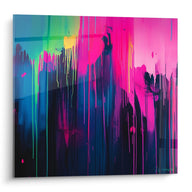

Geometric abstract painting for collaborative workspaces: boosting team creativity
8 min read · by Walensky
MEETING ROOM PAINTING
Ten o'clock in the morning, open-plan office. Three teams cross paths between the coffee machine and the brainstorming area, each with its own energy. On the back wall there is nothing — just white, visual silence, and glances that don't know where to land when an idea is trying to come out.
This is precisely where a geometric abstract painting changes everything. Not as decor ticked off an office fit-out list, but as a visual landmark that structures the space and brings everyone together without a single word being spoken.
The paintings presented here are original digital creations, designed exclusively by Walensky's artists, then printed in North America on acrylic glass or Alu Dibond — never on canvas, never as one-off pieces.
- An open-plan office is managed by zones: brainstorming, focus, break — each can have its own geometric identity.
- Size matters more than the motif: visible from several desks, the painting must take up a real place on the wall.
- Converging lines and symmetrical compositions encourage group concentration, while fragmented shapes spark brainstorming.
Why the collaborative workspace needs a strong visual identity
An open-plan office is not a contemporary-style meeting room scaled up. It is a flow: people passing through, stopping, leaving, changing desks three times a day in flex office. In this shifting context, a bare wall is not neutral — it is absent, and that absence is felt in the way teams cross paths without ever really meeting.
Abstract geometric art answers a specific need: giving a shared visual anchor to teams that don't always share the same job, rhythm, or desk from one day to the next. A strong geometric composition becomes a common reference point, a bit like a village square in the middle of a neighborhood that is always on the move.
In a space without partitions, it is often an image that acts as a wall — without ever blocking circulation.
Unlike a closed room where a single painting can fill a single wall, the open-plan office demands thinking in several viewpoints: from the entrance, from the workstations, from the brainstorming area. Abstract geometric art plays a different role here than elsewhere: it becomes a transversal visual language, not a simple decorative touch.

Favorite
Interlacing Colors Painting - Geometric Abstract Edition
From $273.90
Discover this paintingCriteria for choosing a painting suited to a shared space
The right painting for a collaborative space is chosen with criteria very different from those of a living room or an individual office — just as an urban architecture painting for a design meeting room follows its own requirements. Here, collective visibility takes precedence over personal taste.
Format and visibility from several desks
An open-plan office is crossed with the eye at several meters' distance. A modest format gets lost in the space and serves no landmark function. Aim for an L format (120x70 cm) or larger — XL, XXL, even 2XL depending on the length of the wall to be dressed — so it stays readable from the far end of the room.
Color palette and consistency with brand identity
Color psychology is not a marketing gimmick in this context: blue and green soothe concentration zones, while warm tones like terracotta or orange energize exchange spaces. The palette choice must also converse with the brand identity — logo, graphic charter, materials already present in the premises.
- Blue, white, light grey: calm zones, individual focus within an open-plan office.
- Terracotta, orange, turquoise: brainstorming zones, energy and stimulation.
- Black and white, sharp contrasts: passageways, circulation, reception.
Under strong natural light, facing a floor-to-ceiling window typical of a modern open-plan office, favor Alu Dibond: its matte surface avoids the glare that hampers reading the painting from distant desks.
For a turquoise and orange palette that instantly reenergizes a passage zone, the Interlacing Colors painting plays that card with a deliberately mosaic composition.
— Our selection


Creating distinct zones through geometric art
In a flex office, physical partitions no longer exist — or almost not. Wall art takes over to signal that you are changing zones without needing a door or a sign.
A painting with soft lines, beige and green tones in a cubist-like composition naturally marks a zone of silent focus. A painting with livelier contrasts and fragmented shapes, on the other hand, signals a brainstorming zone where speech flows freely.
This zoning logic through imagery works just as well in a thirty-desk open-plan office as in a small flex office. The essential thing is to keep overall coherence: geometric styles that converse with each other, even if they are not identical. One can also draw on the collection of geometric paintings to compose a visual journey consistent across the different zones.
— Also to discover


Fostering collective creativity: the role of shapes and composition
A line converging toward a single point attracts the eye and, with it, collective attention. This is exactly what a team in the middle of a brainstorming session seeks: a focal point that channels gazes without imposing an idea.
Compositions with visual convergence — lines meeting, shapes pointing toward a center — create a dynamic different from calm, symmetrical motifs. The latter tend rather to foster team cohesion over time, a sense of shared stability more than a momentary creative peak.
A converging composition converges ideas. A balanced composition holds the team together.
The Convergence Points painting, in black and white, illustrates this principle well: its title says it all about its function in a brainstorming space, where the intensity of contrasts captures attention without ever saturating it.

In the same spirit
Luminous Intergalactic Orchestra Painting - Abstract Edition
From $273.90
Discover this painting →2026-2027 trends for modern collaborative spaces
Printing on Alu Dibond is increasingly established in largely glazed offices, where natural light abounds all day long. Its matte surface, free of reflections, keeps the painting clearly readable at any hour.
Another notable evolution: the deliberate mix of several geometric styles within one open-plan office, provided a common chromatic thread is kept. For example, a minimalist beige and white composition in the focus zone is paired with a more contrasted piece in the brainstorming zone — like two movements of the same score.
The technological register also appeals to innovation-oriented companies: motifs evoking circuits or digital structures, in blue and green, echoing the identity of a product or tech team without falling into the corporate poster cliché.
What type of painting for a collaborative space?
A wide format (120x70 cm minimum), a geometric composition readable from a distance, and a palette tied to the company's visual identity. Avoid motifs that are too detailed, illegible from the far end of an open-plan office.
How can art foster creativity at work?
By offering a neutral visual focal point, with no message to decode, that frees attention rather than demanding it. Compositions with visual convergence are particularly stimulating for collective brainstorming sessions.
What painting size should you choose for an open-plan office?
Count on a format occupying 60 to 75% of the available wall width. For a large open-plan office wall, XXL (160x90 cm) or 2XL (180x100 cm) formats keep their impact even when seen from afar.
Should paintings be harmonized across several zones of the same office?
Yes, but without aiming for identical. Keep a common chromatic or stylistic thread — same base palette, same geometric spirit — while letting each zone express its own function, focus or brainstorming.
If you are looking for a more organic silhouette for a break zone, far from the pure lines of the open-plan office, the Geometric Poetry painting brings a welcome breath of air into a very structured journey.
The fit-out of a collaborative space is never played out solely on the paper of an architect's plan. It is also played out in what teams see every day when they look up from the keyboard. A well-chosen wall circulates ideas as surely as a staircase circulates people.
To compose your own visual zones, the meeting room painting collection remains a good starting point, to be completed with our article on colorful abstract painting for a creative meeting room and the entire abstract painting collection to vary the atmospheres from one zone to another.
Explore our collections


