


How did Chinese painters use emptiness to represent cosmic immensity?
April 20, 2026 · 9 min read · by Walensky
I remember that November morning in Shanghai, in the hushed studio of a centenarian calligraphy master. On an ivory silk scroll stretched a strange landscape: a few strokes of black ink forming a mountain, a twisted pine, and... nothing. Square meters of void. "What you don't see," he murmured with a smile, "is precisely what contains the entire universe." That revelation transformed my understanding of space in our contemporary interiors.
Here is what the philosophy of emptiness in Chinese painting brings to our living spaces: a visual breath that expands perspectives, a spiritual depth that soothes the mind, and a timeless elegance that transcends passing trends. Three millennia-old principles that our overcrowded interiors have desperately forgotten.
We accumulate decorative objects, multiply frames, saturate our walls. We fear emptiness as if visual silence were a compositional mistake. Yet the great Chinese masters understood more than a thousand years ago what our architects are rediscovering today: emptiness is not an absence, it is an invisible presence that gives meaning to the visible.
In this article, I take you into the studios of the Song and Yuan dynasties, where this revolutionary aesthetic was forged. You will discover how these painters transformed negative space into a tool for cosmic representation and, above all, how to integrate this ancestral wisdom into your current decorative choices.
Emptiness as vital breath: understanding Qi in composition
Imagine a six-meter vertical scroll. At the top, a few brushstrokes suggest snowy peaks. At the bottom, a tiny boat on a riverbank. Between the two? Paper, immaculate and untouched. To a Western eye, it is an unfinished painting. To a Song dynasty scholar, this is precisely where Qi resides, the vital breath that animates all things.
Chinese painters did not seek to fill space but to free it. In their cosmology, emptiness is not nothingness: it is the matrix from which all forms emerge. When Guo Xi painted his monumental landscapes in the 11th century, he deliberately left entire portions of blank silk. These spaces represented the morning mist, the ether between heaven and earth, that elusive dimension where universal energy circulates.
In our interiors, this principle translates into a golden rule I apply systematically: for every strong visual element, plan three times its equivalent in neutral space. A large nature painting gains power when it breathes on a bare wall, free of visual competition within a radius of one and a half meters.
The 'three distances' technique for creating infinite depth
Chinese landscape masters codified a fascinating method for representing immensity: the theory of the three distances (san yuan). The high distance shows distant mountains seen from below. The deep distance looks toward the horizon through several planes. The level distance follows the contours of a valley.
The genius? Using emptiness to separate these three zones. Between the detailed foreground and the distant mountains, nothing. Or rather: the mist, the clouds, the atmospheric space. This void creates a dizzying depth, as if the gaze could travel to infinity. No progressive gradient, no geometric perspective: just islands of matter floating in immensity.
In a contemporary wall composition, this lesson is precious. Instead of aligning several frames at regular intervals, create asymmetrical breathing spaces. Leave an entire wall empty to magnify a single artwork on the adjacent wall. Emptiness then becomes what it was for Chinese painters: a cosmic connector between the visible elements.
Ink and water: when technique meets philosophy
In the traditional Chinese studio, the painter has only four tools: brush, ink, water and support. No colors to saturate the space, no thick matter to fill it. This austerity is not a constraint but a liberation. Ink diluted in water creates infinite nuances between absolute black and the immaculate white of the paper.
Painters played on these tonal variations to suggest distance and materiality. Nearby mountains received dense strokes, loaded with saturated ink. Distant peaks were merely a grey mist, almost transparent. And beyond? Pure emptiness, which the eye naturally interprets as boundless expanse. The white of the paper becomes sky, fog, ether, cosmic void.
This economy of means finds a striking echo in contemporary Scandinavian or Japanese design. A natural linen sofa against a white wall, a single metal pendant lamp, a monochrome painting: no chromatic overload, just subtle variations around a restricted palette. Chromatic emptiness, like spatial emptiness, allows the eye and the mind to rest.
The principle of the 'unpainted': when absence becomes presence
My greatest revelation came before a work by Ma Yuan, nicknamed 'Ma the Corner' because he concentrated his entire composition in one corner of the scroll. On a parchment one square meter in size, his painted elements occupied barely a quarter of the surface. The rest? Absolute emptiness. Yet this emptiness told more than any detail could have.
In a famous scene, a scholar contemplates the moon from a terrace. The moon itself is not painted. It is the emptiness above the mountains that suggests it. The viewer 'sees' it through its absence, projecting imagination into this undefined space. Emptiness becomes here a space of co-creation between the artist and the one who looks.
Transposed into our interiors, this principle calls for radical simplicity. An entrance console should carry only one remarkable object, not a cluttered collection. A gallery wall gains impact when half the frames are removed. I have guided dozens of clients through this difficult exercise: subtract to reveal, empty to amplify. The results are always spectacular.

Favorite
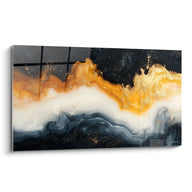
Golden Foliage Painting in Black and White - Vertical Perspective Toward the Celestial Vault - Ginkgo Edition
$233.90
Discover this paintingMountain and water: the dialogue of fullness and emptiness
The Chinese term for landscape is 'shanshui': mountain-water. This duality is no accident. The mountain represents yang, the active, solid, visible principle. Water embodies yin, the receptive, fluid principle, often suggested by... emptiness. In classical paintings, rivers are rarely depicted in blue or with detail. They are white spaces winding between rocky masses.
This brilliant convention forces the viewer to mentally complete the image. The river-void flows in their imagination, creating movement within a static composition. The Song painters mastered this alchemy: they painted the stable and let emptiness depict the moving, the elusive, the eternal change.
In interior decoration, this dialectic translates into a balance between solid architectural elements and fluid spaces. A massive dark wooden piece dialogues with a bare white wall. A crowded bookcase finds its counterpart in a cleared zone. Emptiness does not oppose fullness: it completes it, reveals it, gives it its full measure.
Temporality in emptiness: representing eternity
Chinese horizontal scrolls are 'read' from right to left, unrolled progressively. The viewer travels through the landscape, crossing populated areas and then empty expanses. These blank passages are not neutral transitions: they represent flowing time, distance traveled, the hours of walking between two valleys.
Emptiness thus becomes a temporal dimension. It slows the gaze, creates contemplative pauses, establishes a rhythm. A ten-meter scroll can narrate a journey of several days, where the voids embody nights spent, crossings through fog, moments of pure presence in the world.
This rhythm finds a direct application in the layout of an apartment. Circulation spaces should not be cluttered but treated as 'active voids', soothing transitions between functional rooms. A minimal corridor becomes a breath, a decompression chamber. Architectural emptiness, like pictorial emptiness, structures the experience and gives it meaning.
— Our selection


Integrating the philosophy of emptiness into your contemporary decor
Let us return to essentials: how can these millennia-old principles concretely transform your living space? The answer rests on three simple yet radical gestures. First, identify your focal element in each room. That nature painting you love, that antique console, that design armchair. Then, create around it a protective zone of emptiness. Clear away the stray small objects, free the adjacent walls.
Second gesture: accept the bare wall as a positive value. In classical Chinese thought, emptiness is not a lack to be filled but a richness to be preserved. A stretch of white wall does not desperately await a frame: it offers the eye a space of rest, a visual breath. It optically enlarges the room and enhances the rare elements present.
Third principle: cultivate asymmetry and unpredictability. Chinese compositions avoid perfect symmetry, deemed rigid and artificial. An off-center sofa, a single painting on a large wall rather than three aligned ones, objects in odd numbers: these choices create a natural dynamic. Emptiness then becomes the space where the eye travels freely, unconstrained by predictable geometry.
I applied these principles in a hundred-and-twenty-square-meter Parisian loft. The client initially wanted to furnish every corner. I convinced him to leave a third of the space empty. The result? A doubled sense of amplitude, amplified luminosity, and this spontaneous comment from him: "We can finally breathe." Emptiness had brought cosmic immensity into his urban daily life.
Let immensity into your home
Discover our exclusive collection of nature paintings that embody this philosophy of meaningful emptiness, where each composition breathes and converses with the surrounding space.

— Also to discover


Emptiness as the ultimate luxury in contemporary living
In our societies of abundance, true luxury is no longer accumulation but subtraction. Possessing enough space to place nothing in it becomes the supreme privilege. Chinese painters understood this intuitively: in a world saturated with forms and stimuli, emptiness is the ultimate refinement.
This philosophy resonates powerfully with current concerns. Minimalism, Scandinavian lagom, Japanese ma: all these movements rediscover what the Song masters practiced in the 11th century. Fewer objects but better chosen, less decoration but more intentional, less saturation but more presence.
Imagine your living room tomorrow morning. Raking light reveals an immaculate white wall, a single large painting of misty mountains, a linen sofa and an architectural plant. Nothing else. You immediately feel this inner expansion, this breath that controlled emptiness provides. You have invited into your home a fragment of cosmic immensity.
Chinese painters did not seek to capture the visible world but to open a window onto the invisible. Their emptiness was not a technical absence but a spiritual presence. By adopting even a fraction of this wisdom in your decorative choices, you transform your home into a space of contemplation, where the eye and the soul can finally travel freely.
Start small: remove three decorative objects this week. Observe how the space expands, how your gaze glides differently over the freed surfaces. The emptiness you create is not a lack but an invitation. An invitation to breathe, to dream, to touch the cosmic immensity that Chinese masters knew how to summon with a single brushstroke.

Frequently asked questions
Why did Chinese painters leave so much emptiness?
In their cosmology, emptiness is not nothingness but the matrix from which all forms emerge. This is where Qi, the vital breath, circulates. Guo Xi left entire portions of blank silk to depict the morning mist and the ether between heaven and earth.
What is the theory of the three distances in Chinese painting?
The high distance shows distant mountains seen from below, the deep distance looks toward the horizon through several planes, the level distance follows the contours of a valley. Emptiness separates these three zones and creates a dizzying depth, without geometric perspective or progressive gradient.
How do you apply the philosophy of emptiness to a wall of paintings?
Instead of aligning several frames at regular intervals, create asymmetrical breathing spaces and leave an entire wall empty to magnify a single artwork on the neighboring wall. The rule applied: for every strong visual element, plan three times its equivalent in neutral space.
Why are rivers rarely painted in blue in China?
Chinese landscape is called shanshui, mountain-water. The mountain represents yang, solid and visible; water embodies yin, often suggested by emptiness. Rivers are white spaces winding between rocky masses, which the viewer completes mentally.
Explore our collections


