

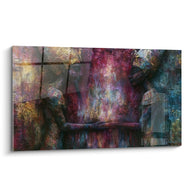

The first time I held a drill core in my hands, in the basement of the Natural History Museum, I understood that I was literally holding time. Every stratum, every shift in color told a story of millennia compressed into a few centimeters. That revelation obsessed me for years: how could I capture this temporal majesty within a wall space?
Here is what the depiction of geological time brings to your interior: it turns a wall into a journey through the ages of the Earth, anchors your space in a dizzying sense of depth, and creates a meditative focal point that transcends fleeting trends. Because when you contemplate 4.5 billion years condensed into a single composition, your daily worries take on an entirely different scale.
Are you fascinated by geology, layered landscapes, and the canyons that reveal the history of our planet? Do you dream of bringing this cosmic dimension into your decor but don't know where to begin? Are you worried the result will be too didactic, too scientific, not beautiful enough for your living room?
Rest assured. Geological time offers an endless wealth of visual richness. Contemporary artists have developed sophisticated approaches that blend scientific rigor with evocative power. I'm going to reveal the time-honored method that allows entire eras to be condensed into a single artwork.
I promise that by the end of this article, you will know exactly how to choose and integrate a stratigraphic composition into your interior, and why this approach will transform your relationship with space and time.
Artistic stratigraphy: when the layers tell the story
The stratigraphic method is the key to representing geological time within a single composition. Drawn directly from geological science, this approach involves layering distinct visual strata, each evoking a specific geological period.
I discovered this technique during an artist residency in Iceland, where coastal cliffs expose millions of years of volcanic history. Icelandic artists master the art of translating these temporal strata into striking wall compositions. Each layer has its own texture, its own color palette, its own symbolic thickness.
In a successful stratigraphic composition, the lower layers typically represent the oldest periods: reddish Precambrian earths, deep gray Archean tones. Moving upward, the hues evolve, sometimes lightening, recounting the oxygenation of the atmosphere, the emergence of life, the great extinctions.
This method allows you to condense geological time intuitively. Our eye naturally reads from bottom to top, following the thread of time the way an archaeologist deciphers an excavation site. The beauty lies in this immediate legibility, paired with infinite complexity on close examination.
The three fundamental principles of visual stratigraphy
To create or choose a piece that authentically represents geological time, three principles are essential. First, temporal continuity: each stratum must flow logically into the next, without abrupt breaks that would disrupt the narrative. Transitions can be sharp (marking cataclysmic events) or gradual (slow evolutions), but always coherent.
Next, textural variation plays a crucial role. In my collaborations with geologist-artists, I learned that each period has its own material signature. The Carboniferous calls for organic, compressed textures. The Cretaceous evokes smooth limestones. These textural variations enrich the representation of time well beyond simple color.
Finally, respect for temporal proportions, even when stylized, anchors the composition in geological truth. The Precambrian accounts for 88% of Earth's history: an honest composition will give it a dominant presence. This rigor distinguishes a true stratigraphic artwork from a mere succession of decorative bands.
The color palette of the ages: decoding the colors of time
Each geological era has its own chromatic signature, shaped by its dominant minerals and the atmospheric conditions of the time. Understanding this temporal palette will help you choose an authentic composition that faithfully represents geological time.
The hues of the Precambrian range from anthracite gray to ferrous reds and basalt blacks. This ancient period, when the Earth was a volcanic cauldron without oxygen, translates into dark, almost metallic tones. In a wall composition, these layers often form the base, dense and mysterious.
The Paleozoic introduces deep greens and organic browns, traces of the first massive Carboniferous forests that would become our coal deposits. This era saw an explosion of life, and artists sometimes incorporate motifs suggesting giant ferns or fossilized trilobites.
The Mesozoic, the age of dinosaurs, is adorned with beige limestones, ochre sandstones, and white chalks. These marine sediments bear witness to a warm climate and shallow seas. In a stratigraphic composition, this period often brings luminosity, a welcome contrast after the dark depths of the ancient eras.
Finally, the Cenozoic, our era, is rendered in rich brown earths, yellowish loess, and sometimes gray volcanic ash. This uppermost layer, the thinnest, reminds us of our fleeting presence on the geological scale. A lesson in humility that I especially love in these compositions.

Beyond science: the emotion of deep time
What fascinates me about the depiction of geological time is its capacity to provoke what the Anglo-Saxons call deep time awe: that feeling of vertigo and wonder mingled together when faced with the immensity of time.
I installed a large stratigraphic composition in the office of a Parisian startup director. Six months later, she told me that contemplating these temporal layers during stressful moments helped her gain perspective. When you visualize 4.5 billion years, a difficult quarter regains its proper proportions.
This meditative dimension makes stratigraphic artworks ideal centerpieces for spaces of reflection: libraries, offices, reading corners. Unlike figurative works that demand attention, a geological composition offers a contemplative support, a visual anchor that soothes without distracting.
Integrating it into different interior styles
Contrary to popular belief, geological time adapts remarkably well to a variety of decorative worlds. In an industrial interior, the raw textures and mineral tones of a stratigraphic composition resonate with concrete and steel. I recently installed a monumental stratigraphic artwork in a New York loft: the effect of coherence was striking.
For a Scandinavian style, opt for compositions with pared-down strata, dominated by the more recent periods: pale limestones and light sandstones, with a few dark touches in the depths. Nordic simplicity pairs perfectly with this minimalist approach to geological time.
High-end contemporary interiors readily welcome abstract stratigraphic representations, where scientific rigor gives way to a freer interpretation. Artists then play with horizontal formats evoking canyons seen in cross-section, creating spectacular pieces for large spaces.
Artistic techniques in the service of geological time
The method for representing geological time takes shape through a variety of artistic techniques, each bringing its own unique dimension. Multilayered acrylic painting allows translucent strata to be superimposed, creating a literal depth that mimics compressed sediments.
Some artists use authentic materials: stone powders, sands from different origins, metal oxides. I collaborated with a creator who incorporates genuine rock micro-fragments into her compositions, so each layer literally contains pieces of the era it represents. This material authenticity deepens the emotional connection.
The layered resin technique offers fascinating possibilities for representing geological time. By successively pouring layers of tinted resin, artists create three-dimensional depth. Light passes through these transparent strata, revealing different eras depending on the viewing angle, a perfect metaphor for archaeological work.
Photographic prints of real geological cross-sections offer a more documentary approach. Some photographers travel the world to capture spectacular cliffs, the Grand Canyon, the Irish coasts, the Atacama deserts, and transform them into strikingly realistic wall compositions.

Creating a dialogue between timescales
The most subtle aspect of the depiction of geological time lies in creating a dialogue between the Earth's deep time and our fleeting human time. In your interior, this tension becomes a daily source of reflection.
I like to pair a stratigraphic composition with deliberately ephemeral contemporary elements: houseplants whose life cycle is measured in months, candles that burn down in hours. This contrast of timescales creates a fascinating, almost philosophical dynamic.
Some collectors I work with choose to place their geological artwork facing a west-facing window. This way, the shifting daylight moves across the strata over the course of the hours, adding the daily solar rhythm to the narrative of geological eras. This layering of timescales turns the artwork into a cosmic clock face.
Format and placement: maximizing narrative impact
The format of a stratigraphic composition profoundly influences its ability to represent geological time. Vertical formats evoke the descent into the Earth's depths, like a drill shaft. This orientation is especially suited to narrow, tall spaces: entryways, hallways, between two windows.
Panoramic horizontal formats recall the geological cross-sections of canyons and coastal cliffs. They create a temporal frieze effect that guides the eye along the history of the Earth. I recommend this orientation for spaces above consoles, sofas, or dining rooms where the artwork accompanies guests.
For maximum impact, place your stratigraphic artwork at seated eye level if it sits in a resting space, or slightly higher in circulation areas. The goal: allow comfortable contemplation that invites a journey through time effortlessly.
Ready to anchor your interior in the depths of time?
Discover our exclusive collection of nature wall art that captures geological majesty and turns your walls into portals through time.
Your wall becomes a portal through time
Imagine yourself six months from now, comfortably seated facing your stratigraphic composition. Your fingers mentally trace the layers, from the dark Precambrian all the way to our thin film of the present. Each stratum tells you its story: mass extinctions, continental drift, the birth of the oceans.
This depiction of geological time is not merely a decorative element. It is a daily invitation to perspective, a reminder that we inhabit an ancient and living planet. In a world obsessed with the instant, contemplating 4.5 billion years condensed into a composition becomes an act of meditative resistance.
Start simply: choose your favorite palette of eras, identify the wall that will become your temporal window, and let the power of deep time transform your relationship with space. Geology does not merely recount the past; it anchors our present in a dizzying continuity that redefines our vision of home.
Your interior deserves this depth. Your gaze deserves this journey. The Earth has 4.5 billion years of stories to share: it is time to give them a place on your walls.
FAQ: Your questions about the depiction of geological time
Do I need to know geology to appreciate a stratigraphic composition?
Not at all, and that is precisely what makes the stratigraphic representation of time so accessible. The visual and emotional impact works on an intuitive level: we naturally perceive the superposition of layers as a temporal narrative, even without scientific knowledge. Your eye spontaneously reads from bottom to top, from the ancient dark tones toward the more recent layers. Over time, you will develop your own interpretation, your favorite strata, your questions. It is this gradual curiosity that makes geological compositions artworks that constantly renew themselves. Some of my clients have even discovered a passion for geology after living with such a piece for several months: daily contemplation naturally sparks the desire to learn more about the periods represented.
How can I tell a true stratigraphic composition from a simple succession of colored bands?
Excellent question, and it shows your sensitivity! An authentic representation of geological time can be recognized by several clues. First, the variation in layer thickness: true compositions respect (even in a stylized way) temporal proportions, with uneven layers reflecting the relative duration of each period. Next, observe the transitions between layers: they should tell something, since a sudden extinction translates into a sharp break, while a slow evolution creates subtle gradients. Textures also play a crucial role: each stratum should have its own materiality, evoking sediments, volcanic rocks, or organic deposits. Finally, a true stratigraphic composition has an overall chromatic coherence that evokes planetary history rather than a mere decorative exercise. Trust your intuition: faced with an authentic piece, you should feel a sense of temporal depth, almost dizzying.
What size should I choose for my first composition depicting geological time?
For a first purchase, I recommend a format that allows detailed contemplation without totally dominating the space, generally between 80 and 120 cm on the longest side. This scale offers enough surface for the geological strata to unfold with clarity, while remaining manageable for most interiors. A format that is too small risks reducing the layers to simple lines, losing the textural richness that gives a stratigraphic composition its soul. Conversely, a monumental format requires a dedicated wall and can feel intimidating in daily life during a first experience with this type of artwork. Also consider orientation: a vertical 100x60 cm format works perfectly in narrow spaces and tells the story of a journey into the depths, while a horizontal 120x60 cm evokes a cliff cross-section, ideal above a piece of furniture. The essential thing is that you can step closer to explore the details of each era, then step back to embrace the whole of Earth's history. This double reading is the very magic of represented geological time.


