

News ·
Aberystwyth: An Immersive Show on Kyffin Williams
In Aberystwyth, the National Library of Wales presents Profiad Kyffin Experience, a bilingual immersive show that brings to life and sets to music paintings by Sir Kyffin Williams. It opens to the public on Wednesday, November 18 and is set to run for three to five years.
By Walensky Editorial Team · 4 min read
- 10 people at a time in the show
- 200 oil paintings bequeathed to the library
- 1950 the year of the first purchase of an oil painting
The National Library of Wales, in Aberystwyth, opens to the public on Wednesday, November 18 with Profiad Kyffin Experience, a bilingual immersive show. It brings to life and sets to music paintings by Sir Kyffin Williams, who died in 2006. The show is set to remain at the library for three to five years.
Kyffin Williams is one of Wales's most important artists. He is known for his Welsh landscapes, painted in thick layers with a palette knife. The same immersive treatment has been given in recent years to Vincent van Gogh, Paul Cézanne, and David Hockney.
The show is set up in three rooms near one of the main entrances, with views of the town and the sea. It is smaller than the shows devoted to Van Gogh, Cézanne, and Hockney, and therefore more intimate: ten people at a time, and admission is free. Advance booking is strongly recommended.
Three rooms, from voice to matter
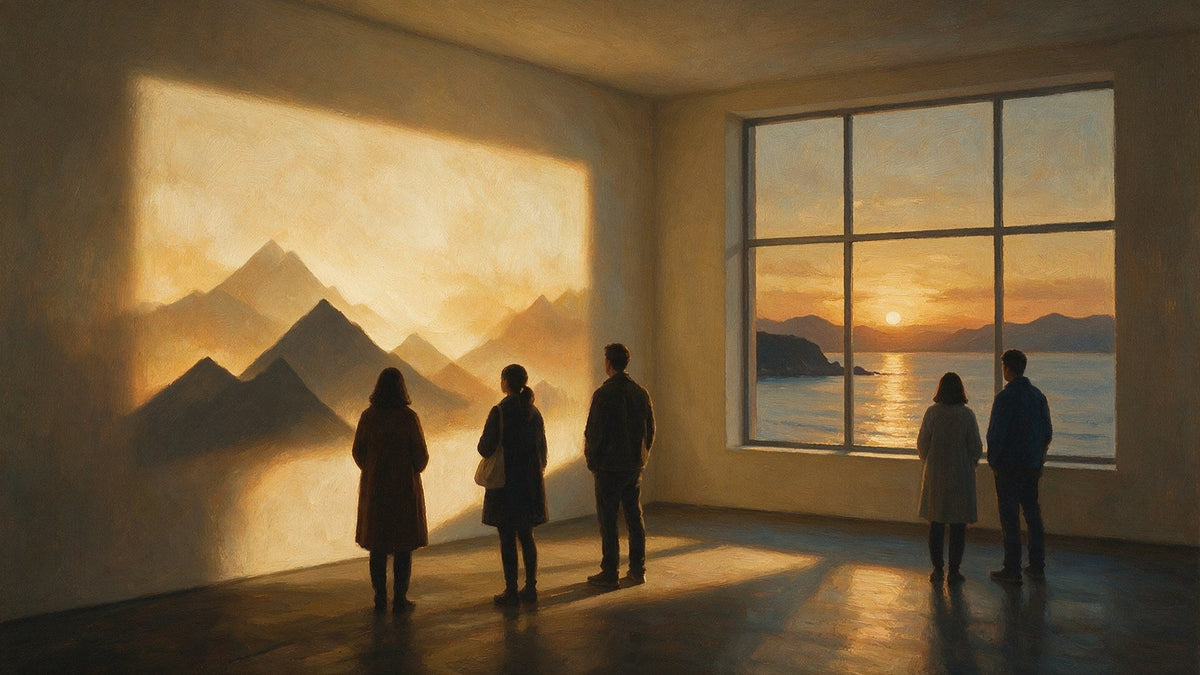
In the first room, Williams's career is presented by singer Sir Bryn Terfel, himself a major collector of his works. The second room projects landscapes, seascapes, and blocks of color onto the walls, floor, and ceilings, accompanied by a Welsh string trio playing chamber and folk music. Visitors can sit in this room or stand.
In the third room, a digital version of a Williams self-portrait can be touched: visitors can feel the thickness of the paint, especially dense at the mustache. On screen, farmers and sheepdogs cross rugged landscapes, waves seem to break within the room, and the sun sets into the sea.
Dennis Outten, managing director of Focal Studios, the show's main designer, explains that the challenge was to project the landscapes without losing the texture. His team spent months with the paintings from the storerooms, searching for the best way to give visitors a sense of Williams's bold palette-knife work. Delicate choices remained, such as how to make the farmers move or the exact colors of the sunset.
"We felt the pressure. You want to stay true to his life, his work, his methods, and he's no longer here to tell us what he thinks."
Dennis Outten, managing director of Focal Studios (quote translated from English)
A collection of more than 1,000 works on paper
The library has been linked to Williams since 1950: it bought an oil on canvas of Cadair Idris mountain from him for £15, while he was teaching art in London. Its current value is estimated at several tens of thousands of pounds, according to Morfudd Bevan, arts curator. Returning to Ynys Môn (Anglesey), his birthplace, he often came to the library to have tea with the staff.
On his death, Williams bequeathed his estate to the library, which became the largest holder of his works in the world: 200 oil paintings, 300 original prints, and more than 1,000 works on paper. These works are kept in storage, along with his palette, his paint-stained phone, and his walking boots. By appointment, they can be viewed in the reading room, displayed on easels.
Morfudd Bevan notes that one of the main goals is to introduce Williams and the library to new audiences, especially young people. According to her, his work romanticized Wales and captures the idea of hiraeth, a Welsh word with no direct equivalent, close to a nostalgia for a place that has vanished or perhaps never existed.
Our take
This show shows that the matter of a painting, here the thickness of the palette knife, is part of what it tells. At home too, it pays to step close to a canvas to see its relief, and not just its subject.
Source: The Guardian.


