



News ·
First exhibition on Kate Faulkner, Morris designer
The Fitzwilliam Museum in Cambridge opens on 23 October the exhibition "A Call to Art: William Morris and the Pre-Raphaelites", the first to showcase Kate Faulkner, who died in 1898. It shows in public for the first time a 6.3-metre reredos she made.
By Walensky Editorial Team · 3 min read
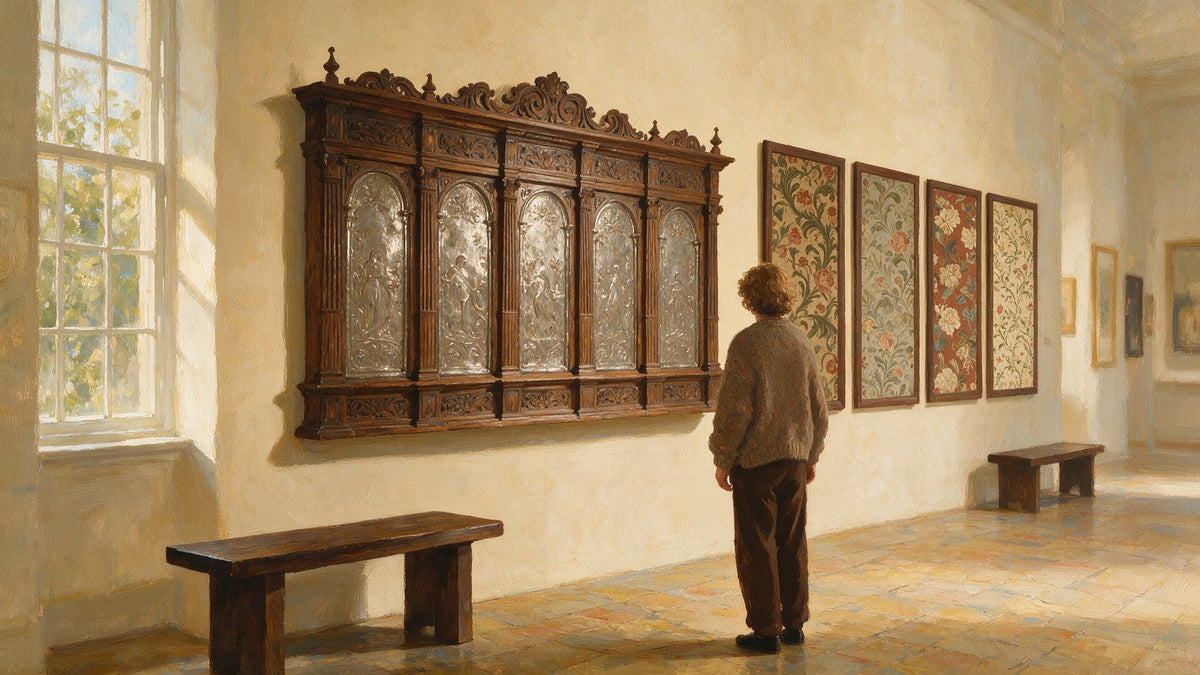
- 6.3metres wide: the reredos shown in public for the first time
- 4designers chosen by Morris for his patterns
- 1879the year of the Mallow wallpaper design, still on sale today
The Fitzwilliam Museum in Cambridge opens on 23 October the exhibition A Call to Art: William Morris and the Pre-Raphaelites, running until 3 May 2027. It is the first to be dedicated to Kate Faulkner, who died in 1898, as a designer, craftswoman and workshop manager at Morris & Co.
The display more broadly re-examines William Morris and his close circle: Edward Burne-Jones, Dante Gabriel Rossetti, Elizabeth Siddal and May Morris, daughter of William and Jane Morris.
Kate Faulkner was the first person after Morris to design wallpapers and textiles for Morris & Co, and one of only four designers to whom he entrusted this task. Several of her patterns from the 1870s and 1880s are still sold today. For more than a century, however, her work remained in the background, sometimes confused with Morris's.
"Kate Faulkner did not simply work in the shadow of William Morris: she was a major artist in her own right."
Karen Livingstone, principal curatorial adviser to the exhibition (quotation translated from English)
A 6.3-metre reredos shown for the first time
The most remarkable piece is a reredos in oak and silvered gesso, 6.3 metres wide, commissioned from Faulkner by Morris & Co in 1886. Gesso is a coating of plaster and glue, here silvered. This reredos had never before been shown to the public. Also on display are her textile designs and wallpaper patterns, including Mallow, created in 1879 and still sold by the firm.
Among the other highlights, a ceramic tile depicting Penelope, heroine of Greek mythology, after a drawing by Burne-Jones, and painted ceramics by Faulkner, including decorative plates sold in the Morris & Co shop.
An embroidery of Artemis attributed to Faulkner
Recent research by Karen Livingstone establishes that a Morris design depicting the goddess Artemis was embroidered by Faulkner for Red House, Morris's Arts and Crafts villa in Bexleyheath, south-east London. This embroidery, now lost, was one of 12 panels planned for the dining room. A preparatory drawing and three surviving panels, embroidered by Elizabeth Burden, are on display.
According to Karen Livingstone, Faulkner, a socialist like Morris, regularly visited Red House, where the women embroidered together. Her brother Charles was one of the co-founders of Morris & Co. Karen Livingstone considers it very likely that she took part in the discussions then taking place at Red House about the future Morris & Co, and suspects that other works remain to be identified, some still attributed to Morris.
Karen Livingstone is also seeking the descendants of Lucy Orrinsmith, Faulkner's sister, in the hope of finding a photograph or portrait of her. No image of Kate Faulkner is known, and her family research has so far yielded nothing.
Our view
Patterns we think we know may carry a different name from the one we associate with them. At home, we may wonder who designed what we have before our eyes.
Source: The Guardian.


