


News ·
Gerhard Richter Opens a Permanent Hexagonal Pavilion in Doha
Gerhard Richter's permanent pavilion, "Doha Pavilion: Gerhard Richter," is open in Doha, in MIA Park, in front of the Museum of Islamic Art. Created with Selldorf Architects, the pavilion opens alongside the Rubaiya Qatar 2026 quadrennial.
By Walensky Editorial Team · 3 min read
- 8,192 vertical stripes at most
- 6 exterior walls bearing the decorative motifs
- 1990 the year of the original painting
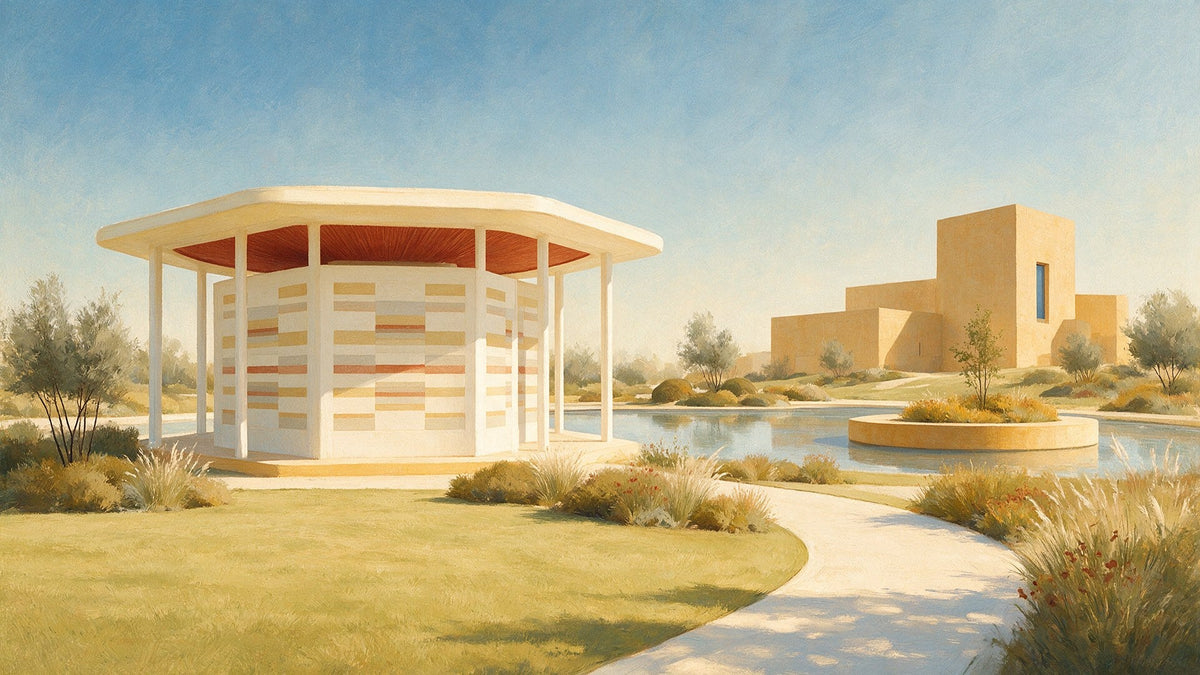
Gerhard Richter's permanent pavilion is now open in Doha, Qatar. Titled Doha Pavilion: Gerhard Richter, it sits in MIA Park, outside the Museum of Islamic Art. Designed as a standalone work of art and architecture, it was created with Selldorf Architects for the institution Qatar Museums.
The structure is hexagonal and extends into space Richter's research on abstraction, repetition, and perception. It houses the artist's paintings and sculptures, including works created specifically for the project.
Motifs drawn from a 1990 painting
The six exterior walls bear decorative motifs derived from Abstract Painting (724-4), a work Richter created in 1990. The mathematical process began in 2010: the painting was digitally divided into increasingly thin vertical stripes, up to 8,192 sections. Each stripe is mirrored and then repeated, producing a symmetrical horizontal pattern applied to the exterior.
According to Designboom, these motifs recall the repetitive geometries and interlaced arabesques of Islamic visual culture. They thus connect Richter's experimental approach to the artistic traditions of the region.
What you see inside
Three new large-format works from the Strip series, begun in 2011, are shown in the pavilion. They translate the original abstract painting into thin horizontal slices, each 0.08 millimeters wide. At the center stands STRIP-TOWER (2026), a standalone sculpture in three parts designed by Richter specifically for the site.
Two large Mirrors floor to ceiling occupy the narrowest walls. They belong to a set the artist began in the 1980s. According to Designboom, their reflective surfaces capture the artworks and visitors, creating shifting visual relationships. Outside, a stone sculpture, Brunnen (Well), extends the installation into the park.
An idea born in 2013
The idea for the pavilion dates back to Richter's visit to Doha in 2013, two years after the start of the Strip series. According to him, the city's architecture and history inspired the desire for a pavilion bringing together the thematic threads of that body of work.
"Doha is the right place and the only place for my pavilion."
Gerhard Richter, artist (remarks translated from English)
The project is part of the legacy of the Qatar-Germany Year of Culture 2017. MIA Park already houses public works by international artists, including Richard Serra, Nairy Baghramian, and Peter Fischli and David Weiss. Qatar Museums chairperson Sheikha Al Mayassa bint Hamad bin Khalifa Al Thani explains that the pavilion aims to connect contemporary practices with Islamic geometric traditions and to make art accessible in everyday life.
The opening coincides with the first edition of Rubaiya Qatar 2026, an international visual arts quadrennial running from November 21, 2026 to April 30, 2027, and with the Qatar Creates Fall/Winter 2026–27 program.
Our take
Here, a single painting is cut up, reflected, and repeated until it becomes a decor that wraps an entire building. For anyone who loves art, it's a different way to look at abstraction: through the repetition of a motif, and the way a reflection changes what you think you see.
Source: Designboom.


