

News ·
Nice: the Matisse Museum pairs Matisse with Alex Katz
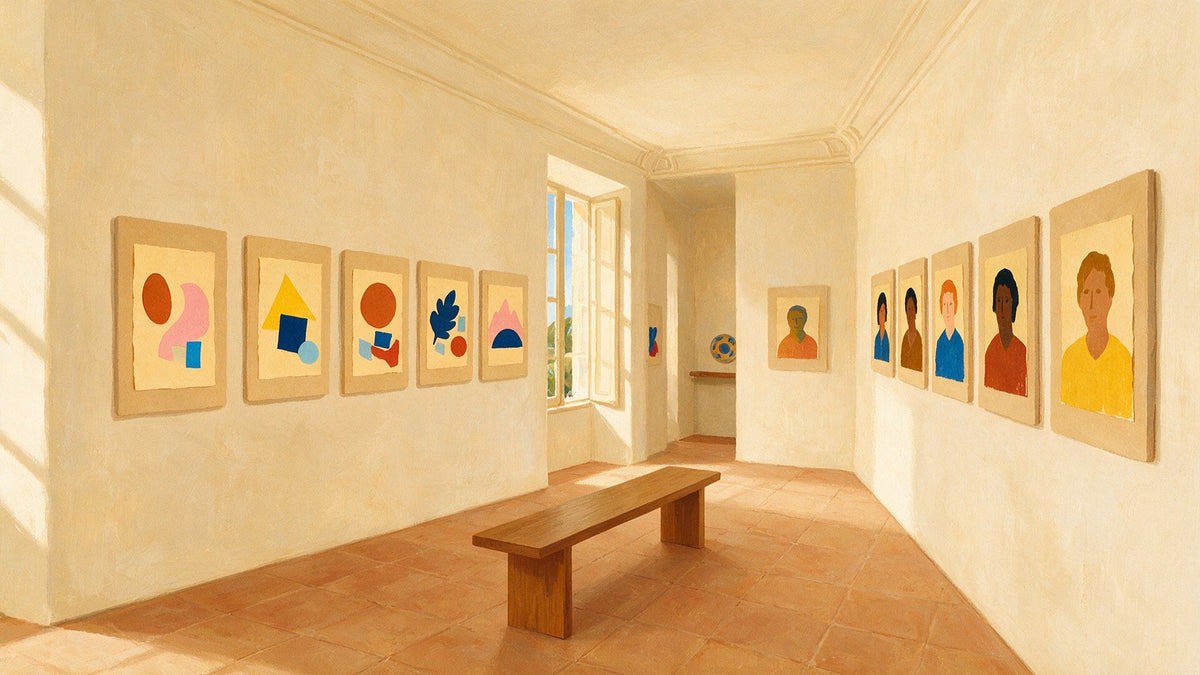
The Matisse Museum in Nice presents "The Silence of Painting," which pairs works by Henri Matisse with those of Alex Katz. The hang, designed with the American artist himself, brings together more than 80 of his works and nearly 170 by Matisse.
By Walensky Editorial Team · 3 min read
- Around 170 works by Matisse, gathered in Nice
- At least 80 works by Alex Katz, on display
- 1949the year Katz was struck by Matisse
The Matisse Museum in Nice presents the exhibition The Silence of Painting, which pairs works by Henri Matisse, who died in 1954, with works by Alex Katz, an American artist born in 1927. The hang, in four sections, was designed together with Katz himself.
More than 80 works by the American are shown alongside nearly 170 by Matisse. The curator, Aymeric Jeudy, who is also the museum's director, has drawn out the technical and sensory connections between the two artists. According to Beaux Arts, this pairing offers a fresh look at the museum's permanent collection of roughly 900 pieces, most of them donated by Matisse's widow and children.
The two men never met. Alex Katz, who still paints at 99, was a student at the Cooper Union in Manhattan when he had an aesthetic shock in February 1949. At the Pierre Matisse gallery in New York, he was discovering the exhibition Henri Matisse: Paintings, Papiers découpés, Drawings, 1945–1948. The brush drawings and cut-out gouache papers left him stunned. The Nice exhibition comes 77 years later.
Precise pairings of works
The portrait of his wife by Katz, Ada with White Dress (1958), is placed beside Matisse's Head of Lorette on Green Background (1916). Reclining Bather (1960), in which Katz shows his muse in a lemon-yellow square-cut swimsuit, hangs next to Odalisque with Red Box (1927). According to Beaux Arts, Katz does not officially claim to have taken Matisse's paintings as models, but the pairing remains deeply unsettling.
On the still lifes, Katz cut out and glued oranges onto a watercolor in 1957. According to Beaux Arts, they seem to have been picked from Matisse's Still Life with Pomegranates, painted in November 1947. Also shown are Katz's cut-out gouache papers from the second half of the 1950s, directly inspired by Matisse. His small formats are more narrative, whereas Matisse worked with materials and colors without wanting to tell a story.
"I think he is the best painter of all time from a technical standpoint. There is such ease in his work."
Alex Katz, artist, on Henri Matisse
What the two painters share
Beaux Arts notes several common points. Both chose to paint recognizable subjects at a time when abstraction dominated, something the art world strongly disapproved of. Their attention to nature and flowers was criticized as simplistic and bourgeois. They also share a strong interest in dance, with collaborations with choreographers and costume design, as well as a marked taste for flat areas of a single color and for simplified forms, which reveal the essentials and heighten emotions.
Some works are rare. The drawing Geranium in a Vase (1915-1916), in graphite pencil, is fragile and rarely exhibited in Nice. The linocuts André Rouveyre and Guillaume Apollinaire in Conversation (1952) belong to a private collection. The hang also shows Katz's early works, whereas his recent exhibitions, notably at Thaddaeus Ropac in Pantin in 2025, focused on his more recent paintings.
Our take
This exhibition reminds us that a painting can converse with another without resembling it, through a color, an outline, or a way of simplifying. For anyone who lives with artwork, it is an invitation to notice what, at home, answers from one wall to the next.
Source: Beaux Arts.


