

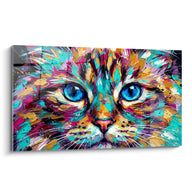

How to pair an emotion with a wall artwork without falling into kitsch?
October 11, 2025 · 16 min read · by Walensky
You just bought that perfect painting that moved you in the store, but once hung in your living room, the magic faded. Instead of the deep emotion you hoped for, you feel a vague unease: "Does it look too kitsch?"
That doubt keeps gnawing at you. You study your wall, watch your guests' faces, wait for their reactions... The artwork that was supposed to express your artistic sensitivity now seems to scream "amateur" or worse, "supermarket decor".
You may have tried to compensate by adding other decorative pieces, changing the lighting, or even moving the painting several times. But nothing works: the authentic emotion you were looking for remains elusive.
This frustration is perfectly normal, and it isn't your fault. The problem doesn't come from your artistic sensitivity, but from a lack of familiarity with the subtle codes that distinguish authentic emotional art from decorative kitsch.
By the end of this article, you will master the secrets of professional decorators to create a sophisticated emotional atmosphere, and you will know how to transform any space into a place that truly reflects you.
Why can your "perfect" painting suddenly look disappointing?
Emotional art without kitsch follows precise rules that the vast majority of amateurs ignore. If you wait for "the right moment" to learn these subtleties, you risk making impulse purchases and costly disappointments. It's like trying to cook a refined dish without knowing the art of spices: even the finest ingredients can yield a bland or cloying result.
💡 Revealing testimony: Sophie, an interior architect, recounts: "A client had spent €800 on a 'love at first sight' painting of a sunset. Magnificent in the store, but at her place it turned her modern living room into a roadside diner. The problem? Emotional intensity that was too direct, with no nuance or subtlety."
A conversation with a decor expert
The golden rule of professional decorators: A successful emotional wall artwork should create a subtle tension rather than perfect harmony. This tension generates authentic emotion within 2-3 weeks of daily observation.

Our selection
Mountain Painting Dream of Altitude - trompe l'oeil edition
$233.90
Discover this paintingWhat really lies behind your artistic doubts
You probably recognize yourself in these three situations: you hesitate for a long time before hanging a new painting, you constantly ask your loved ones for their opinion, or you regularly move your artworks around hoping to find "THE" right combination.
What really happens is that you unconsciously apply the codes of commercial decoration instead of the principles of emotional art. Your brain has been conditioned by years of exposure to standardized decor catalogs.
It's like trying to play jazz using classical music rules: technically correct, but emotionally flat.
The first illusion: "The more obvious, the more expressive"
Contrary to what everyone believes, powerful artistic emotion arises from suggestion rather than obviousness. An overly glorified landscape will be less evocative than a colorful abstraction that leaves room for your imagination.
Imagine the difference between a heavy perfume that overwhelms you the moment you walk in and a subtle fragrance that unfolds gradually. The first marks you immediately then wears you out, the second seduces you lastingly.
This approach completely changes the way you choose wall art: instead of looking for what "says" something, you learn to spot what "suggests" and invites daydreaming.
🔍 Instant test: Look at your current painting and close your eyes for 30 seconds. Open them again: if your gaze is immediately "saturated" by the image, that's a sign of emotional overload.
The second illusion: "It has to match perfectly"
Perfect harmony kills emotion. True art collectors know this: an artwork must create a slight visual dissonance to stimulate the eye and maintain interest over time.
This is the principle of the beauty mark that makes a face unforgettable, or of the blue note that elevates a jazz chord.
As a result, you stop searching for the "missing piece" of your decor puzzle and start composing a visual symphony where every element has its own personality.
The third illusion: "Art is for cultured people"
Many believe you need advanced artistic knowledge to create an emotional atmosphere. In reality, your emotional intuition is your best guide, far more reliable than any decorating manual.
You already instantly recognize whether a place soothes or stimulates you, whether a color comforts or irritates you. This natural sensitivity is more than enough.
The impact on your daily life is immediate: you gain confidence in your artistic choices and finally dare to express your true personality.
🚨 The 3 warning signs of unintentional kitsch :
- The "shop window" effect: Everything looks too coordinated, like in a catalog. This indicates a commercial rather than emotional approach.
- Rapid visual fatigue: After a few days, you no longer really "see" your painting. A sign of overly direct stimulation that wears out.
- Constant need for validation: You keep asking whether "it looks good". Reveals a lack of personal connection with the artwork.
The trigger factor: the intention behind the choice
What truly makes the difference is why you choose an artwork. Buying to "look pretty" creates kitsch. Choosing to "feel something" generates authentic emotion. This is the domino effect of true art: a pure intention transforms even a simple artwork into a magnetic focal point.
The 10-second rule: An emotionally right artwork makes you feel "something" within the first 10 seconds, without your being able to explain it rationally. Test this before any purchase.
| ❌ Decorative approach | ✅ Emotional approach | 💡 Why it works | 🎯 Felt benefit |
|---|---|---|---|
| Looking for what "goes well" with the furniture | Choosing what "speaks" to you emotionally | Emotion transcends decorative logic | Lasting, personal pleasure |
| Favoring "obvious" subjects (landscapes, flowers) | Daring abstraction and suggestion | Imagination completes the artwork | Discovery of new nuances |
| Seeking the perfect harmony of colors | Accepting subtle contrasts | Visual tension stimulates attention | Renewed interest every day |
| Following the trends of the moment | Expressing your authentic personality | Authenticity withstands fashion | Trusting your own taste |
— Also to discover


The 3-circle method: from raw emotion to subtle elegance
Don't worry: transforming your artistic approach requires neither expensive training nor any particular gift. It's a gradual process, like learning to cook: you start by mastering the basics, then develop your own signature. In 3 simple steps, you'll move from constant hesitation to confident artistic self-assurance.
🎯 Overview of the transformation: Like a photographer who first learns to frame, then to play with light, and finally to create his own aesthetic, you will first clarify your target emotion, then learn the visual codes of sophistication, and finally develop your unique decorative signature.
Step 1: Identify your personal emotional palette
Starting with this step is crucial because your emotional compass guides all your future choices. Without this solid foundation, you risk collecting contradictory artworks that cancel each other out. Once this groundwork is laid, you'll immediately feel more coherence in your choices.
What you need for this exploration
- An emotional logbook: A simple notebook or your phone to note your spontaneous reactions to artworks. It serves as emotional memory to identify your preference patterns. Avoid complicated apps: simplicity encourages spontaneity.
- Moments of pure observation: 15 undistracted minutes a day to truly look at your current environment. It's like ear training for the eye: the more consciously you observe, the sharper your sensitivity becomes.
- A collection of visual references: Photos, magazines, or web images that move you without your knowing why. These references reveal your unconscious aesthetic and help you turn it into conscious choices.
Now let's move on to concrete practice
How to decode your emotional DNA
Create your map of desired emotions: For one week, note 3 emotions you'd like to feel when coming home (serenity, energy, nostalgia, mystery...). This mapping reveals your deeper needs beyond surface tastes and prevents impulse purchases disconnected from your personality.
⏱️ Time: 10 minutes a day | ✅ Succeeded when: You identify 2-3 recurring emotions and can describe them precisely | ⚠️ Caution: Don't confuse the emotion you "should" feel according to magazines with the one you actually feel
Analyze your spontaneous favorites: Photograph 10 visual elements that naturally attract you in your daily life (architecture, nature, objects, colors). This collection reveals your instinctive aesthetic, far more authentic than outside influences.
⏱️ Time: 1 week of collecting | ✅ Succeeded when: You detect patterns (colors, shapes, moods) | ⚠️ Caution: Resist the temptation to "correct" your natural tastes to appear more sophisticated
Test emotional durability: Hang a test image (even printed) for 3 days and note how your sensations evolve. A true emotional connection strengthens over time instead of fading, unlike mere visual appeal.
⏱️ Time: 3 days of observation | ✅ Succeeded when: You clearly distinguish lasting pleasure from novelty effect | ⚠️ Caution: Don't judge too quickly: some artworks take time to reveal their richness
✅ Step 1 validation: You should be able to describe in 2-3 words the emotional atmosphere you seek, and have identified at least 5 visual elements that generate this emotion in you. If it's still unclear, extend the observation a few days: emotional clarity is the key to everything else.
Step 2: Master the codes of visual sophistication
Now that you know your emotional compass, you'll learn to refine its expression. This is where the magic happens: your natural sensitivity takes on an elegance that impresses without ostentation. This step turns your spontaneous tastes into artistically asserted choices.
Tools of artistic refinement
- The rule of measured contrasts: Learning to balance tension and harmony in your compositions. It's like adjusting the heat of a dish: too bland or too spicy, the effect fails. The optimal contrast creates interest without aggression.
- The palette of emotional nuances: Each color carries different emotions depending on its saturation and luminosity. A bright red stimulates, a muted red soothes. This nuance makes all the difference between sophistication and vulgarity.
- The golden proportions of wall art: Certain sizes and hanging positions maximize emotional impact. These age-old rules still work because they respect the natural way the human eye explores space.
Applying the codes of sophistication
Apply the emotional 60-30-10 rule: 60% dominant emotion (serenity), 30% complementary emotion (mystery), 10% accent emotion (surprise). This distribution creates richness without confusion, like a balanced perfume where each note has its place without dominating the others.
⏱️ Time: 1 hour of planning | ✅ Succeeded when: Your space exudes a clear main atmosphere with subtle nuances | ⚠️ Caution: Don't mix contradictory emotions (zen + intense dynamism) without a transition
Create visual breathing points: Alternate emotionally charged zones with neutral spaces so the eye and mind can "breathe". A wall entirely covered in art tires, like a conversation without pauses. Empty areas create emotional relief.
⏱️ Time: 30 minutes observing your space | ✅ Succeeded when: Your gaze circulates naturally without getting lost | ⚠️ Caution: "Empty" doesn't mean "blank": a bare wall can have as much presence as an artwork
Step 3: Develop your unique emotional signature
This final step takes you from "I like it" to "this is me". You develop that instinctive recognition that true art lovers possess: people recognize your aesthetic universe the way they recognize your voice. This is the level where art becomes authentic personal expression.
Building your artistic identity
Create your "aesthetic sentence": Define in one sentence the unique atmosphere you want to create ("mysterious elegance with touches of warmth", "soothing modernity with natural accents"). This sentence becomes your selection filter for all future artistic purchases.
⏱️ Time: 45 minutes of reflection | ✅ Succeeded when: Your sentence immediately evokes precise mental images | ⚠️ Caution: Avoid clichés ("chic cocooning"): look for YOUR words for YOUR sensitivity
Establish your artistic choice protocol: Create a decision process of 5 questions maximum to validate your future favorites. This protocol prevents impulse buying while preserving emotional spontaneity. It's your personal safeguard against kitsch.
⏱️ Time: 20 minutes of formulation | ✅ Succeeded when: You can test an artwork in 2 minutes flat | ⚠️ Caution: Don't over-intellectualize: keep emotion as the main criterion
The rule of artistic maturation: Wait until you've mastered one step before moving to the next. You're ready when you make decisions without excessive hesitation and your choices satisfy you lastingly (more than 3 months).
You are now equipped with the expert subtleties that distinguish the informed art lover from the simple decoration consumer. These nuances make all the difference between an interior that "makes an impression" and a space that truly moves you.
🔥 Pro-level secret: Experienced collectors often buy their most striking works during periods of personal change (moving, career shift, breakup). Intense emotions reveal our most authentic tastes, free from social conventions.
"What if I already have paintings that no longer match this approach?"
"I realize my current paintings don't fit at all with what I've discovered about myself. Do I have to change everything at once?"
Your question shows a healthy awareness ! Rather than revolutionizing your decor overnight, start by identifying one artwork that truly matches your new criteria. Place it in a strategic spot and observe how it transforms the overall atmosphere. Often, one strong piece "converts" the others by giving them a new context. It's gradual and less costly than a major artistic overhaul.
💡 Immediate action: Choose ONE main wall and create your "emotional laboratory" there with a test artwork. The rest of your decor will gradually orbit around this new artistic direction.
— In the same spirit


The emotional traps that turn art into kitsch
Warning: some well-intentioned reflexes can sabotage your artistic efforts. These mistakes are so common they seem "normal", yet they explain why so many homes look like impersonal decor catalogs.
- 🎯 The obsession with the "perfect match": Seeking for everything to coordinate perfectly kills artistic emotion. It's tempting because it reassures, but the result looks like a store window. Prefer an imperfect harmony that lets personality breathe: it's this controlled "wrong note" that makes a space memorable.
- 📐 The trap of systematic symmetry: Perfectly centering and balancing everything gives a "chain hotel" effect. It's reassuring because predictable, but it lulls the eye. Dare to use off-center compositions: they create visual movement and keep attention alert.
- 💰 Confusing high price with emotional quality: An expensive painting is not automatically more moving than an affordable work. This confusion pushes you to buy the "label" rather than the emotion. Your personal connection with the artwork matters infinitely more than its market value.
- 📱 The "perfect photo" syndrome: Choosing based on what will look pretty in an Instagram photo rather than what nourishes you daily. This superficial approach creates photogenic interiors that are emotionally empty. Favor what makes you feel good to live with, not to show off.
- ⏰ Emotional impatience: Wanting to feel a strong emotion immediately and giving up if the artwork takes time to reveal itself. Some artworks are like deep friendships: they unfold gradually. Give them that chance.
🛡️ Quick self-check system: Before any purchase, ask yourself: "Does this artwork still surprise me after 5 minutes of looking?", "Can I explain why it moves me without using words like 'beautiful' or 'pretty'?", "Would I buy it even if no one were ever to see it?" If you answer no to any of these, wait.

Other selected pieces
Origami Dance of Paper painting - origami edition
$233.90
Discover this painting →Your questions about emotional art without kitsch
Allow 3 to 6 months to see a noticeable shift in your approach, and a year to develop a true aesthetic signature. Speed up the process by exposing yourself regularly to varied works (museums, galleries, even online) and systematically noting your reactions. Take Claire, who turned her "IKEA catalogue" living room into a personal, recognizable space in 4 months by applying this method.
Start with 200-500€ for 1-2 strong pieces rather than 10 average works. A single piece that truly speaks to you transforms the atmosphere more than several "decent" purchases. Optimize by starting with your main living space, then gradually expand. Emotional investment matters more than financial investment.
For works up to 70x50cm and 3kg, a DIY hang is enough with wall anchors suited to your wall. Beyond that, or for valuable pieces, a professional guarantees safety and optimal placement. Test the position first with masking tape. Invest in a spirit level: a 2cm offset can ruin the effect of a beautiful piece.
Absolutely, as long as you respect an emotional "red thread" rather than a uniform style. Mix eras and techniques while keeping coherence in colors or mood. For example: contemporary photography + antique engraving + modern painting, all in earthy tones for a "calm time-travel" atmosphere. A shared emotion unites disparate styles.
Favor non-permanent solutions : hanging systems that require no drilling, decorative easels, or works placed on furniture. Focus on 2-3 important pieces rather than covering every wall. A rental can feel as personal as an owned home with the right temporary decorating tricks.
Your artistic transformation starts now
In a few weeks, you will walk into your home with that smile of satisfaction we feel when we truly feel at home. Your gaze will no longer be drawn to decorating "flaws" but to these works that resemble you and shift with your mood. Your guests will notice this particular atmosphere, this emotional signature they may not be able to name but that will leave a mark.
Beyond decoration, you will have developed an aesthetic confidence that carries over into all your visual choices: clothing, interior design, even professional presentation. This assurance in your artistic tastes reveals and strengthens your authentic personality.
The hardest part was understanding that emotional art follows different rules than simple decoration. Now that these mechanisms hold no secrets for you, start by truly observing your current space with your new criteria. The art of living in a world that resembles you begins with this first enlightened look.
🚀 Your first artistic mission: Within 24 hours, identify an emotion you would like to feel more often at home, then find a visual element that already evokes it in your environment. Your emotional transformation begins with this awareness!
Also read: 🔍 Read more articles on emotional art
Explore our collections


