

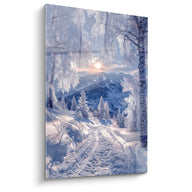

Are backlit LED paintings compatible with a sleep-friendly atmosphere?
May 8, 2026 · 13 min read · by Walensky
3:47 a.m. You stare at the ceiling, eyes wide open, while your alarm clock reminds you cruelly how little time is left before getting up. Does this scene sound familiar? You are not alone. In my practice as a sleep and interior design consultant for over a decade, I have guided hundreds of people seeking to turn their bedroom into a true sanctuary of rest. And among the most frequent questions of recent years is this one: can backlit LED paintings coexist with restorative sleep?
Here is what these lighting pieces bring when they are properly integrated: a calibrated, soothing ambiance, indirect lighting that respects your circadian rhythm, and a relaxing atmosphere that naturally prepares you for sleep. But beware: not all backlit paintings are equal, and their installation requires a precise understanding of sleep biology.
Many hesitate to introduce an additional light source into their bedroom, fearing it will further disrupt an already fragile sleep. This reluctance is legitimate. We live in an era where our screens strain our eyes until the very last minute, where light pollution seeps through windows, and where our biological clock is constantly thrown off balance. Yet giving up the elegance of a backlit painting out of fear of its effects is not the only option.
What I have discovered over the course of my consultations is that the problem does not lie in LED technology itself, but in the way it is used. Color temperature, light intensity, timing of use, distance from the bed: these are the parameters that turn a backlit painting into either a sleep disruptor or a precious ally for your nights.
In the lines that follow, I will reveal exactly how to choose and use a backlit LED painting so that it enhances your bedroom without sacrificing the quality of your sleep. You will discover the scientific criteria to respect, the common mistakes to avoid, and the integration strategies that truly work.
Blue light: understanding the enemy to better tame it
Let's speak frankly about what truly worries people: the blue light emitted by LEDs. This particular wavelength, situated between 380 and 500 nanometers, has a powerful biological effect on our body. It suppresses the production of melatonin, that essential hormone which signals to our body that it is time to sleep.
Chronobiology studies are clear: exposure to blue light in the evening delays sleep onset by 30 to 90 minutes on average. This is why your smartphone keeps you awake well beyond your intended bedtime. But here is the crucial nuance that many overlook: not all LED lighting produces the same light spectrum.
Modern backlit paintings now offer color temperature options. On the Kelvin scale, the lower the figure, the warmer the light tends to be (red, orange, amber). Conversely, higher values produce cool light rich in blue. For a bedroom, I systematically recommend paintings equipped with warm white LEDs, ideally between 2000K and 2700K. At this temperature, the emission of blue light becomes negligible and practically no longer interferes with your melatonin.
Better still, some manufacturers now offer backlit paintings with amber LED technology, completely free of blue spectrum. These devices reproduce the ambiance of candles or a sunset, creating a warm atmosphere that naturally accompanies the transition to sleep.
Light intensity: the golden rule too often overlooked
Color temperature is only half of the equation. Light intensity, measured in lux, plays an equally decisive role. I have visited bedrooms where backlit paintings created a brightness worthy of a main light, turning the room into a waking space rather than a cocoon of rest.
Here is the benchmark to remember: to promote sleep, the ambient lighting of your bedroom should not exceed 10 lux in the evening. By comparison, a normally lit room shows between 300 and 500 lux, while a candle produces about 1 lux at one meter's distance.
LED backlit paintings compatible with sleep must imperatively include an intensity dimmer. This feature lets you adjust brightness according to the time of day and your needs. In early evening, moderate intensity remains acceptable. But as bedtime approaches, gradually reduce the lighting to prepare your body for the night in a gentle way.
Some high-end models even offer automatic programming that gradually decreases intensity according to a preset timing. This function simulates natural dusk, a powerful signal for your biological clock. In my practice, I have observed that people using this feature report falling asleep 15 to 20 minutes faster on average.

Favorite
Liberating Red Fire Dance Painting - Abstract Dancer Edition
$233.90
Discover this paintingWhen to turn your backlit painting into a sleep ritual
The mistake I see most often? Leaving a backlit painting on all night. This practice cancels out every possible benefit and turns your decorative investment into a chronic sleep disruptor. Even at low intensity, any light source during the night alters the quality of deep sleep.
Here is how I integrate backlit paintings into an optimal sleep protocol: use them as a ritual transition between your active day and your restorative night. Two hours before bedtime, switch on your backlit painting in dimmed mode (warm white, low intensity) while turning off the main lights. This subdued ambiance signals to your brain that the day is coming to an end.
During this window, avoid screens and favor calm activities: reading, meditation, gentle conversation, a skincare routine. The indirect lighting of the backlit painting creates an atmosphere conducive to these moments of unwinding. Then, 15 to 30 minutes before going to bed, switch off the painting completely. Finish your preparation in darkness or with a minimal night light if necessary.
This sequence respects your body's natural functioning. It allows a gradual descent into sleep, without the abrupt transition between bright light and total darkness that would disorient your nervous system. Several of my clients have adopted this ritual and notice not only easier sleep onset but also an improvement in the overall quality of their sleep.
— Our selection


Where to position your backlit painting in the bedroom?
The location of your backlit painting directly influences its impact on your sleep. Contrary to popular belief, the wall facing the bed is not always the optimal choice for a bedroom.
Favor a lateral or perpendicular position relative to your nighttime field of vision. Placed to the side, the backlit painting diffuses ambient light without directly stimulating your retina when you are lying down. This configuration creates indirect lighting, much softer and more conducive to relaxation.
The distance between your bed and the backlit painting also matters. I recommend a minimum of 2 meters so that the light diffuses sufficiently and loses its direct intensity. The further the painting is from your resting position, the less it will stimulate your retinal photoreceptors.
Also consider the size of the backlit painting. In a bedroom, a modest format (40x60 cm or 50x70 cm) is generally enough to create an ambiance without overloading the space with light. Large formats are better suited to living areas where lighting can be more generous.

— Also to discover


LED technologies in the service of sleep: what really changes
Not all LED backlit paintings are created equal. Technological advances in recent years have enabled the emergence of solutions truly compatible with the physiological needs of sleep.
Look for paintings equipped with adjustable-spectrum LEDs. These intelligent systems allow switching between different color temperatures depending on the time: neutral light during the day to admire the artwork's details, warm light in the evening to prepare for sleep. This flexibility turns a decorative element into a tool for circadian well-being.
Continuous dimming represents another major advance. Unlike basic dimmers that offer only a few intensity levels, continuous dimming provides infinitely precise adjustment. You can thus find exactly the brightness level that suits your personal sensitivity and the time of the evening.
Some high-end backlit paintings even integrate ambient light sensors. They automatically adjust their intensity according to the natural light present in the room, always maintaining an optimal comfort level without manual intervention. This built-in intelligence simplifies use and ensures consistency with your biological rhythm.
Finally, favor models with a total absence of flicker (flicker-free). Lower-quality LEDs produce imperceptible variations in brightness at high frequency. Although invisible to the naked eye, these micro-fluctuations fatigue the nervous system and can contribute to nighttime restlessness. Premium backlit paintings use sophisticated electronic drivers that eliminate this phenomenon.

In the same spirit
Painting Botanical Rhapsody - Tropical Landscape Edition
$233.90
Discover this painting →When backlit paintings become therapeutic allies
Beyond their decorative function, I have observed how certain backlit paintings can even make it easier to fall asleep for anxious people. Total darkness sometimes generates apprehension, particularly after a stressful event or in those who suffer from mild nyctophobia.
A backlit painting at minimal intensity creates a reassuring point of reference in the space. It visually structures the bedroom without stimulating the waking system. The choice of subject plays a psychological role here: soothing natural landscapes, soft abstract compositions, nocturnal scenes... These visuals combined with subdued light act as a support for mental relaxation.
I notably worked with a client suffering from chronic insomnia who could not relax in complete darkness. The introduction of a backlit painting depicting a misty forest, set to 2200K at 5% intensity, allowed her to create an environment secure enough to let go. After several weeks of use as part of a complete protocol, her time to fall asleep was cut in half.
This approach works particularly well when the backlit painting is combined with breathing or visualization techniques. The soft light then becomes a sensory anchor, a stable element on which the mind can rest during relaxation exercises.
Transform your bedroom into a sanctuary of rest without giving up elegance
Discover our exclusive collection of bedroom paintings that combine refined aesthetics with respect for your sleep. Each piece has been selected to create the soothing atmosphere you dream of.

Other selected pieces
Painting When the Day Falls Asleep - Beach Landscape Edition
$233.90
Discover this painting →Fatal mistakes to absolutely avoid
Now that you know the best practices, let's talk about the pitfalls I regularly see even the most conscientious people fall into.
Mistake no. 1: choosing a multicolor RGB backlit painting. These festive models with their changing color options are seductive, but disastrous for sleep. Blue, green or violet hues strongly stimulate wakefulness. If you own this type of painting, imperatively limit its use to red, orange or amber colors in the evening.
Mistake no. 2: neglecting the quality of the artwork itself. A backlit painting constantly displays its subject. In a bedroom, avoid dynamic, energizing or emotionally charged visuals. Action scenes, aggressive contrasts, saturated colors... all of this maintains a level of mental activation incompatible with relaxation. Favor uncluttered compositions, soft tones, natural or meditative subjects.
Mistake no. 3: considering the backlit painting as the main lighting. Even set to warm white, it does not replace your usual light sources during the day or early evening. Its optimal role lies precisely in this transition phase toward sleep, not as a functional lighting solution.
Mistake no. 4: ignoring your own sensitivity. We are not all equal when it comes to light. Some people tolerate residual brightness better than others. Listen to your feelings: if you notice difficulty falling asleep after installing a backlit painting, adjust its intensity, its positioning, or switch it off earlier in the evening. Your sleep always takes precedence over aesthetics.
The perfect compromise exists
After years of seeking the balance between beauty and functionality in restful spaces, I am convinced that an LED backlit painting can find its place in a bedroom. Not despite the constraints of sleep, but precisely by respecting them.
The key lies in rigorous selection: warm temperature, adjustable intensity, precise control, and strategic use limited to the pre-sleep phase. Add a thoughtful placement and a soothing subject, and you obtain an element that enriches your space without compromising your rest.
What I particularly appreciate about this approach is that it reconciles two seemingly contradictory dimensions: the need for a visually stimulating environment in our daily life, and the imperative of a sanctuary conducive to nocturnal regeneration. The backlit painting, correctly chosen and used, fulfills both functions by adapting to the different moments of the day.
Picture yourself in a few weeks: you come home after an intense day, you enter your bedroom transformed into a welcoming cocoon. Your backlit painting casts an amber glow that caresses the walls, creating that particular atmosphere you enjoy finding every evening. You know that in two hours you will switch it off to slip into restorative sleep. But for now, this soft light accompanies you in your transition, helping you set down the tensions of the day. Decoration and well-being no longer oppose each other: they converse harmoniously.
The choice is now yours. You possess all the information needed to intelligently integrate an LED backlit painting into your restful space. Start by defining your non-negotiable criteria: color temperature, dimmer, positioning. Then let your aesthetic sensibility guide your selection among the artworks that respect these parameters. Your bedroom deserves this attention, and your nights will thank you.
Frequently asked questions about backlit paintings in the bedroom
Can a backlit painting stay on all night without disturbing sleep?
No. Even at very low intensity, I strongly advise against leaving a backlit painting on throughout the night. Our sleep passes through different phases, notably deep sleep and REM sleep, which require maximum darkness for optimal quality. Sleep medicine studies show that even minimal light exposure during the night disrupts melatonin production and fragments sleep cycles. If you absolutely need a nighttime light source for safety or anxiety reasons, favor a red night light placed on the floor and set to the lowest possible intensity. Red is the wavelength that least disturbs our nocturnal physiology. Your backlit painting, however well adjusted, should switch off the moment you go to bed. Think of it as an evening companion, not a night one. This distinction makes all the difference between a decorative accessory compatible with sleep and a chronic disruptor of your rest.
What color temperature should you choose for a backlit painting in a bedroom?
For a bedroom, turn exclusively to warm white LEDs, ideally between 2000K and 2700K at most. These temperatures reproduce the light of a sunset or candles, naturally soothing sources for our brain. Below 2700K, the emission of blue light becomes negligible and practically no longer interferes with the secretion of melatonin, the sleep hormone. By comparison, a neutral white LED sits around 4000K, and cool white at 6000K or more. These temperatures should be strictly avoided in the evening in a restful space. If you hesitate between several models, always favor the one that descends lowest on the Kelvin scale. Better still, opt for a backlit painting with adjustable color temperature: you can enjoy a more neutral light during the day to admire the artwork's details, then switch to warm mode for your evenings. Some premium models even offer amber LEDs completely free of blue spectrum, an ideal option for people who are particularly light-sensitive or suffer from sleep disorders. This attention to technical detail translates directly into the quality of your nights.
Do backlit paintings consume a lot of electricity if they are used every evening?
Excellent question that many people legitimately worry about. The good news is that LEDs are exceptionally energy-efficient, especially when used at low intensity as I recommend for a bedroom. A medium-sized LED backlit painting (50x70 cm) typically consumes between 10 and 30 watts at maximum power. When you set it to 20-30% intensity for your evening use, consumption drops to roughly 3 to 9 watts, which is less than a standard LED bulb. If you use it two hours each evening as a transition element toward sleep, that amounts to about 0.006 to 0.018 kWh per day, or 2 to 6.5 kWh per year. At the average electricity rate, your backlit painting will cost you between 50 cents and 1.50 euros per year. This negligible energy expense makes daily use perfectly reasonable from both an ecological and economic standpoint. Furthermore, the lifespan of quality LEDs generally exceeds 25,000 to 50,000 hours, meaning that even with daily use, your backlit painting will last 15 to 30 years before needing replacement. This exceptional longevity makes it a durable investment that more than offsets its initial cost while minimizing the environmental impact of frequent replacement.
Explore our collections


