

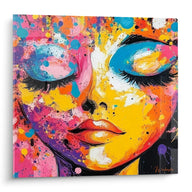

Integrating paintings into an energy-efficient house
October 11, 2025 · 17 min read · by Walensky
You've just moved into your energy-efficient home you've been dreaming of, with its large bay windows and clean lines. But you find yourself standing in front of your immaculate white walls, your collection of wall art in boxes, paralyzed by a nagging question: "What if my artworks ruined the architectural balance?"
This anxiety about a decorating blunder keeps you up at night. You can already imagine the disapproving looks of visitors, these colorful paintings that clash with the minimalist aesthetic, these frames that break the purity of the bioclimatic lines.
You've tried to find inspiration on Pinterest, flipped through decor magazines, even consulted a decorator. But all this generic advice doesn't match your particular passive house , with its thermal constraints and principles of simplicity .
It's normal to feel lost: energy-efficient houses follow specific aesthetic codes that few advisors truly master. Most classic decor recommendations completely ignore bioclimatic principles and the importance of energy balance .
At the end of this article, you will know exactly how to choose, position, and highlight your wall art so that it enhances your low-energy home rather than detracting from it. You will rediscover the pride of presenting your interior without the slightest hesitation.
Why does wall art become the invisible soul of a passive house?
In a bioclimatic architecture, every element counts double: it must be beautiful AND respect the energy balance of the place. Waiting for the "right moment" to decorate is to risk living for months in a cocoon that is certainly efficient, but emotionally cold. It's like having a sports car in the garage and never taking the wheel: the investment loses all its meaning if you don't fully enjoy it. Your bare walls represent a huge untapped potential.
🏡 Testimonial revealing: Marie, an interior architect specializing in sustainable housing, recently confided in me: "My clients invest €400,000 in their passive house, then hesitate for months to hang a painting worth €200. The result? A technically perfect interior but emotionally empty, where no one wants to linger."
Conversation with a decor expert
The golden rule of bioclimatic wall art: Your paintings must dialogue with the natural light that constitutes the "nervous system" of your home. Observe how the rays evolve on your walls according to the seasons, and you will obtain natural and free lighting for your artworks in 3 to 6 months of observation.

Our selection
Painting Stairway Rosy White Curves - Monumental Ascension - Architecture Edition
$233.90
Discover this paintingWhat does your current relationship with wall art really reveal?
Do you recognize these situations? You've been pacing around for weeks in front of that perfect wall near the south-facing window. You change your mind about your paintings every three days. You ask everyone's opinion except... your own.
What lies behind these hesitations is not a lack of taste. It's simply that you're applying classic decorative codes to a home that functions differently. Your passive house has its own lighting and energy rules.
Imagine a Michelin-starred chef trying to cook with their grandmother's techniques in an ultra-modern molecular kitchen: the tools have changed, the methods too. Your decor approach must evolve with your home.
The first hidden cause: the trap of "absolute neutrality"
Contrary to popular belief, a low-energy house does not require total austerity. This belief comes from a confusion between energy performance and aesthetic austerity. In reality, good insulation allows for more decorative freedom, not less!
It's like believing that an economical car must necessarily be dull: the best hybrid cars are often the most elegant. Technical performance can perfectly combine with beauty.
This fear of color deprives you of the pleasure of coming home. It transforms your energy cocoon into a cold museum where you no longer dare to express your personality.
🔍 Instant test: Photograph your main room at 3 times: morning, noon, evening. You will see that the light completely changes the atmosphere. Your paintings must adapt to these variations, not fight them!
The second hidden cause: ignoring "thermal dialogue"
Many think that it is enough to hang a painting to decorate. But in a passive house, every surface interacts with airflow and thermal regulation. Your artworks are part of this ecosystem.
It's like trying to grow orchids in a vegetable garden: technically possible, but you need to understand the specific environment. Your wall art must respect the air circulation zones and humidity variations.
Result: you place your paintings in the wrong places, they degrade prematurely, and you end up thinking that art and sustainable habitat are incompatible.
The third hidden cause: neglecting the "light amplification effect"
Here's what almost no one notices: in a low-energy house, optimized natural light multiplies the visual impact of your paintings. A small format can have the presence of a large canvas in a classic home.
Spot the moments when light naturally "catches" certain areas of your walls: that's where your paintings will have the most impact with the least effort. Often near bioclimatic openings or skylights.
This lack of knowledge leads you to buy artworks that are too large or too small, creating a visual imbalance that disrupts the overall harmony of your space.
🎯 3 signs that your approach is not suitable:
- You regularly change the position of your paintings: This reveals a lack of knowledge of your habitat's optimal zones . It's like replanting a tree every month.
- Your guests notice the house but not the artworks: Your paintings are overshadowed by the architecture instead of enhancing it. The balance is not found.
- You hesitate to buy new paintings: This paralysis reveals a lack of confidence in your choices, a symptom of an approach unsuitable for your type of habitat.
The trigger: mastering the "luminous seasons"
What really makes the difference is understanding that your passive home has its own luminous seasons, different from the outside. Bioclimatic orientation creates visual microclimates that you need to learn to read. It's the perfect domino effect: once you master these variations, all your decorative choices become obvious. You instantly know where and how to position each artwork to reveal its maximum beauty.
Rule of 3 lights: Observe each wall zone at 3 times of the day for a week. The places that "light up" naturally are your premium locations for wall art. Test today with a simple sheet of white paper glued to the wall.
| ❌ Traditional approach | ✅ Bioclimatic approach | 💡 Why this changes everything | 🎯 Concrete benefit |
|---|---|---|---|
| Avoid bright colors | Choose according to natural light | Thermal performance improves lighting | Your artworks reveal their true beauty |
| Uniform, minimalist frames | Materials in harmony with insulation | Consistency with bio-sourced materials | Sense of unity and authenticity |
| Hang based on personal taste only | Respect thermal flows | Preservation of artworks and comfort | Optimized durability and well-being |
| Standard store sizes | Formats adapted to light amplification | Multiplication effect of passive light | Maximum impact with a controlled budget |
— Also to discover


How to transform your walls into a bioclimatic gallery in 3 steps?
Rest assured, you don't need to be an architect to succeed in this transformation. The method follows the natural logic of your habitat: first understand the light, then choose the locations, finally select the artworks. It's like cultivating a garden: we study the soil, prepare it, and then plant. The result? A perfect harmony between your art and your sustainable architecture, visible from the first hangings.
🗺️ Your roadmap in 3 steps: Mapping your "light zones" (week 1), identifying your premium locations (week 2), composing your personal gallery (week 3-4). Each step gives you immediate satisfaction and brings you closer to the final goal.
Step 1: Decode the luminous secrets of your home
Starting with light is the foundation of all passive habitat decor success. It is what determines where your paintings will thrive. This solid foundation will avoid 90% of common mistakes and give you the confidence of professionals when choosing your artworks.
Your light observation kit
- A smartphone with a camera: It will allow you to capture variations in light without subjectivity. Prefer the "grid" mode to identify balance zones. Disable the automatic flash to see the true natural light.
- White A4 or A3 paper: Your "intensity light revealer". It faithfully reflects the variations that your eyes get used to not seeing anymore. Temporarily attach it to the tested areas to objectively compare zones.
- A notebook and pen: To note your observations without relying on your memory. Note the time, the weather, and the intensity felt on a scale of 1 to 5. This data will become your personalized decorative bible .
Now, let's move on to concrete practice
Your observation protocol in 7 days
Photograph your walls at fixed times: Take 3 photos per candidate wall (9am, 2pm, 6pm) for a week. This regularity reveals the constant luminosity on which you can rely all year round. Keep the same angle to be able to compare easily.
⏱️ Time: 15 minutes per day | ✅ Successful when: You clearly distinguish the zones that "light up" regularly | ⚠️ Attention: On very cloudy days, observations are skewed - postpone to the next day
Test with white paper: Attach an A4 sheet to different locations on each wall for 2 hours, photograph the result. This test reveals the actual light amplification of each zone, that your future paintings will perceive.
⏱️ Time: 30 minutes of installation, photos on the fly | ✅ Successful when: Some sheets "shine" noticeably more than others | ⚠️ Attention: Avoid areas of traffic to avoid damaging your tests
Note thermal sensations: Bring your hand close to each tested zone and note if you feel air currents or temperature variations. These microclimates affect the preservation of your artworks and your contemplation comfort.
⏱️ Time: 10 minutes per wall | ✅ Successful when: You identify 2-3 thermally "stable" zones | ⚠️ Attention: Areas near ventilation systems or vents should be avoided absolutely
✨ Step 1 validation: You must have identified at least 2 zones per room where light and thermal stability combine harmoniously. If you are still unsure, extend the observation period by 3 days: every passive house has its own rhythm. Patience will now save you years of satisfaction.
Step 2: Create your personalized gallery plan
Now that you master the light in your home, you will move to the next level: compose the space. This step is more rewarding as you begin to visualize the concrete result. The snowball effect begins: each location choice facilitates the following.
Your spatial composition tools
- Craft paper or old newspapers: To cut out templates the size of your future wall art. This crucial step avoids costly proportion errors. Secure them to the wall to test the visual impact before any purchase.
- Spirit level or smartphone app: The human eye immediately perceives imbalances, even millimeter ones. In a passive architecture with pure lines, this precision becomes even more critical for overall harmony.
- Tape measure: To respect the golden proportions and measure the distances between artworks. The rule of 2/3 of the width of furniture remains valid, but adapted to bioclimatic volumes which are often more generous.
Your professional composition method
Draw your plan on the floor: Reproduce your walls on paper with the identified luminous zones. This overview reveals the balances and imbalances impossible to perceive room by room. Mark existing furniture to anticipate visual interactions.
⏱️ Time: 45 minutes | ✅ Successful when: You clearly visualize the "conversations" between walls | ⚠️ Attention: Don't forget door openings in your measurements
Test the formats with templates: Cut out and position different sizes of rectangles on your favorite walls. This simulation avoids impulsive purchases and reveals the ideal formats for each location in your passive house.
⏱️ Time: 1 hour of cutting, 30 min of testing | ✅ Successful when: Some formats seem "obvious" to you | ⚠️ Attention: Step back 3 meters to judge - perspective changes everything
Step 3: Select and install your bioclimatic collection
You are now reaching the level of mastery where choices become intuitive. You no longer suffer your decoration, you consciously compose it. This final step transforms your habitat into a living work of art, where each glance reveals a new harmonious detail.
Your intelligent acquisition checklist
- List of optimal dimensions: Based on your template tests, it guides your purchases without hesitation. Prefer "portrait" formats for the high walls of passive houses, which are often more slender than in traditional housing.
- Color palette reference: Photograph your existing materials (wood, stone, plaster) to harmonize your choices. Bio-sourced materials have subtle nuances that must be respected for overall balance.
- Adapted hanging system: Prefer discreet fixings that preserve the integrity of your high-performance walls. Command hooks or magnetic systems often suit better than drillings in the insulation.
Installation and final adjustments
Install in bright zones: Start with your identified premium locations. This logical progression gives you quick wins that motivate you for the rest and immediately validates your method.
⏱️ Time: 30 min per painting | ✅ Successful when: The artwork seems "perfect for this place" | ⚠️ Attention: Allow 24h before definitively judging - the eye gets used to it
Adjust according to the seasons: Observe your installations for 1 month and adjust if necessary. Passive houses reveal their nuances with solar variations. This patience guarantees a lasting result.
⏱️ Time: 15 min of daily observation | ✅ Successful when: No artwork "bothers" your view | ⚠️ Attention: Adjustments of more than 10 cm often indicate an initial incorrect location choice
Optimal progression rule: Install a maximum of 2 artworks per week to allow your eye to gradually get used to them. A successful composition is built like a garden: patiently and harmoniously. Criteria for moving to the next step: immediate satisfaction + desire to show the result.
Congratulations! You now master the aesthetic codes of passive houses. This expertise gives you a considerable advantage: you can now advise other owners and even anticipate future decor trends, when sustainable housing is the norm.
🏆 Master Decorator Tip: Photograph your successes at the same times as your initial tests. This documentation reveals the evolution of your eye and becomes your personal portfolio for future projects or advice to those around you. True successes are immediately visible in photos.
A common question from beginners
"I'm afraid my paintings will deteriorate the energy efficiency of my passive house... Am I risking compromising the thermal performance?"
I totally understand this concern - you have invested in state-of-the-art technology and want to preserve it. But you are mistaken: your paintings do not interfere with insulation or ventilation, provided that air circulation zones are respected. It's even the opposite: successful decor makes you benefit more from your energy investment by making the space more pleasant to live in. Many owners discover that they heat less when they feel good at home!
💡 Reassuring test: Measure the temperature before and after installation in the same room with a digital thermometer. You will see that there is no difference, which will confirm that your artworks enrich without harming.
— In the same spirit


The 5 mistakes to absolutely avoid (even with the best intentions)
Attention, I'm going to reveal the most costly mistakes that even well-informed owners make. These traps are insidious because they seem logical at first glance, but they totally sabotage the harmony of your low-energy house.
- 🚫 Resist the urge to copy decor magazines: It's tempting to recreate that beautiful interior seen in Maison & Travaux, but the aesthetic codes of passive homes are different. The result: a mix of styles that devalues your architecture. Instead, draw inspiration from architects' showrooms specializing in sustainable housing.
- 🌡️ Ignoring ventilation openings: Placing a painting near a ventilation system may seem insignificant, but the forced air gradually degrades colors and distorts supports. This mistake is costly in terms of replacements. Always maintain a minimum distance of 80 cm from ventilation systems.
- ⚖️ Underestimating the "amplification" effect: In a passive house, optimized lighting multiplies the visual impact. Buying too large is the number one mistake for beginners. A 40x60 cm piece can have the presence of an 80x120 cm piece in a classic home. Always test with templates before buying.
- 🎨 Choosing solely based on impulse: Your artistic instinct remains important, but it must be combined with the bioclimatic logic of your home. A beautiful painting in the wrong place loses 70% of its impact. Combine emotion and technical reflection for an optimal result.
- ⏰ Wanting to install everything at once: Impatience ruins the most beautiful projects. Your eye needs time to adjust to each addition in the particular lighting environment of passive homes. A gradual installation guarantees lasting harmony.
🛡️ Your early warning system: Check each week that your paintings still provide the same satisfaction as on the first day. Monitor for signs of discoloration or distortion near technical systems. If you hesitate for more than 3 days on a location, it's not the right one. And above all: if your guests notice a painting that "clashes", listen to them - the outside eye remains objective.
— Other selected pieces


Your most frequently asked questions about bioclimatic wall art
Allow 3 to 6 weeks for a satisfactory result and 3 to 6 months for perfect harmony. Minimum budget: 300-500€ for 3-4 quality artworks that will already transform the atmosphere. To optimize: start with the premium zones identified, the effect will be immediate. Concrete example: Marie spent 420€ and obtained a "magazine" result that her guests systematically photograph.
You can absolutely succeed on your own with this method! A decorator specializing in passive housing costs 800-1500€ for consulting. The only limit: if you have more than 15 artworks to install or particular technical constraints (earth walls, complex home automation systems). In 90% of cases, your patience and this method are sufficient.
The foolproof test: if the artwork visually fades when you're not paying attention, but reveals its beauty when you consciously look at it, you've got it! Avoid styles that "shout" or dominate the architecture. Natural materials, organic abstractions, and nature photos generally harmonize well with the bioclimatic spirit.
On the contrary! Passive houses maintain a more stable temperature (19-22°C) and regular humidity (40-60%) than traditional housing. Your artworks are better protected. Only precaution: avoid areas near ventilation systems where air circulates directly. Optimal thermal regulation better preserves your artistic investments.
Excellent idea! Bioclimatic houses evolve with the solar seasons. Some locations are more beautiful in winter (near south-facing bay windows), others in summer (cooler north walls). Create a "seasonal rotation" of 2-3 artworks to renew pleasures without destabilizing the overall harmony. It's like a decorative wardrobe that adapts!
Your new life in a home that finally resembles you
In a few weeks, when you cross your threshold, it won't be that feeling of a "cold museum" that welcomes you. Your walls will tell your story, your paintings will dialogue with the natural light of your passive house, and that deep sense of pride will wash over you with every glance at your interior. Your guests will no longer talk only about your energy performance, but about that unique atmosphere you have created.
This transformation goes far beyond simple decoration. You will have developed a keen eye for bioclimatic wall art, a rare and valuable skill that will serve you throughout your life. This confidence gained in your aesthetic choices will radiate to other aspects of your daily life - when you master harmony at home, you see life differently.
You now have all the keys in hand. Understanding was indeed the most complex part! Your first gesture? Observe your walls tomorrow morning with that expert eye. This new perspective will change your relationship with your home forever. Your passive house deserves this attention, and you deserve this daily satisfaction.
✨ Your transformation begins now: Every passive house owner who applies this method rediscovers the pleasure of coming home. It's exactly within your reach, and the result will exceed your expectations. Your personal bioclimatic gallery awaits you!
Read also: 📖 Read more articles on sustainable art and architecture
Explore our collections


