

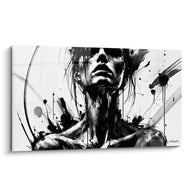

THE ORIGINALS
A windowless hallway is often the poor relation of the home. We pass through it, never linger, and eventually stop noticing it altogether. So we hang a quick poster there, the one from university or the last IKEA sale, and close the door on this corridor we cross while looking at our phone.
Yet this same blind space can become the most intense moment of the home. Not with just any image: with an artwork designed to exist without daylight, one that captures artificial light instead of suffering it.
The direct answerAn original artwork transforms a windowless hallway because it reacts to artificial light rather than reflecting it flatly: acrylic glass adds depth under a directed spotlight, while Alu Dibond absorbs light without stray reflections. Walensky paintings are exclusive digital creations, imagined by the house's artists and printed in North America — not standard reproductions. In a narrow hallway, this choice makes all the difference between a wall you walk past and a wall you truly look at.- Acrylic glass slightly returns light and creates a gallery-like depth, ideal under a directed LED spotlight.
- Alu Dibond, matte and reflection-free, is better suited if the hallway is continuously lit with no shadow zones.
- A large format (at least 120x70 cm for landscape formats) remains the relevant starting size for a hallway: no small piece lost in the length of the corridor.
Why does a unique piece act differently from a reproduction?
A windowless hallway has only one source of truth: artificial light. Everything hung there must work with it, not with the sun. A cheap poster, printed on flat matte paper, absorbs this light and gives nothing back: it remains an image, full stop.
An artwork designed for this context reacts differently. The original painting on acrylic glass, for example, reflects part of the light and gives an almost physical impression of depth, even though the visual is entirely digital. The image is not merely lit: it seems to inhabit the wall.
The finish's grain under halogen or LED spotlights
Under an LED spot angled at 30 degrees, acrylic glass creates zones of brightness that shift subtly depending on the viewing angle — an effect a hallway, precisely because we walk through it, showcases particularly well. Alu Dibond, on the other hand, stays matte regardless of spot intensity: no stray reflections, a crisp reading of the image even in grazing light.
If your hallway has a single light source, central and without intensity variation, prefer Alu Dibond: it avoids any annoying reflection that would break the reading of the artwork from the entrance of the hallway.

Favourite
Cloud painting, Celestial Window – trompe-l'oeil edition
From $228.90
Discover this paintingThe presence effect: what an original artwork brings that a poster cannot
A blind hallway lacks one specific thing: a visual anchor point. Without a window, the eye has nowhere natural to rest, so it slides over the walls without ever stopping. This is where an artwork conceived as a focal point changes the dynamics of the entire space.
A windowless hallway has no view to offer. It can, however, offer a presence — and that is often stronger than a view.
The paintings in the Les Originaux collection play on this register: they are exclusive creations, imagined by Walensky's artists and then printed in North America, with compositions designed to capture the eye even without any natural light whatsoever. We are far from the anonymous reproduction found everywhere; here, the visual was conceived precisely for this kind of space.
In a hallway, this presence works like a rite of passage. You don't stop in front of a generic poster. Sometimes you slow down in front of an artwork that seems to belong there and nowhere else.
our collection of hallway paintings— Our selection


Concrete examples of original artworks that elevate a windowless hallway
A windowless corridor calls for two very different visual strategies: digging out the space with depth, or conversely inventing a false luminous opening. Both work, but not for the same corridors. For a large bare wall at the end of a corridor, an original panoramic painting can combine both effects at once.
Playing depth with an artwork of strong sculptural presence
The painting Profile in Grey and Beige with Stacked Blocks, Statue edition, builds a face that dissolves into an architecture of suspended blocks. Under a directed spot on acrylic glass, the visual relief effect is striking: it looks almost like a sculpture mounted on the wall, though it is a flat print. In a narrow hallway, this illusion of volume compensates for the complete absence of real perspective.

Same logic with the Digital Tunnel in Violet and Electric Blue, Cyberpunk edition: a vortex that literally draws the eye toward an imaginary vanishing point. Placed at the end of a straight hallway, it visually extends the space rather than closing it off.
Creating a false luminous vanishing point
Another option, softer: simulate a window that doesn't exist. The Heavenly Window Cloud painting, trompe-l'œil edition, reproduces a blue sky cut by white clouds, with the effect of an open window. Hung at the end of a blind hallway, it plays on the illusion of a luminous exit where there is none.
The Heavenly Window Sky, in the same trompe-l'œil spirit, pushes the illusion even further with a representation of sky that seems to extend the wall toward infinity. It is one of the rare categories of paintings where the motif literally works against the absence of a window, instead of simply decorating it.
For a more architectural look, the Copper Soul Metropolis, in panoramic format, stretches the gaze along the length — a relevant choice if your hallway is long and narrow, since this format precisely follows that proportion.
the comparison between a backlit painting and a traditional artwork for a dark hallway— Also worth discovering


Tips for showcasing an original artwork in a narrow space
A narrow hallway imposes constraints the living room doesn't have: limited viewing distance, frequent passage, often only point lighting. Three simple adjustments transform the final result.
- Lighting : a spot angled at 30-45 degrees, placed at a good distance from the wall, avoids flat reflections and shows off the acrylic glass finish at its best.
- Height : the center of the artwork should sit at eye level, regardless of the hallway's width.
- Format : in a corridor, a bold piece in L format (120x70 cm or 100x100 cm depending on the painting) is preferable to a small piece lost on a large bare wall.
The usual rule is that an artwork should occupy 60 to 75% of the width of the wall or piece of furniture it hangs above — in a hallway, it is often the width available between two doors that dictates this calculation, not the entire wall.
our article on botanical paintings for a windowless hallway
Other Selected Pieces
Painting Black Face with Shattered Features - Inner Metamorphosis - Statue Edition
From $273.90
Discover this painting →Frequently Asked Questions
How to light an original artwork in a windowless hallway?
An angled LED spotlight, placed high and slightly at an angle, remains the simplest solution. Avoid flat frontal lighting, especially on an acrylic glass finish, which would create a uniform reflection and erase the sense of depth.
What is the difference between an original artwork and a reproduction for a hallway?
The paintings in the Les Originaux collection are exclusive creations by Walensky's artists, conceived as complete compositions in their own right — not copies of existing works. This bespoke design for the space changes how the visual interacts with artificial lighting.
Which original artwork format should you choose for a narrow hallway?
Favor the L format as a starting point: 120x70 cm in landscape, or 100x100 cm square depending on the chosen painting. If the wall is more constrained, custom sizing lets you finely adjust the dimensions without losing presence.
Does an original artwork lose value in a hallway without natural light?
No, as long as you choose the right finish. Acrylic glass compensates for the absence of natural light by working with artificial lighting; Alu Dibond, for its part, keeps a crisp, reflection-free reading even in low or constant light.
A windowless hallway isn't a failed room to endure. On the contrary, it is the ideal place to hang an artwork that deserves a pause — because it has, precisely, no competition from the outside. No view, no distraction: just the wall, the light you choose, and the artwork you place there.
The Les Originaux collection was designed for exactly this kind of space, where natural light will never come to rescue the visual. the full collection of hallway paintings remains the best starting point for finding the piece that will finally make you want to stop, even for a second, in that hallway you used to walk through without looking.
Explore our collections


