

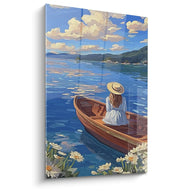

Why do some studios rent artworks rather than buying them?
June 8, 2026 · 11 min read · by Walensky
Last week I spent three hours in a yoga studio in Le Marais, Paris. While looking at the walls, I noticed a stunning abstract piece – turquoise and gold tones that seemed to breathe with the students' movements. Six months later, when I returned, the space had transformed: a minimalist canvas with clean lines had taken its place. The owner confided her secret: she didn't own any of these artworks. She rented them.
Here is what renting artwork brings to studios: total creative flexibility to refresh the atmosphere with the seasons, a financially controlled investment without compromising aesthetics, and access to pieces by renowned artists that would otherwise be out of reach. A quiet revolution is transforming professional spaces today.
Perhaps you run a yoga studio, a wellness space, or you simply dream of an interior that evolves with the rhythm of your life. The idea of investing thousands of euros in a single piece paralyzes you – and what if your tastes change? What if the desired atmosphere calls for something different in six months?
The good news? Dozens of studios before you have found an elegant solution that reconciles creativity and pragmatism. It is neither a compromise nor a temporary fix: it is a contemporary approach to art in our living spaces. Let's explore together why this practice appeals so much to atmosphere creators.
Art as a changing costume: total creative flexibility
Imagine being able to adapt your décor to each new energy, each season, each change in your activity. This is exactly what the rental of artworks allows. In my observation of studios adopting this approach, I have noticed a constant: they generally renew their pieces every 3 to 6 months.
A Brussels pilates studio I frequent orchestrates its changes with the equinoxes. Spring: botanical watercolors in tender greens. Summer: bold compositions in bright yellows. Autumn: deep, coppery abstractions. Winter: soothing monochromes. This rotation of works creates an ever-renewed experience for members, who discover a subtly reinvented space with each cycle.
This flexibility also responds to the natural evolution of a business. A studio that opens with a young, dynamic clientele may favor energetic works, then shift toward more contemplative compositions as its community matures. Renting paintings allows this organic adaptation, impossible when you permanently own a collection.
Testing before investing: the luxury of exploration
How many times have I heard: "I loved that canvas in the gallery, but at home it doesn't work"? Art rental eliminates this risk. Studios can experiment with different styles, artists, and formats without the anxiety of a costly mistake.
A meditation center in Lyon thus tested five different atmospheres over two years before discovering that zen geometric compositions – rather than the expected naturalistic landscapes – generated the most positive feedback. This exploration period allowed them to refine their visual identity before any definitive purchase.
The economic equation that changes everything
Let's talk numbers without beating around the bush. An original work by an emerging artist easily costs 1,500 to 3,000 euros. For an established artist? Multiply by five, ten, sometimes twenty. Now, equipping a studio with three or four pieces represents an initial investment of at least 6,000 to 15,000 euros – not counting insurance, maintenance, and the risk of theft or damage.
Renting artworks radically reverses this equation. For 80 to 200 euros per month depending on formats and artist reputation, a studio gains access to museum-quality pieces. Over a year, that amounts to 1,000 to 2,400 euros – the price of a single purchased work, but with four rotations and thus four different atmospheres.
This financial accessibility also frees up budget for other priority investments: equipment, training, marketing. I supported the opening of a yoga studio in Nantes where the founder calculated that by renting her paintings rather than buying them, she saved enough to fund three additional months of digital advertising. A strategic choice that accelerated her growth.
The hidden argument: the tax deduction
Here is a detail few mention: art rental constitutes a fully deductible operating expense. Unlike purchasing works – subject to complex depreciation rules and often less tax-advantageous – rental is recorded as a current expense. For a developing studio, this accounting optimization is far from negligible.

Favorite
Golden and White Feather Painting in Textured Relief - Natural Elegance - Feather Edition
$233.90
Discover this paintingReaching the unreachable: prestige without ownership
A revelation struck me while visiting a Parisian studio in the 16th arrondissement: on its walls hung two works by an artist whose retrospective I had seen at the Palais de Tokyo a few months earlier. Price of her canvases on the market? Between 8,000 and 15,000 euros. The manager rented them for 180 euros monthly each.
This phenomenon democratizes access to quality artworks. Galleries and rental platforms work with represented artists, graduates of fine arts schools, sometimes exhibited internationally. Creations an independent studio could never acquire, but which it can now temporarily integrate into its visual identity.
This aesthetic elevation directly influences客clientele perception. A space adorned with works by recognized artists breathes sophistication, attention to detail, refinement. It is a subliminal yet powerful signal: here, nothing is left to chance, not even the beauty of the walls deserves a thoughtful curation.
All-inclusive service: art without the constraints
Owning a work entails responsibilities that are often underestimated. Specific insurance. Professional hanging. Cleaning adapted to techniques (oil, acrylic, mixed media). Protection against humidity, UV rays, and temperature variations. Not to mention the headache of storage if you wish to change your décor.
Artwork rental services handle this logistics in full. Installation by professional hangers. Insurance included against theft and accidental damage. Easy rotation: a single call, and the team comes to replace your pieces. Some platforms even offer personalized advice to select works suited to your space and clientele.
This peace of mind has considerable value. A studio manager confided to me: "I want to focus on my classes, my students, the energy of my space. Not become an expert in art conservation or negotiate with specialized insurers." Rental allows her exactly that: enjoying beauty without the mental burden.
A commitment without commitment
Unlike purchasing – a heavy, definitive, anxiety-inducing decision for many – art rental generally works without long-term commitment. Flexible contracts allow you to suspend, modify, or stop depending on the evolution of your activity. If your studio goes through a quiet period, you can temporarily reduce the number of works. If you move to a larger space, you expand your collection.
This contractual flexibility fits perfectly with the reality of wellness entrepreneurs, whose business often experiences marked seasonal cycles. Why chain yourself to a fixed artistic heritage when rental offers this precious adaptability?
— Our selection


Building an evolving visual identity
Some studios push the logic further: they use the rotation of works as an identity signature. "Here, the walls tell a story that keeps renewing itself" becomes a marketing argument, a reason to return, a conversation starter with regulars.
A yoga center I know in Marseille holds an "art discovery evening" each quarter where the founder presents the new rented works, shares the artists' universe, and creates a cultural connection with her community. This educational dimension adds a layer of value: the studio is not merely beautiful, it becomes a place of artistic discovery.
This approach turns décor into a living experience. Students no longer come simply for physical practice, but for a renewed aesthetic immersion. Some photograph the works and share them on their networks, creating organic visibility for the studio. Rented art becomes an unintentional ambassador.
Ready to transform your space into an evolving gallery?
Discover our exclusive collection of paintings for yoga centers that harmonize energy and aesthetics in every corner of your studio.
— Also to discover


When art becomes an attraction strategy
Look at the studios thriving on Instagram. Often, their visual success rests on a refined, Instagram-worthy, photographically remarkable aesthetic. Works of art play a central role in this desirable imagery.
By regularly renewing your paintings, you constantly feed your visual content with new perspectives, new backdrops, new atmospheres. Each rotation offers an opportunity to reinvent your visual storytelling, to create fresh content without altering the architecture or investing in a complete overhaul.
A digital marketing strategist specializing in wellness studios explained to me that her clients who rent artworks generate on average 30% more usable photographic content than those who keep static décor. In a sector where digital presence drives growth, this detail matters enormously.
The word of mouth of aesthetics
"Have you seen the new paintings at Lumina Yoga?" This sentence overheard in a Parisian café illustrates a subtle phenomenon: when a place regularly changes its art, it creates conversational micro-events. Regulars notice, comment, and recommend a visit to the curious.
This dynamic turns your décor into permanent news. Unlike a static space one eventually stops seeing, an evolving environment keeps attention awake and stimulates natural recommendation. Artwork rental thus becomes a discreet yet effective tool for loyalty and acquisition.
The ecological awareness of the temporary
Here is an emerging dimension: the ecological aspect of rental. In an era where overconsumption and excessive possession are questioned, the sharing economy naturally extends to art.
Rather than each studio buying and accumulating works that may end up stored or resold, rental enables optimal circulation. A single artwork can successively embellish five, ten, fifteen different spaces over the years, maximizing its aesthetic impact and creative purpose.
Several artists I have met appreciate this model: their creations travel, reach diverse audiences, and live fully instead of ending up in a private living room. This philosophy of circulation resonates particularly in the world of yoga and wellness, where values of material detachment and impermanence find a natural echo.

In the same spirit
Painting Black silhouette in ochre and grey tones - Solar momentum - Yoga edition
$233.90
Discover this painting →Toward a new definition of luxury
Ultimately, why do some studios rent artworks rather than buy them? Because they have understood that contemporary luxury no longer lies in possession, but in experience, flexibility, and access.
Owning a piece means committing to it for good. Renting it, on the other hand, means cultivating an evolving relationship with beauty. It means acknowledging that our tastes change, our needs evolve, and that impermanence is not a weakness but a form of wisdom.
Visiting these pioneering studios, I understood that they aren't "making do" for lack of a budget to buy. On the contrary: they consciously chose a more fluid, more contemporary approach, one more aligned with their philosophy. They don't endure rental; they celebrate it as a form of freedom.
Picture your studio six months from now. The same walls? Or a new emotional palette to match the new season, the new intentions, the new energy you wish to cultivate? Imagine your students discovering this reinvented space, the constant attention to details that makes every visit subtly different, always inspiring.
Renting artwork is not an economic compromise. It is a statement of intent: we are creating a living place, one that breathes and evolves. Just like our practices, our bodies, our awareness. A space that refuses stagnation and embraces the perpetual movement of beauty.
Start small if you're hesitant. A single rented artwork in your main space. Observe how it transforms the atmosphere. Listen to the reactions. Then, three months later, swap it out. Feel the excitement of novelty, the quiet rebirth of your space. You will understand then why so many space creators never look back.
Frequently asked questions about renting artwork for studios
Does renting artwork really cost less than buying it?
Absolutely, and the difference is significant. An original work of good quality costs between 1,500 and 5,000 euros to buy, depending on the artist and format. Renting comparable pieces costs between 80 and 200 euros per month. Over a year, you invest 1,000 to 2,400 euros, roughly the price of a single work you would own. But the major advantage lies elsewhere: with that same sum, you can rotate four different works over the year, constantly renew your decor, and test different styles. Rental also generally includes insurance, professional installation and rotation service, costs that would add up considerably if you bought. For a studio just starting out or looking to optimize its budget, renting is an economically brilliant solution with no aesthetic compromise.
What happens if a rented artwork is damaged in my studio?
Rest assured, this is precisely why rental services systematically include insurance. Accidental damage, such as a splash during a class, an unintended knock, or even theft, is covered by the contract. You won't have to pay thousands of euros to replace a damaged piece. Reputable platforms fully understand that artworks live in active spaces where people circulate, and they factor that risk into their model. Usually, you simply report the incident, the work is collected, and replaced if necessary. No stress, no complicated procedures. This full protection is one of the major arguments in favor of renting: you enjoy the beauty without the anxiety of an owner constantly worrying about their investment. Just check the insurance terms in your rental contract, though know that this is an industry standard.
Can I choose the artworks myself, or must I accept a selection imposed on me?
Excellent question, since your studio's visual identity belongs entirely to you. The vast majority of art rental services work with online catalogs where you precisely select the works that resonate with your universe. You choose the artists, styles, colors and formats, exactly as if you were buying, but with the freedom to change your mind later. Some platforms go further: they offer personalized advisory services where a curator visits your space, understands your clientele and positioning, then suggests a tailored selection. You always validate the final choice. Some premium services also offer 3D visualizations so you can see how the work will integrate into your decor before committing. This freedom of curation truly transforms the experience: you benefit from the expertise of art professionals while keeping full creative control over your ambiance.
Explore our collections


