

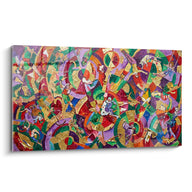


Himalayan Painting 2
Four feline faces, one same blue gaze that runs through the material: the Himalayan 2 Painting collection gathers portraits where the softness of the cream coat meets precious settings, from purple velvet to lacquered piano. Between golden impasto, pastel watercolor and hushed interior scenes, each canvas composes a singular atmosphere. These are pieces both tender and refined, designed to bring presence and character to a wall without ever weighing it down.
All about Himalayan Painting 2
- Himalayan Painting 2 Presentation
- Symbolism of the Himalayan cat
- Colors and decorative integration
- Staging of the Himalayan cat
The Himalayan Painting 2 collection gathers four portraits of Himalayan cats, each built around the same anchor point: an intense blue gaze that immediately captures attention. Around this gaze, the compositions unfold in very different worlds, from thick golden material to the pastel mist of a wholly gentle scene, passing through opulent interiors worthy of a bygone drawing room.
What unites these works is the way they make the feline a noble, almost ceremonial subject. Sometimes painted with a palette knife with flecks of gold leaf, sometimes sketched in a watercolor blur of lilac and cream tones, the Himalayan cat becomes a motif oscillating between wild elegance and childlike tenderness. Each painting tells a different facet of this same quiet nobility.
In an interior, these pieces bring a warm presence without ever becoming overwhelming. The burgundy, ivory, chocolate brown and gold tones blend easily with materials such as velvet, dark wood or brass, while the more pastel compositions, in lilac and powdered pink, suit brighter, more streamlined spaces.
Finally, the variety of framings, from the close-up on the face to the full narrative scene with piano or chaise longue, makes it possible to compose an entire wall with several canvases from this collection, or to choose a single piece as the focal point of a living space.
What the gaze of the Himalayan cat reveals in these portraits
Why does the blue gaze dominate each composition?
In all four works, the blue eyes of the Himalayan cat act as a visual magnet. Whether painted with a knife in golden and purple material, or delicately sketched in a watercolor blur, they concentrate the full intensity of the painting. This contrast between the clarity of the gaze and the warmth of the surrounding tones creates a soft, almost hypnotic tension that holds the eye long after the first glance. It is this constancy of the gaze, whatever the pictorial style, that gives the collection its deep unity.
The Himalayan cat, between softness and poise
This feline carries a rare duality: a silky coat that invites tenderness, and an aristocratic bearing inherited from its lineage. The works play precisely on this ambivalence, sometimes showing a kitten with outstretched paws in a confident, relaxed pose, sometimes installing it on a velvet chaise longue or a grand piano, like a silent guardian of a refined interior. This dual nature makes the Himalayan cat a particularly rich subject for contemporary animal painting.
A presence that structures the painted space
Beyond the portrait, each painting builds a true scene around the feline. The setting, whether a background streaked with brown tones, a window frame suggested in pastel, or a nineteenth-century drawing room with draped curtains and a dark chest of drawers, is never neutral. It reinforces the presence of the Himalayan cat as a central, almost narrative figure that seems to genuinely inhabit these painted interiors rather than simply being placed within them.
How these Himalayan cat paintings fit into an interior
Which tones dominate the collection?
The palette of these works moves between two distinct registers. On one side, deep and precious tones, burgundy, chocolate brown, gold and ivory, that evoke a sumptuous, hushed interior. On the other, pastel shades, lilac, powdered pink and off-white, that bring a lighter, more vaporous atmosphere. This dual palette allows you to choose a painting according to the mood already present in the room, without ever forcing an artificial color match.
Which materials do these canvases pair with best?
Scenes with purple and golden tones find a natural echo in velvet, dark wood or brass, while the more pastel compositions blend with light materials, from natural linen to white lacquered surfaces. The Himalayan cat staged in this way becomes a point of continuity between the painting and the surrounding furniture, rather than an added element that would clash with the rest of the decor.
A warm accent without visual overload
Despite the richness of some compositions, notably those playing on impasto and gold leaf, the whole remains legible and soothing thanks to the simplicity of the central subject. The feline, always framed with care, occupies the space without ever saturating it. This makes it possible to install these paintings in rooms already furnished and textured, such as a living room or bedroom, without risking an effect of decorative overload.
Choosing and positioning a Himalayan cat painting at home
Should one favor a close-up portrait or a full scene?
Close-up portraits, centered on the cat's face and gaze, are particularly suited to spaces where an intense, immediate presence is desired, such as an entrance or a hallway. Conversely, more narrative scenes, with piano, chaise longue or drawing-room setting, require a little more distance to be fully appreciated and fit readily into a spacious living room or a bedroom where the eye can linger on the details of the painted decor.
How to combine several works from the collection?
The diversity of styles, golden impasto, pastel watercolor, classic interior scene, makes it possible to compose a wall with two or three paintings without creating redundancy. The unity of the blue gaze of the Himalayan cat ensures visual coherence, even when the palettes and techniques differ strongly from one canvas to another. This combination creates a narrative ensemble, like a gallery of portraits of the same character seen from several facets.
What effect is sought depending on the room?
In a living room, a scene such as the grand piano or the purple chaise longue establishes a hushed, slightly theatrical atmosphere, conducive to conversation. In a more intimate bedroom or study, a close-up portrait in pastel tones brings an enveloping softness, without excessive dramatization. The choice of painting thus depends less on its size than on the emotional intensity one wishes to install in the space.
FAQ about Himalayan Painting 2
At what height should a painting from this collection be hung?
For a natural result, the center of the painting should sit at eye level, about 145 to 155 cm from the floor. For close-up portraits of the Himalayan cat, this reference reinforces the face-to-face effect with the feline's blue gaze. Adjust slightly according to the height of the surrounding furniture, especially if the painting is placed above a sofa or console.
Do these paintings suit a modern, minimalist interior?
Yes, particularly the versions in pastel and lilac tones, whose vaporous softness pairs well with light, minimalist interiors. The richer compositions, gold and purple, on the contrary bring a more assertive accent, ideal for warming a contemporary space without overloading it, provided they are visually isolated rather than multiplied.
Can a light painting and a darker one from the collection be combined in the same room?
Absolutely, it is even one of the assets of this collection: the constant presence of the Himalayan cat's blue gaze creates a common thread between the different atmospheres. Simply take care to balance the wall surfaces and leave sufficient space between the canvases so that each composition retains its own visual breathing room.
Further reading
Our articles on this topic
- Persian or Himalayan Cat on Canvas: Spotting the Differences Before Choosing Your Painting
- Blue and Gold Square Face Painting: Create a Zen, Calming Space
- How to Choose the Right Size for a Himalayan Cat Painting for Your Living Room
- Himalayan Cat Painting: Create a Cosy Living Room with Soft Wall Décor
- Why Gift a Himalayan Cat Painting
- Bengal Cat Painting: Which Wall Best Showcases the Leopard Pattern?
L'art qui suscite l'envie
Maison belge d'art mural grand format
14 jourspour changer d'avis*
Protection Walenskyincluse
Fabriquéen Italie
FormatXXL
Kit de fixationtoujours fourni
* Hors tableaux personnalisés et tailles personnalisées


