


White Swiss Shepherd Dog Black and White Canvas Art
Our Painting Bernese Mountain Dog Black and White captures the timeless elegance of this majestic breed. This artistic collection highlights the pure beauty and nobility of the Bernese Mountain Dog through refined monochrome compositions. Each artwork reveals the intensity of the gaze, the natural grace, and the loyal character of this exceptional companion. Perfect for lovers of dog wall art Bernese Mountain Dog and admirers of black and white canine portraits, this collection brings a sophisticated touch to your interior.
 Dog Portrait Wall Art with Expressive Eyes - Intense Gaze - White Swiss Shepherd Edition$249.90
 White Swiss Shepherd Wall Art with Melancholic Gaze - Canine Tenderness - White Swiss Shepherd Edition$249.90
 White and Black Profile Portrait Wall Art - Noble Gaze - Swiss White Shepherd Edition$249.90
 White Swiss Shepherd Black and White Portrait Wall Art - Intense Gaze - White Swiss Shepherd Edition$249.90
 Dog Portrait Wall Art with Gray Nuances - Complicit Gaze - White Swiss Shepherd Edition$249.90
Explore further
In White Swiss Shepherd Dog Black and White Canvas Art
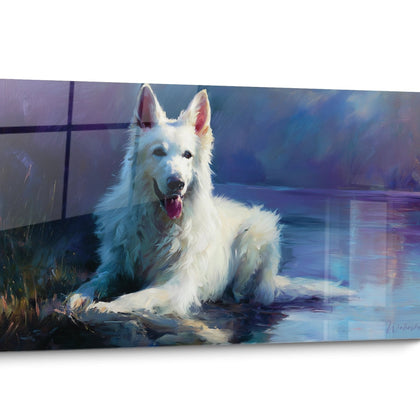
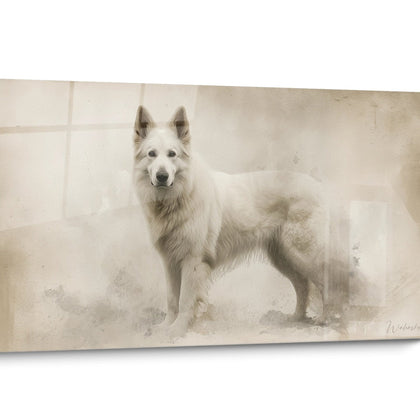
All about White Swiss Shepherd Dog Black and White Canvas Art
- Presentation Painting White Swiss Shepherd Black and White
- Monochrome Contrast and Elegance
- Visual Impact in Large Format
- Decorative Sophistication
The painting White Swiss Shepherd black and white represents a fascinating artistic exploration of chromatic contrast applied to this majestic breed. This monochrome interpretation reveals the subtle nuances of the White Swiss Shepherd's immaculate coat through a binary palette that amplifies every anatomical detail. The absence of color radically transforms the visual perception, focusing attention on textures, shadows, and the characteristic facial expressions of this exceptional breed. This graphic approach is particularly suitable for clean, contemporary environments where chromatic sobriety is the dominant decorative signature.
The Power of Monochrome Contrast to Sublime the White Swiss Shepherd
The black and white interpretation of the White Swiss Shepherd generates an exceptional visual dramatization that transcends traditional photographic representations. This chromatic reduction accentuates the specific anatomical contours of the breed, notably the triangular facial structure, the characteristic erect ears, and the intelligent expression of the gaze. The shadow areas created by the monochrome treatment sculpt the dense coat visually, revealing a three-dimensional depth impossible to obtain with a standard color reproduction.
How does black and white treatment intensify canine expression?
The suppression of chromatic nuances forces the eye to focus on the facial micro-expressions of the White Swiss Shepherd. The tonal variations between the pure white of the coat and the shaded areas create a play of contrasts that underlines the underlying muscular anatomy. This graphic approach is ideally suited to minimalist Scandinavian interiors, industrial lofts with exposed metal structures, or high-end professional spaces seeking discreet sophistication. For a complete collection dedicated to this breed, explore our painting White Swiss Shepherd range, which offers various artistic interpretations.
Harmony with contemporary monochrome environments
In spaces dominated by gray palettes, polished concrete, or bleached wood, a black and white White Swiss Shepherd painting integrates as an architectural element rather than a simple wall decoration. Its chromatic neutrality allows for maximum decorative versatility, functioning as effectively in a executive office as in a parent's bedroom with soothing tones. White Swiss Shepherd owners particularly appreciate this graphic version that captures the essence of their companion without chromatic distractions, creating a timeless and elegant tribute.
Which materials amplify the monochrome rendering?
Matte surfaces absorb light differently than glossy finishes, radically changing the perception of tonal gradations. For high-definition photographic rendering, large-format prints on rigid supports preserve the sharpness of transitions between light and dark areas. The absence of light reflection guarantees that the subtle details of the coat remain perceptible even under lateral or direct zenithal lighting, unlike glossy surfaces which create areas of glare masking the intermediate nuances essential to visual depth.
Monumental Impact of XXL Formats in Monochrome Treatment
A painting of a white Swiss Shepherd dog in black and white of a large size radically transforms the spatial dynamics of a room. From 120x80 cm, the monochrome representation generates a wall presence comparable to an architectural work, where each hair of the coat becomes a distinct graphic element. This monumental scale reveals anatomical details invisible on smaller formats: the variations in density of the undercoat, the reflections of light on the black truffle, the infinitesimal nuances between pure white and off-white that structure the volume of the muzzle.
Why does the large format specifically magnify the black and white treatment?
The monumental enlargement amplifies the tonal contrast which constitutes the aesthetic foundation of the monochrome rendering. On a surface of 150x100 cm, the eye simultaneously perceives the overall vision and the micro-textural details, creating a layered visual experience impossible with reduced dimensions. This scale is particularly suitable for double heights, partition walls in open spaces, or prestigious hallways where the available wall length justifies a panoramic composition. Our painting of a white Swiss Shepherd dog portrait selection offers close-up framing optimized for this monumental reading.
The management of optimal viewing distances
A large format monochrome painting requires a minimum viewing distance of 2.5 meters so that the eye reconstructs the overall image from the tonal variations. This spatial constraint directly influences the choice of location: facing the main sofa in a generous living room, at the back of an executive meeting room, or as a focal point in an entrance with deep perspective. At close range (less than one meter), the observer perceives only the abstract transitions between light and dark zones, temporarily transforming the figurative representation into a quasi-abstract graphic composition.
How do horizontal versus vertical proportions change perception?
Horizontal panoramic formats (such as 180x90 cm) favor dynamic profile compositions, capturing the white Swiss Shepherd in motion or in a characteristic alert posture. Vertical formats (100x150 cm) are suitable for majestic frontal portraits, accentuating the imposing stature and natural nobility of the breed. The black and white treatment amplifies these compositional choices by eliminating chromatic distractions that would fragment the visual unity, concentrating all graphic energy on the guiding lines and structuring tonal masses.
Decorative Sophistication and Timelessness of the Monochrome Rendering
The painting of a white Swiss Shepherd dog in black and white embodies a decorative elegance that transcends ephemeral color trends. This chromatic neutrality guarantees aesthetic durability for decades, resisting the evolution of dominant color palettes in the interior design sector. Unlike colored representations that may appear dated after furniture or textile renewal, the monochrome version retains its stylistic relevance regardless of environmental transformations.
Which professional environments favor the monochrome treatment?
Specialized veterinary clinics for Nordic breeds, offices of professional breeders of Swiss White Shepherds, and dog club reception areas are massively opting for monochrome representations. This graphic sobriety communicates professionalism and expertise, avoiding the sentimental connotations associated with hyperrealistic color representations. In high-end residential environments, this version harmoniously integrates with collections of contemporary photographic art, establishing a visual continuity with other black and white works in the space.
Compatibility with directed architectural lighting,
Track lighting systems with adjustable spotlights fully reveal the potential of a large-format monochrome painting. The absence of colors eliminates the risk of chromatic distortion caused by the variable color temperatures of LED light sources. Whether illuminated in 2700K (warm white) or 5000K (cold white), the monochrome rendering preserves its visual integrity, unlike color versions whose palette may seem altered under certain light spectra. This chromatic stability considerably simplifies museum lighting technical choices.
How does black and white enhance breeds with immaculate white coats?
Paradoxically, monochrome reduction enhances white breeds more than faithful color reproduction. The subtle tonal gradations between different areas of the white coat become the main subject, revealing the structural complexity of a fur that appears uniformly white to the untrained eye. The shadows created by the variable density of the hair, the skin folds around the muzzle and eyes, the transitions between cover fur and undercoat generate an unsuspected graphic richness that fully justifies the monochrome artistic choice for this specific breed.
FAQ - Frequently Asked Questions about Swiss White Shepherd black and white paintings
Is a Swiss White Shepherd black and white painting suitable for colorful interiors?
Absolutely, chromatic neutrality acts as a visual stabilizing element in environments with saturated palettes. It creates a point of visual rest counterbalancing the surrounding chromatic stimulations without conflicting with existing dominant tones.
How does the monochrome treatment influence the emotional perception of the canine subject?
Eliminating colors directs attention to the pure facial expression and body gesture, intensifying the emotional connection by focusing on universally recognizable elements of canine emotion rather than the superficial chromatic attributes of the coat.
What optimal tonal density should be sought for an impactful Swiss White Shepherd black and white painting?
Prioritize compositions presenting a complete tonal spectrum from absolute black to pure white, with at least seven distinct intermediate values. This tonal richness guarantees three-dimensional depth and avoids the two-dimensional effect of monochrome renderings with excessive contrast that lose the subtle nuances essential for specific breed recognition.
Further reading
Our articles on this topic
- White Swiss Shepherd painting for a child's room: the decor guide
- Panoramic Swiss White Shepherd painting: what size to choose above the bed?
- Dog-themed white fluffy wall art for an adult bedroom: a guide to texture and mood
- White Japanese Spitz Painting in Scandinavian Style for the Living Room: How to Integrate It Well
- Schnauzer painting for a grey and white Scandinavian living room: how to match it well
- Black and white Boston Terrier painting for an entrance: the guide to a successful first impression
L'art qui suscite l'envie
Maison belge d'art mural grand format
14 jourspour changer d'avis*
Protection Walenskyincluse
Fabriquéen Italie
FormatXXL
Kit de fixationtoujours fourni
* Hors tableaux personnalisés et tailles personnalisées


